Numerical simulation of flow over tail-escape weirs

Research Abstract
weirs play an important role in controlling and managing water in irrigation canal networks through
several functions such as discharge measurements, water diversion, lowering the water level, and
removing excess water at the ends of canals to protect them from water flooding that may lead to the
collapse of the earthen banks of these canals. Over the previous decades, the flow over the linear
sharp-crested weirs was extensively investigated by many researchers; however, the tail-escape-weirs
have not received sufficient attention. These types of weirs were mostly constructed in the form of
vertical wells that may be circular or rectangular in shape, and water may flow through the entire
perimeter of the weir or part of the perimeter. In the present research, the effect of the tail escape-weir
shape and flow direction on the flow characteristics over the tail escape-weirs were studied
numerically and experimentally. For this purpose, a set of models were constructed in different
shapes, circular and square, and the entire perimeter of the weir or part of the perimeter is working as
the weir crest length. The turbulence model RNG k-ε Ansys Fluent software was used to simulate flow
over the tail escape-weir physical models. The verification of the numerical model was based on the
profiles of the water surface and the velocity profile above the weir crest, which both showed
acceptable agreement. The comparison of the experimental and numerical results for the water head
over the weir crest showed acceptable agreement with minimum and maximum absolute percentage
errors (0.17% ─ 6.5%) for all models. The results showed that the crest position has a significant
impact on the vortex intensity and irregularity of the flow streamlines behind the weir; these
characteristics significantly increase behind weirs with a partial crest length upstream compared to
those with a full-length crest and two-thirds of the perimeter crest downstream. In addition, the
decrease in weir crest length increases the maximum magnitude velocity value that occurs directly
above the weir crest and decreases the main velocity value inside the channel.
Research Date
Research Department
Research Journal
3rd International Conference on Civil Engineering: (Development & Sustainability),24-27 October, Hurghada, Egypt
Research Pages
113-127
Research Publisher
Assiut University
Research Year
2023

Assiut University's Faculty of Engineering workshops are a promising model for the circular economy and achieving sustainable development goals.

ت

The Faculty of Engineering workshops at Assiut University represent a promising model for the circular economy and achieving sustainable development goals. They represent the first center of expertise in applying circular economy principles within the university. Their activities are not limited to manufacturing, education, training, and providing technical consulting, but also extend to the maintenance and renewal of products (such as furniture and research equipment) through refurbishment and refurbishment processes.

This extends the useful life of consumables, preventing depreciation (depreciation of assets) and reducing waste.

Practical Example: Refurbishing Dilapidated Seats:

As shown in the images, a set of seats that were on the verge of depreciation in one of the university's faculties was revived through:

1. Repairing the structure (in the metalworking and bodywork workshops).

2. Adding aesthetic touches (in the metalworking and painting workshops).

3. Returning them to service more efficiently and at a lower cost compared to purchasing new seats.

This model achieves Goal 12 of the Sustainable Development Goals (SDGs):

"Ensure sustainable consumption and production patterns"

- by reducing waste (Target 12.5).

- Promoting reuse (Target 12.6).

Tangible benefits:

- Cost reduction: Reducing the university's annual purchasing bill.

- Environmental protection: Reducing the carbon footprint resulting from the manufacture of new products.

- Empowering students and researchers: Practical application of sustainability and circular economy concepts in engineering education.

Finally, the Faculty of Engineering workshops at Assiut University are not merely manufacturing units; they are incubators for sustainable innovation, translating the principles of the circular economy into action and providing a model for integrating academic, environmental, and economic goals into a single framework.

. ♻️

1

2

3

The Supreme Council of Universities announces the timetable for the new academic year 2025/2026:

ا

The Supreme Council of Universities announces the schedule for the new academic year 2025/2026:

- September 20: Start of classes for the new year at universities and institutes

- January 1: Beginning of final exams for the first semester

- January 24: Beginning of the mid-year break for the new academic year

- February 7: Beginning of the second semester

- May 21: End of the second semester

For more details:

https://scu.eg/news/academic-year-2025-2026-timeline/

May be an image of text


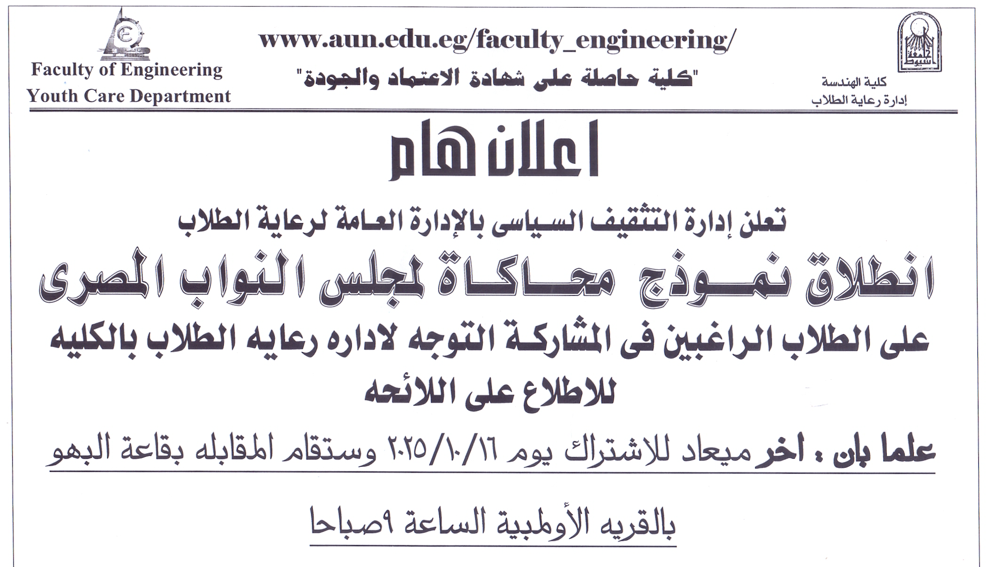
المجلس الأعلى للجامعات

June 3 at 8:22PM  · 

The Supreme Council of Universities announces the schedule for the new academic year 2025/2026:

- September 20: Start of classes for the new year at universities and institutes

- January 1: Beginning of final exams for the first semester

- January 24: Beginning of the mid-year break for the new academic year

- February 7: Beginning of the second semester

- May 21: End of the second semester

For more details:

https://scu.eg/news/academic-year-2025-2026-timeline/

Discussion of the master's thesis submitted by Eng. Mina Maged Agaby, Bachelor of Civil Engineering, Civil Engineering Department, Minya University, entitled "Evaluation of risk factors causing delays and cost overruns in road construction in Egypt"

The Department of Civil Engineering is honored to invite you to attend the defense of the master's thesis submitted by Eng. Mina Maged Agaby, Bachelor of Civil Engineering, Department of Civil Engineering, Minia University, entitled "Evaluation of Risk Factors Causing Delay and Cost Overrun in Road Construction in Egypt" on *Wednesday* corresponding to 6-11-2025.. at 12 noon in the hall of Professor Dr. Abdel Rahman Megahed for scientific discussions in the Department of Civil Engineering.

Egyptian Student Participation Survey

1

The Supreme Council of Universities has launched the second edition of the Egyptian Student Engagement Survey, targeting final-year students for the 2024/2025 academic year. The survey includes a follow-up assessment of the quality of educational services at Egyptian universities through the following link:

الاستبيان المصري للمشاركات الطلابية

Please note that the survey website will be closed at the end of July 2025.

Smart Max Electronics donates mineral exploration equipment to the college. We wish you success and prosperity, God willing.

Professor Dr. Khaled Salah, Dean of the College, received Engineer Mohamed Abdel Rahman Awad, Chairman of the Board of Directors of Smart Max Electronics, to honor him for donating scientific equipment for mineral exploration to the Department of Mining and Metallurgy Engineering. He also presented a scientific symposium on mineral exploration and the equipment used.

The reception was attended by Professor Dr. Jamal Yahya Baghdadi, Head of the Department of Mining and Metallurgy Engineering, and Dr. Masoud Ali Hussein, an instructor in the department.


Congratulations to Dr. Gamal Abdel Nasser Ahmed on the occasion of the issuance of the decision of His Excellency Professor Dr. Ahmed El-Minshawy, President of the University, appointing him as Coordinator of the Mechatronics and Robotics Engineering Prog

The College Administration extends its sincere congratulations to Dr. Gamal Abdel Nasser Ahmed on the issuance of a decision by His Excellency Professor Dr. Ahmed El-Minshawy, President of the University, appointing him as Coordinator of the Mechatronics and Robotics Engineering Program. We wish him success and prosperity, God willing.


Professor Dr. Khaled Salah, Dean of the Faculty, extends his sincere congratulations to Dr. Wael Mohamed Ahmed, Lecturer in the Department of Electrical Engineering, on the occasion of the issuance of the decision of Professor Dr. Ahmed El-Minshawy, Presi

On behalf of the College's administration and all its members, Professor Dr. Khaled Salah, Dean of the College, extends his sincere congratulations to Dr. Wael Mohamed Ahmed, Lecturer in the Department of Electrical Engineering, on the occasion of the issuance of the decision by Professor Dr. Ahmed El-Minshawy, President of the University, appointing him as a member of the Executive Team of the Center for Sustainable Development at the University. We wish him every success in his mission.

The college hosts the first meeting of the Board of Directors of the Technical Center for the Depreciation of Scientific and Laboratory Equipment at the university after its restructuring.

On Tuesday, April 15, 2025, the Faculty hosted a meeting of the Board of Directors of the University's Technical Center for the Disposal of Scientific and Laboratory Equipment following its restructuring. The meeting was chaired by Professor Mahmoud Abdel-Alim, Vice President for Community Service and Environmental Development. Professor Abdel-Alim chaired the meeting, which primarily addressed mechanisms for activating the Center's role to achieve its founding goals. Professor Mohamed Abbas, Director of the Center, presented a presentation that included the Center's current status, available capabilities and human resources, obstacles, proposals for overcoming them, and a future work plan.

Professor Khaled Salah, Dean of the Faculty and Vice Chairman of the Center's Board of Directors, explained the significant importance of this Center and the complementary role it is expected to play in cooperation and integration with the Scientific Equipment Maintenance Center. This will provide the University with its spare parts needs, maximizing the University's utilization of its scientific and laboratory equipment, reducing operating costs and the University's overall need for new equipment or spare parts. This will have significant benefits in light of Egypt's Vision 2030 and the National Strategy for Higher Education in Egypt.

1

2

3


Subscribe to