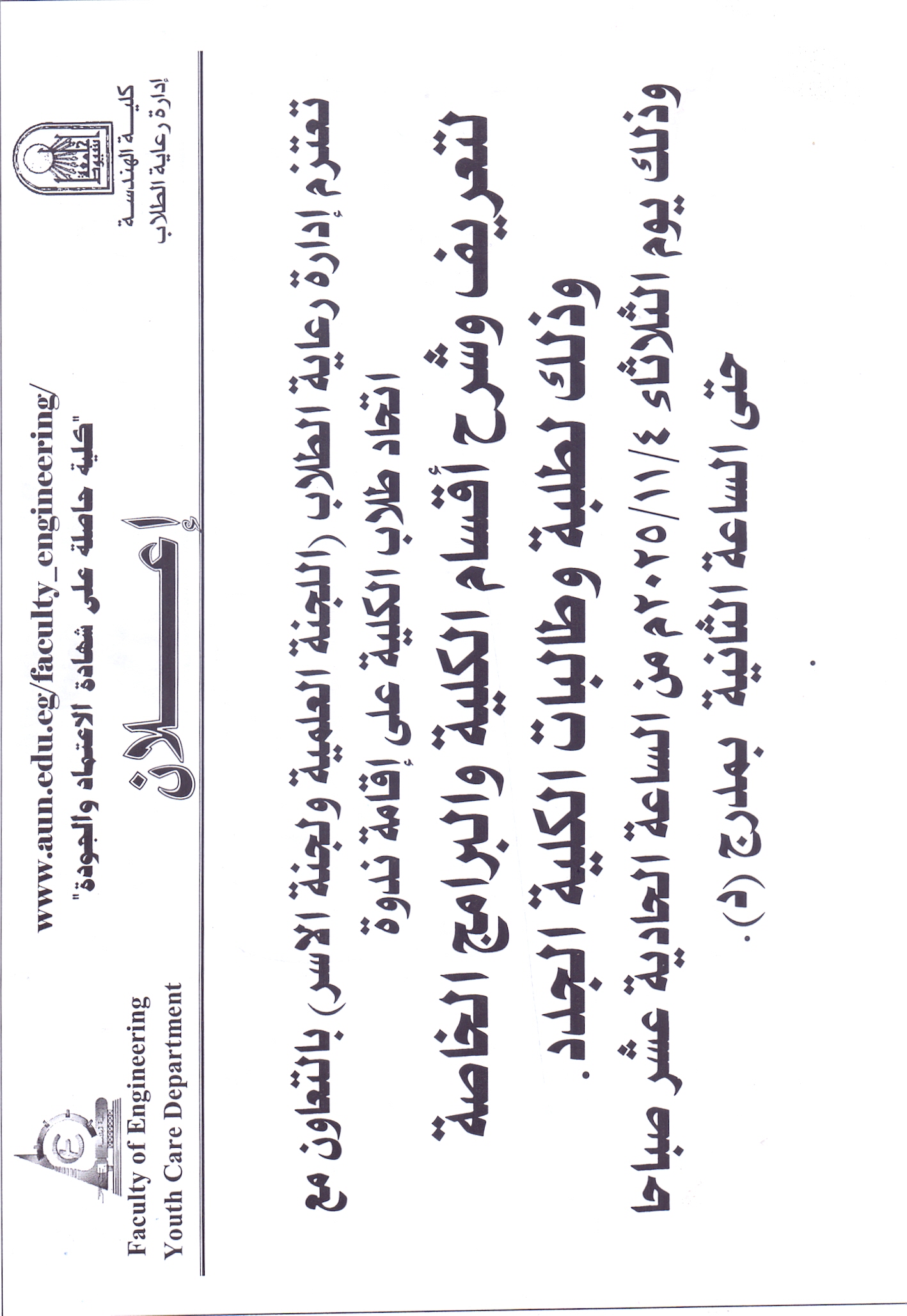
The Department of Electrical Engineering at the college announces seminars on Thursday, June 19, 2025... at the HP Lab in the Department of Electrical Engineering.

The Department of Electrical Engineering at the college announces seminars on Thursday, June 19, 2025... at the HP Lab in the Department of Electrical Engineering.


Professor Dr. Khaled Salah, Dean of the College, extends his sincere congratulations to all members of the College, including faculty members, support staff, administrative staff, and students, on the occasion of Eid al-Adha.

On the occasion of Eid al-Adha, and on behalf of the college administration, Prof. Dr. Khaled Salah, Dean of the College, extends his sincere congratulations and blessings to all members of the college, including faculty members, support staff, administrative staff, and students, on the occasion of Eid al-Adha. May God bring it back to everyone with all goodness and blessings for many years and long times.


Professor Dr. Khaled Salah, Dean of the Faculty, congratulates Professor Dr. Mohamed Safwat Abu Reya on the occasion of the issuance of the decision of His Excellency Professor Dr. Ahmed El-Minshawy, President of the University, appointing him as Vice Dea

On behalf of the College Administration and all its members, Professor Dr. Khaled Salah, Dean of the College, extends his sincere congratulations to Professor Dr. Mohamed Safwat Abu Reya on the occasion of the issuance of the decision by His Excellency Professor Dr. Ahmed El-Minshawy, President of the University, appointing him as Vice Dean for Education and Student Affairs. We wish him all the best and prosperity.

Performance Projection of Vacuum Gate Dielectric Doping-Free Carbon Nanoribbon/Nanotube Field-Effect Transistors for Radiation-Immune Nanoelectronics

Research Abstract

This paper investigates the performance of vacuum gate dielectric doping-free carbon nanotube/nanoribbon field-effect transistors (VGD-DL CNT/GNRFETs) via computational analysis employing a quantum simulation approach. The methodology integrates the self-consistent solution of the Poisson solver with the mode space non-equilibrium Green’s function (NEGF) in the ballistic limit. Adopting the vacuum gate dielectric (VGD) paradigm ensures radiation-hardened functionality while avoiding radiation-induced trapped charge mechanisms, while the doping-free paradigm facilitates fabrication flexibility by avoiding the realization of a sharp doping gradient in the nanoscale regime. Electrostatic doping of the nanodevices is achieved via source and drain doping gates. The simulations encompass MOSFET and tunnel FET (TFET) modes. The numerical investigation comprehensively examines potential distribution, transfer characteristics, subthreshold swing, leakage current, on-state current, current ratio, and scaling capability. Results demonstrate the robustness of vacuum nanodevices for high-performance, radiation-hardened switching applications. Furthermore, a proposal for extrinsic enhancement via doping gate voltage adjustment to optimize band diagrams and improve switching performance at ultra-scaled regimes is successfully presented. These findings underscore the potential of vacuum gate dielectric carbon-based nanotransistors for ultrascaled, high-performance, energy-efficient, and radiation-immune nanoelectronics.

Research Authors
Khalil Tamersit , Abdellah Kouzou, José Rodriguez, Mohamed Abdelrahem
Research Date
Research Department
Research Journal
Nanomaterials
Research Pages
1-16
Research Publisher
MDPI
Research Rank
Q1
Research Vol
14
Research Website
https://www.mdpi.com/2079-4991/14/11/962
Research Year
2024

Enhanced Maximum Power Point Tracking Using Modified PSO Hybrid With MPC Under Partial Shading Conditions

Research Abstract

Conventional methodologies such as Incremental Conductance (IC) and Perturbation and Observation (P&O) can be considered effective and low-cost solutions for PV Maximum Power Point Tracking (MPPT) problems in most cases. However, these methods fail to guarantee global maximum tracking in certain situations, such as multiple peak challenges caused by Partial Shading Conditions (PSCs). Therefore, metaheuristic algorithms, like Particle Swarm Optimization (PSO), are employed in literature to address the MPPT problems during PSCs. Nevertheless, traditional PSO encounters issues such as slow convergence and a high probability of failure in tracking the global maximum power point during complex PSCs, which cause a reduction of system efficiency. To address these issues, a modified PSO hybrid with a finite control set Model Predictive Control (MPSO-MPC) has been developed as a robust MPPT technique. The MPC is incorporated into the proposed method to increase the tracking speed. The proposed approach combines a new initialization scheme that ensures uniform initial population distribution across the P-I curve. Additionally, an innovative method is used to update the search space once the partial shading pattern is detected to include only the feasible solutions in the search process. Finally, Incremental Conductance (IC) is introduced to refine the tracking process of global peak and increase its efficiency. The proposed MPSO-MPC algorithm is implemented using dSPACE MicroLabBox for real-time applications. Comprehensive investigations through MATLAB/Simulink simulation and experimental studies validate that the developed method outperforms traditional PSO and Cuckoo Search (CS) algorithms, with a convergence time that does not exceed 0.35 s and a tracking efficiency above 99.5 % under various complex PSCs. Furthermore, the results demonstrate that the proposed technique outperforms both PSO and CS across a range of environmental conditions and load disturbances.

Research Authors
MOHAMED A. HENDY, MOHAMED A. NAYEL, JOSE RODRIGUEZ , MOHAMED ABDELRAHEM
Research Date
Research Department
Research Journal
IEEE Access
Research Pages
145318-145330
Research Publisher
IEEE
Research Rank
Q1
Research Vol
12
Research Website
https://ieeexplore.ieee.org/document/10701066
Research Year
2024

Enhanced Fault Diagnosis in Rotating Machinery Using a Hybrid CWT-LeNet-5-LSTM Model: Performance Across Various Load Conditions

Research Abstract

The presented research paper proposes a novel integrated technique combining LeNet-5 with Continuous Wavelet Transform (CWT) along with Long Short-Term Memory (LSTM). The purpose of this integration is to improve the performance of mechanisms used for the detection of defects in rotatory machines across various operating conditions. The Convolutional Neural Networks (CNN) assists the presented CWT-LeNet-5-LSTM technique in finding the complex characteristics in the data, while LSTM learns the trends in the dataset and performs the necessary analysis of vibrations occurring in faulty machines. The developed model was examined for various loads and faults to extract results having accuracies of 99.6%, 96.9%, 92.5% and 96.6% for load conditions 3, 2, 1, and 0, respectively. These results demonstrate the ability of the proposed model to adapt according to varying load conditions while having the necessary levels of accuracy. This validates the model to perform precise fault detection and diagnosis, offering capabilities of predictive maintenance in industrial settings.

Research Authors
MUHAMMAD AHSAN, MUHAMMAD WAQAR HASSAN, JOSE RODRIGUEZ , MOHAMED ABDELRAHEM
Research Date
Research Department
Research Journal
IEEE Access
Research Pages
1026-1045
Research Publisher
IEEE
Research Rank
Q1
Research Vol
13
Research Website
https://ieeexplore.ieee.org/document/10816403
Research Year
2024

Simultaneous Optimization of Network Reconfiguration and Soft Open Points Placement in Radial Distribution Systems Using a Lévy Flight-Based Improved Equilibrium Optimizer

Research Abstract

This research paper focuses on the application of a new method for the simultaneous reconfiguration and the optimum placing of Soft Open Points (SOPs) in Radial Distribution Systems (RDS). The proposed Lévy Flight-based Improved Equilibrium Optimizer (LF-IEO) algorithm enhances the standard Equilibrium Optimizer (EO) by integrating several techniques to improve exploration and exploitation capabilities. SOPs are highly developed power electronics devices that can enhance distribution utility networks in terms of reliability and effectiveness. However, identifying their optimum place along with network reconfiguration is a challenging task that requires advanced computation techniques. The performance of the proposed LF-IEO algorithm has been first verified on several benchmark functions. Subsequently, it is implemented on a IEEE 33-Bus, 69-Bus, 118-Bus, and Algerian 116-Bus distribution network to solve the problem of simultaneous network reconfiguration and optimal SOP placement. For the Algerian 116-bus system case study, the algorithm achieved a significant 14.89% reduction in power losses, improved the minimum voltage, and generated substantial net annual savings of 74,426.40 $/year. To prove its superiority in terms of solution quality and robustness, the proposed LF-IEO approach was compared with several newly developed algorithms from the literature.

Research Authors
Ridha Djamel Mohammedi, Djamal Gozim, Abdellah Kouzou, Mustafa Mosbah, Ahmed Hafaifa, Jose Rodriguez, Mohamed Abdelrahem
Research Date
Research Department
Research Journal
Energies
Research Pages
1-37
Research Publisher
MDPI
Research Rank
Q2
Research Vol
17
Research Website
https://www.mdpi.com/1996-1073/17/23/5911
Research Year
2024
Subscribe to