A new achievement added to the achievements of Assiut University Hospitals - the use of positron scanning and F18 Psma examination

انجاز جديد يضاف لانجازات المستشفيات الجامعة بأسيوط استخدام المسح البوزيتروني وفحص f18 psma  

   أعلنت مستشفيات جامعة أسيوط عن توفير فحص f18 psma الخاصة بمرضى أورام البروستاتا، وتوفير المسح البوزيتروني لتحديد حيوية عضلة القلب بالوحدة.

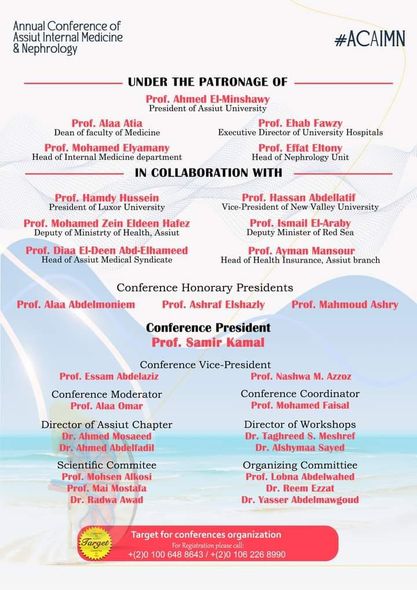
 تحت رعاية

 الدكتور أحمد المنشاوي- رئيس جامعة أسيوط

والدكتور علاء عطيه- عميد كلية الطب ورئيس مجلس إدارة المستشفيات

والدكتور إيهاب فوزي- المدير التنفيذي للمستشفيات الجامعية.

  تعد خدمة فحص f18 psma الخاصة، الأولى من نوعها في صعيد مصر، مما يسهل على المرضى تلقيها بمستشفيات جامعة أسيوط دون مشقة السفر إلى القاهرة، وتتواجد هذه الخدمة بوحدة الطب النووي بالمستشفى الجامعي الرئيسي تحت إشراف الدكتور سمير شحاته رئيس قسم علاج الأورام والطب النووي، والدكتور وليد دياب مدير الوحدة.

  كما توفر مستشفيات جامعة أسيوط، خدمة المسح البوزيتروني الخاص بتحديد حيوية عضلة القلب بالوحدة، إلى جانب استمرار العمل بعدد من الفحوصات كالمسح الذري على الجسم كله باستخدام مادة FDG، ومسح ذري على الكليتين، ومسح ذري على العظام، ومسح ذري على الغدة الدرقية والغدة الجار درقيه، ومسح ذري على القلب، ومسح ذري على المعده.

College Council Meeting - Monday, September 18, 2023

اجتماع مجلس الكلية الاثنين الموافق ١٨ سبتمبر ٢٠٢٣

برئاسة الاستاذ الدكتور عميد الكلية و بحضور السادة وكلاء الكلية ورؤساء الأقسام ونقيب اطباء اسيوط ووكيل وزارة الصحة ولفيف من أعضاء هيئة التدريس بالكلية .

حيث تضمن اجتماع المجلس مناقشة عدد من الموضوعات الأكاديمية والإدارية الخاصة بسير العمل داخل الكلية.

Pharmacogenetic study of phosphatase and tensin homolog polymorphism (rs701848) in childhood epilepsy: relation to circulating Wnt signaling

Research Abstract

ABSTRACT

Objective: The present study aimed at evaluating the potential contribution of Phosphatase and Tensin Homolog (PTEN) and its gene polymorphism (PTEN rs701848 T/C) in relation to Wingless/integrase-1 (Wnt) signaling in childhood epilepsy and the impact of antiepileptic medications on their serum levels.

Methods: This study included 100 children with epilepsy (50 pharmacoresistant and 50 pharmacoresponsive) and 50 matched controls. All subjects had their genotypes for the PTEN rs701848T/C polymorphism assessed using TaqManTM assays and real-time PCR. By using the sandwich ELISA technique, the blood concentrations of PTEN and Wnt3a were measured.

Results: Serum Wnt3a levels in epileptic patients were significantly higher than in the control group, p < 0.001. Children with epilepsy who received oxcarbazepine had considerably lower serum Wnt3a levels than those who didn’t, p < 0.001.With an AUC of 0.71, the cutoff value for diagnosing epilepsy as serum Wnt3a > 6.2 ng/mL has a sensitivity of 55% and a specificity of 80%. When compared to controls, epileptic children had considerably more (TT) genotype and less (TC and CC) genotypes, p < 0.05 for all. Epileptic children had significantly higher (T) allele frequency than controls, p = 0.006 with OR (95%CI) = 1.962(1.206–3.192). Pharmacoresistant epileptic children had significantly higher (TT) genotype compared to pharmacoresponsive type (p = 0.020).

Conclusion: We originally found a strong association between PTEN rs701848 T/C and childhood epilepsy, in particular pharmacoresistant type. Serum Wnt3a levels increased in epilepsy, but were not significantly different between different alleles of PTEN. In pharmaco-responsive children Wnt3a levels differed significantly between the different PTEN genotypes. Antiepileptics may affect Wnt3a levels.

Research Authors
Mohammed H. Hassan a , Ahmed Y. Nassarb , Abdel-Raheim M.A. Mekib,c, Shimaa A. Nasserd , Ali Helmi Bakrie and Eman Radwanb,
Research Date
Research Department
Research Journal
Neurological Research
Research Member
Research Pages
99-110
Research Publisher
Taylor & Francis
Research Vol
46 (2)
Research Website
https://www.researchgate.net/publication/373901122
Research Year
2024

Molecular Identification of Dermo-Mycotic Infection and the Effect of Dietary-Essential Oils on Broiler Chickens in Upper Egypt

Research Abstract

The importance of searching for natural alternatives away from chemicals in poultry health and treatment has benefits for humans in many directions, as we control the bad effect of the accumulation of harmful chemicals in their meat, as well as reduce the risk of zoonotic infection and preserve the environment from chemical pollution. Enormous fungi induce a considerable level of annihilation in the poultry industry and human consumers due to their zoonotic implications. This study was designed to explore the effects of keratogenic and toxigenic skin fungal affection and the effects of dietary-essential oils on broiler chickens (n-120). Skin scrapings and feather samples were examined mycologically in association with PCR sequencing for genomes of the culturally detected fungi (in South Korea) based on phylum tree and all Sequences data was deposited in GenBank and each was assigned an accession number. Sera samples of the tested broilers were examined by ELIZA against biogenic amine mainly histamine during the summer season, also a histopathological examination of skin sections before and after taking feed additives (essential oils) as anti-fungal for thirty days, the broiler-fed diet was supplemented with peppermint, thyme, and Carvacrol 70 mg/kg (w/w) in dietary feed. The isolated fungi were: Fifteen fungal species belonging to 9 genera of filamentous fungi which were isolated from skin scrapings and feathers of chickens. Aspergillus niger and A. flavus are the most prevalent species (20 samples representing 100% of total samples for each. Rhizopus oryze 20% and Fusarium oxysporum 15% were cultured from total samples respectively. Four fungal species appeared in 10% of the tested samples which are Aspergillus qudrilineatus, Paecilomyces variotii (Byssochlamys spectabilis), Scopulariopsis brevicaulis and Exserohilum rostratum. Finally, the other seven fungi presented as 5% from tested samples. The average level of serum histamine before treatment was 16.6 ng/ml and after feeding was 12.3 ng/ml (significant decrease, P < 0.05) referring to the significant role of the essential oils in broilers ration.

Research Authors
Aml Mokhtar, Ahmed M. Moharram, Ahmed Y. Nassar
Research Date
Research Department
Research Journal
Journal of Advanced Veterinary Research
Research Member
Research Pages
1425-1432
Research Publisher
Journal of Advanced Veterinary Research
Research Vol
13 (7)
Research Website
https://www.advetresearch.com/index.php/AVR
Research Year
2023
Subscribe to