Rebamipide potentially mitigates methotrexate-induced nephrotoxicity via inhibition of oxidative stress and inflammation: A molecular and histochemical study

Research Abstract

Methotrexate (MTX) is a widely used chemotherapeutic agent; nevertheless, the nephrotoxicity associated with its use has limited its clinical use. Rebamipide (REB) is a gastro-protective agent with diverse promising biological activities. Here, we investigated the renoprotective effects of REB against MTX-induced nephrotoxicity in rats. Male Wistar rats were allocated into four groups: the normal control group, the REB group (100 mg kg-1 day-1 , PO, for 12 days), the MTX group (which received a single injection of 20 mg/kg, ip), and the REB + MTX group (which received 100 mg kg-1 day-1 REB for 7 days before and 5 days after being injected with 20 mg/kg MTX). Interestingly, MTX triggered kidney injury, characterized by renal dysfunction along with histopathological alterations. Moreover, increased reactive oxygen species level and inflammatory response were detected in the kidney of MTX-treated rats. However, REB prevented MTX-induced oxidative kidney injury and boosted an antioxidant balance. Mechanistically, REB markedly activated the NRF-2 protein and upregulated the expression of both SIRT-1 and FOXO-3 genes. Additionally, REB administration strongly inhibited the inflammatory response by downregulating both NF-κB-p65 and TLR-4. Finally, the coadministration of REB and MTX activated the mTOR/PI3K/AKT signaling pathway. Simultaneously, REB treatment attenuated the reduction in glomerular size, the widening of the capsular spaces, and the tubular cell damage due to MTX administration. Taken together, these results indicate the potential of REB as adjuvant therapy to prevent nephrotoxicity in patients receiving MTX treatment.

Research Authors
Rasha A Elmansy, Hanan S Seleem, Amany R Mahmoud, Emad H M Hassanein, Fares E M Ali
Research Date
Research Department
Research Journal
The Anatomical Record
Research Pages
647-661
Research Publisher
WILEY
Research Vol
304(3)
Research Website
https://anatomypubs.onlinelibrary.wiley.com/doi/10.1002/ar.24482
Research Year
2021

Alleviation of Simvastatin-Induced Myopathy in Rats by the Standardized Extract of Ginkgo Biloba (EGb761): Insights into the Mechanisms of Action

Research Abstract

Statins are the most widely prescribed cholesterol-lowering drugs to reduce the risk of cardiovascular diseases. Statin-induced myopathy is the major side effect of this class of drugs. Here, we studied whether standardized leaf extracts of ginkgo biloba (EGb761) would improve simvastatin (SIM)-induced muscle changes. Sixty Wistar rats were allotted into six groups: control group, vehicle group receiving 0.5% carboxymethyl cellulose (CMC) for 30 days, SIM group receiving 80 mg/kg/day SIM in 0.5% CMC orally for 30 days, SIM withdrawal group treated with SIM for 16 days and sacrificed 14 days later, and EGb761-100 and EGb761-200 groups posttreated with either 100 or 200 mg/kg/day EGb761 orally. Muscle performance on the rotarod, serum creatine kinase (CK), coenzyme Q10 (CoQ10), serum and muscle nitrite, muscle malondialdehyde (MDA), superoxide dismutase (SOD), and catalase (CAT) activities were estimated. Additionally, muscle samples were processed for histopathological evaluation. We found that SIM decreased muscle performance on the rotarod, serum CoQ10, as well as muscle SOD and CAT activities while it increased serum CK, serum and muscle nitrite, as well as muscle MDA levels. SIM also induced sarcoplasmic vacuolation, splitting of myofibers, disorganization of sarcomeres, and disintegration of myofilaments. In contrast, posttreatment with EGb761 increased muscle performance, serum CoQ10, as well as muscle SOD and CAT activities while it reduced serum CK as well as serum and muscle nitrite levels in a dose-dependent manner. Additionally, EGb761 reversed SIM-induced histopathological changes with better results obtained by its higher dose. Interestingly, SIM withdrawal increased muscle performance on the rotarod, reduce serum CK and CoQ10, and reduced serum and muscle nitrite while it reversed SIM-induced histopathological changes. However, SIM withdrawal was not effective enough to restore their normal values. Additionally, SIM withdrawal did not improve SIM-induce muscle MDA, SOD, or CAT activities during the period studied. Our results suggest that EGb761 posttreatment reversed SIM-induces muscle changes possibly through its antioxidant effects, elevation of CoQ10 levels, and antagonizing mitochondrial damage.

Research Authors
Amany R Mahmoud, Esam Omar Kamel , Marwa A Ahmed, Esraa A Ahmed, Tarek Hamdy Abd-Elhamid
Research Department
Research Journal
Cells Tissues Organs
Research Pages
158–176
Research Publisher
Karger
Research Vol
208
Research Website
https://www.karger.com/Article/Abstract/507048
Research Year
2019

Ursodeoxycholic acid abrogates gentamicin-induced hepatotoxicity in rats: Role of NF-κB-p65/TNF-α, Bax/Bcl-xl/Caspase-3, and eNOS/iNOS pathways

Research Abstract

Aim: The present study focused on the possible underlying protective mechanisms of UDCA against GNT-induced hepatic injury.

Methods: For achieving this goal, adult male rats were allocated into 4 groups: normal control (received vehicle), GNT (100 mg/kg, i.p. for 8 days), UDCA (60 mg/kg, P.O. for 15 days), and GNT + UDCA (received UDCA for 15 days and GNT started from the 7th day and lasted for 8 days).

Results: The results revealed that UDCA significantly improved GNT-induced hepatic injury, oxidative stress, apoptosis, and inflammatory response. Interestingly, UDCA inhibited apoptosis by marked down-regulation of the Bax gene, Caspase-3, and cleaved Caspase-3 protein expressions while the level of Bcl-xL gene significantly increased. Moreover, UDCA strongly inhibited the inflammatory response through the down-regulation of both NF-κB-p65 and TNF-α accompanied by IL-10 elevation. Furthermore, the obtained results ended with the restored of mitochondria function that confirmed by electron microscopy. Histological analysis showed that UDCA remarkably ameliorated the histopathological changes induced by GNT.

Significance: UDCA may be a promising agent that can be used to prevent hepatotoxicity observed in GNT treatment. This effect could be attributed to, at least in part, the ability of UDCA to modulate NF-κB-p65/TNF-α, Bax/Bcl-xl/Caspase-3, and eNOS/iNOS signaling pathways.

Keywords: Bax/Bcl-xl/Caspase-3; Gentamicin; Mitochondrial dysfunction; NF-κB-p65/TNF-α; Ursodeoxycholic acid.

Research Authors
Fares E M Ali, Emad H M Hassanein , Adel G Bakr , Ehab A M El-Shoura , Dalia A El-Gamal , Amany R Mahmoud , Tarek Hamdy Abd-Elhamid
Research Date
Research Department
Research Journal
Life Sciences
Research Publisher
ELSEVIER
Research Vol
254
Research Website
https://www.sciencedirect.com/science/article/pii/S0024320520305087?via%3Dihub
Research Year
2020

Coenzyme Q 10 protects hepatocytes from ischemia reperfusion-induced apoptosis and oxidative stress via regulation of Bax/Bcl-2/PUMA and Nrf-2/FOXO-3/Sirt-1 signaling pathways

Research Abstract

Coenzyme Q10 (CoQ10) is a component of the mitochondrial electron transport chain and regarded as a strong anti-oxidant agent. In this study, we focused on the mechanistic insights involved in the hepato-protective effects of CoQ10 against hepatic ischemia reperfusion (IR) injury. Our results revealed that CoQ10 significantly improved hepatic dysfunctions and oxidative stress caused by IR injury. Interestingly, as compared to IR subjected rat, CoQ10 inhibited apoptosis by marked down-regulation of both Bax and PUMA genes while the level of Bcl-2 gene was significantly increased. Moreover, CoQ10 up-regulated PI3K, Akt and mTOR protein expressions while it inhibited the expression of both GSK-3β and β-catenin. Additionally, CoQ10 restored oxidant/antioxidant balance via marked activated Nrf-2 protein as well as up-regulation of both Sirt-1 and FOXO-3 genes. Moreover, CoQ10 strongly inhibited inflammatory response through down-regulation of NF-κB-p65 and decrease both JAK1 and STAT-3 protein expressions with a subsequent modulating circulating inflammatory cytokines. Furthermore, histopathological analysis showed that CoQ10 remarkably ameliorated the histopathological damage induced by IR injury. Taken together, our results suggested and proved that CoQ10 provided a hepato-protection against hepatic IR injury via inhibition of apoptosis, oxidative stress, inflammation and their closed related pathways.

Research Authors
Amany R Mahmoud , Fares E M Ali, Tarek Hamdy Abd-Elhamid , Emad H M Hassanein
Research Date
Research Department
Research Journal
Tissue and Cell
Research Pages
1-13
Research Publisher
ELSEVIER
Research Vol
60
Research Website
https://www.sciencedirect.com/science/article/pii/S0040816619302447?via%3Dihub
Research Year
2019

Positive effects of systemic sodium benzoate and olanzapine treatment on activities of daily life, spatial learning and working memory in ketamine-induced rat model of …

Research Authors
GS Mahmoud, SA Sayed, SN Abdelmawla, MA Amer
Research Date
Research Department
Research Journal
International journal of physiology, pathophysiology and pharmacology 11 (2), 21
Research Member

International accredited courses and certificates for doctors at Assiut University Hospitals

International accredited courses and certificates for doctors at Assiut University Hospitals


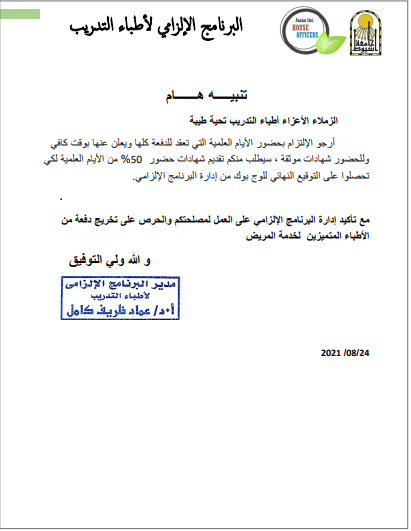
تحت رعايه الاستاذ الدكتور طارق الجمال رئيس جامعه اسيوط والاستاذ الدكتور علاء عطيه عميد كليه الطب ورئيس مجلس اداره المستشفيات والاستاذ الدكتور إيهاب فوزي المدير التنفيذي للمستشفيات الجامعيه والاستاذ الدكتور هاني المربع رئيس قسم التخدير و الدكتور عماد ظريف كامل مدير البرنامج الالزامي لأطباء التدريب.

تم تخصيص برنامج خاص باطباء التدريب واخر للأطباء المقيمين بقسم التخدير والعنايه المركزه. وذلك لزياده الوعي الطبي والبحثي لدي الاطباء الجدد وتوفير بعض الدورات العلميه العالميه المتميزة والمعتمدة و دون تكلفه على الطبيب . من خلال الالتحاق بموقع Incision academy  علي الإنترنت  والمتعاقد معها المجلس الأعلى للجامعات عن طريق بنك المعرفة المصري. يختار الطبيب من بين مئات الدورات المتاحه اون لاين ما يود  ليتدرب عليها ثم يجتاز  امتحان MCQ  فيحصل على  شهاده موثقه معتمده دولية  من  The Royal College of Surgeons.

Investigation of the levels of circulating miR-29a, miR-122, sestrin 2 and inflammatory markers in obese children with/without type 2 diabetes: a case control study

Research Abstract

Aim

The present work investigated serum levels of miR-29a, miR-122 and sestrin2 in obese children with/without type-2-diabetes mellitus (T2DM), and their correlations with inflammatory, metabolic and anthropometric parameters.

Methods

The study included 298 children, divided into: G1 (control, n = 136), G2 (obese without diabetes, n = 90) and G3 (obese with T2DM, n = 72). Metabolic and anthropometric parameters, miR-29a, miR-122 relative expressions, and sestrin2, high sensitivity C-reactive protein (hsCRP), interleukin-6 (IL-6), and tumor necrosis factor-α (TNF-α) levels were measured by their specific methods. The data was processed and analyzed by SPSS V.26 using the corresponding tests. After testing the variables’ normality, Kruskal–Wallis one-way-ANOVA, Spearman correlations coefficient were used.

Results

Significant higher serum miR-29a, miR-122, IL-6, hsCRP and TNF-α and lower sestrin2 levels were found in G2 and G3 than G1 and in G3 than G2 (p= > 0.001 for all). Especially in G3, miR-29a and miR-122 levels correlated positively while sestrin2 levels correlated negatively with waist circumference and BMI percentiles, serum levels of LDL-cholesterol, triacylglycerol, total cholesterol, HbA1c%, glucose, insulin, c-peptide, homeostatic model assessment-insulin resistance (HOMA-IR), IL-6, hsCRP and TNF-α.

Conclusion

The change in the serum miR-29a, miR-122 and sestrin2 levels in obese children with/without T2DM may suggest a possible role of these biomarkers in the pathogenesis of childhood obesity and their accompanied complications e.g. inflammations and T2DM. Also, further studies are required to test drugs that antagonize the action miR-29a and miR-122 or upregulate sestrin2 in the management of these cases.

Research Authors
Khalid M. Mohany, Osamah Al Rugaie, Osama Al-Wutayd & Abdullah Al-Nafeesah
Research Date
Research Department
Research Journal
BMC endocrine disorders
Research Pages
152
Research Publisher
BMC
Research Vol
21
Research Year
2022

Mechanics of guided growth of the distal femur for correction of fixed knee flexion deformities: an extra-articular technique

Research Abstract

Introduction

Anterior distal femoral hemiepiphysiodesis using intra-articular plates for correction of pediatric fixed knee flexion deformities (FKFD) has two documented complications: postoperative knee pain and implant loosening. The aim of this study is to investigate the mechanical properties of a novel extra-articular technique for anterior distal femoral hemiepiphysiodesis in patients with FKFD and to compare them to the conventional technique.

Materials and methods

Sixteen femoral sawbones were osteotomized at the level of the distal femoral physis and fixed by rail frames to allow linear distraction simulating longitudinal growth. Each sawbone was tested twice: first using the conventional technique with eight plates placed anteriorly just medial and lateral to the femoral sulcus (group A) and then with plates inserted in the proposed novel location at the most anterior part of the medial and lateral surfaces of the femoral condyles with screws in the coronal plane (group B). Gradual linear distraction was performed, and the resulting angular correction was measured. Strain gauges were attached to the plates, and the amount of strain (and equivalent stress) over the plates in response to linear distraction was recorded. The two groups were compared using the Wilcoxon signed-rank test.

Results

The amount of angular correction was statistically higher in group B (extra-articular plates) at 5, 10-, and 15-mm of distraction (p < 0.001). As regards stress over the plates, the maximum stress and the area under the curve (sum of all stresses measured throughout the distraction process) were significantly higher when the plates were inserted at the conventional position (group A) (p < 0.001).

Conclusions

During anterior distal femoral hemiepiphysiodesis, the fixation of the eight plates in the coronal plane at the anterior part of the femoral condyles may produce a greater amount of correction and a lower degree of stress over the implants as compared to the conventional technique.

Research Authors
Mohamed Y. Hassanein, Ahmed Hassanein, Mahmoud Y. Hassanein, Mohamed Khaled & Nariman Abol Oyoun
Research Date
Research Journal
Archives of Orthopaedic and Trauma Surgery
Research Publisher
Springer
Research Rank
Q2
Research Website
https://link.springer.com/article/10.1007/s00402-021-03911-2
Research Year
2021
Subscribe to