Do you have any questions?

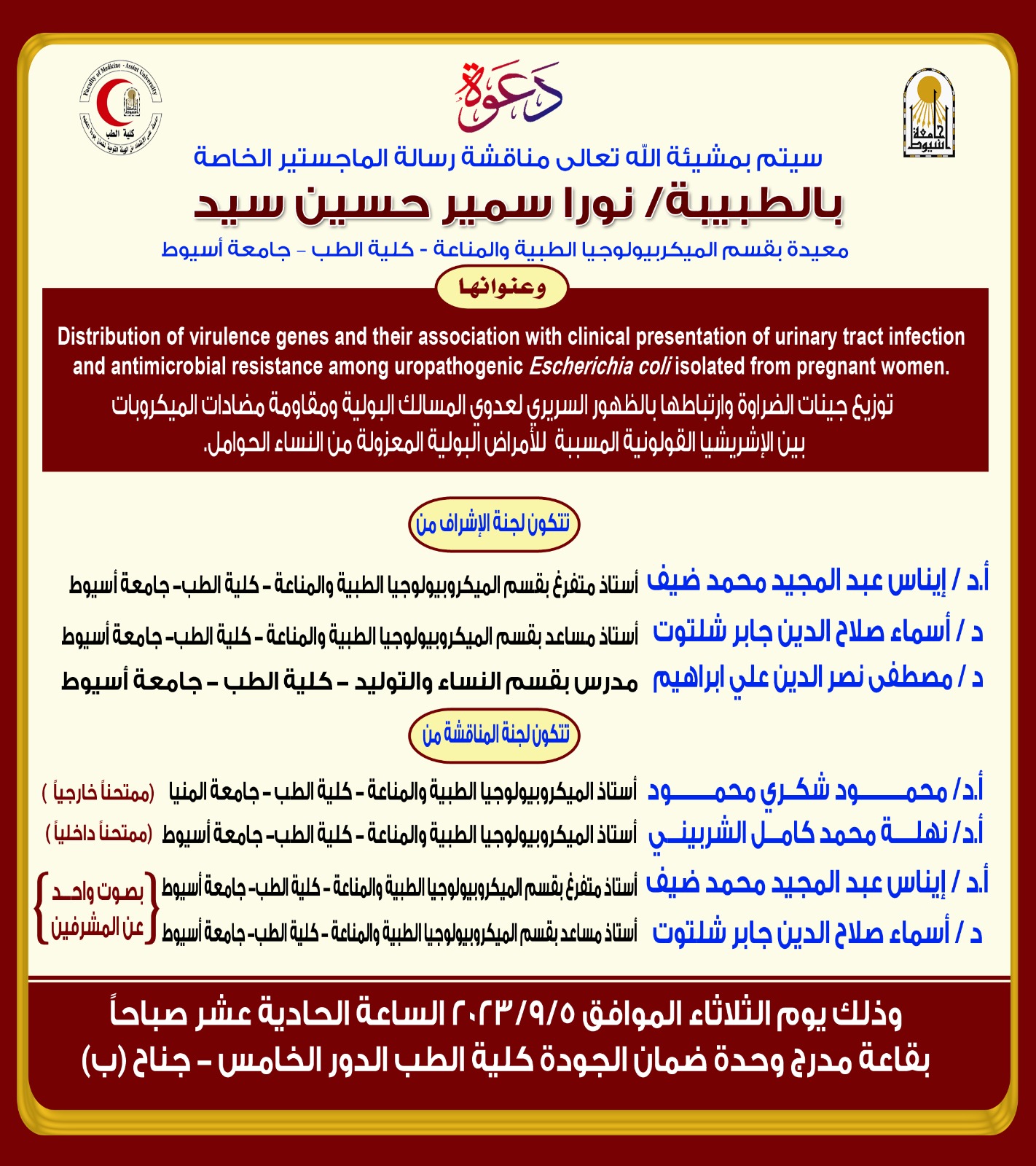
Seminar by Dr. Noura Samir Hussein Sayed - Teaching Assistant, Department of Microbiology - Faculty of Medicine - Assiut University
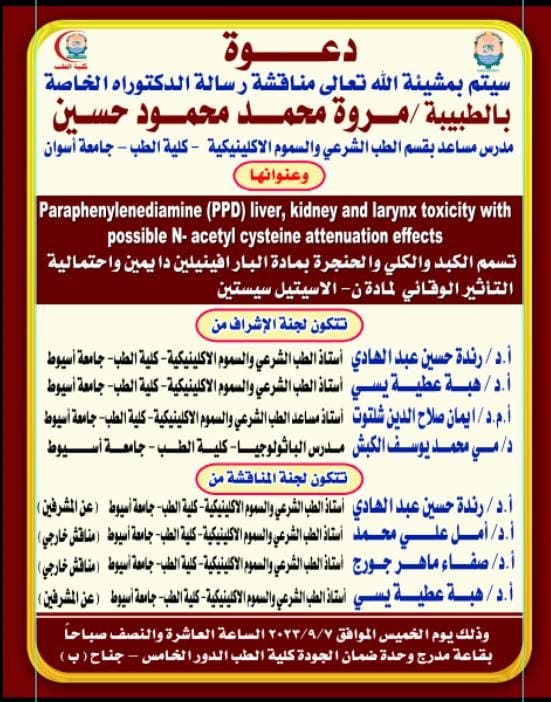
Seminar by Dr. Marwa Mohamed Mahmoud Hussein - Assistant Lecturer, Department of Forensic Medicine and Clinical Toxicology - Faculty of Medicine - Aswan University
Percutaneous needle quadriceps tenotomy for treatment of idiopathic congenital dislocation of the knee
Research Abstract
Background:
Congenital dislocation of the knee is a rare condition with an incidence of 1:100000 and can be idiopathic or syndromic. Our study evaluated percutaneous needle tenotomy for treatment of idiopathic flexible congenital dislocation of the knee.
Methods:
A prospective case series was done on 15 infants with idiopathic congenital dislocation of the knee: nine boys and six girls. Closed reduction was first attempted, and if it failed the knee was examined. If the knee could be flexed beyond 0, serial casting was done. If the knee could not be flexed beyond 0, percutaneous needle tenotomy was done.
Results:
Fifteen infants presented with idiopathic flexible congenital dislocation of the knee. Three dislocations were reduced closed, five were reduced with serial casting with gradual flexion, and seven that could not be flexed beyond 0 underwent percutaneous needle tenotomy. All patients could walk within the normal age range with no pain. All had full range of motion and good quadriceps function. Ultrasound was done in patients who had percutaneous needle tenotomy at walking age to ensure healing of the quadriceps tendon, which was adequately healed in all patients.
Conclusions:
Percutaneous needle tenotomy is a good option for treatment of congenital dislocation of the knee. Careful selection of patients is mandatory.
Research Date
Research Department
Research Journal
Current Orthopaedic Practice
Research Member
Research Year
2018
Submuscular locked plate for fixation of pediatric fracture femur using cluster technique
Research Abstract
Abstract
Background: This study evaluates submuscular locked plate in the pediatric femoral shaft fractures at the age from 6 to 12 years old.
Methods: A prospective study was done on 30 patients with fracture shaft femur. 18 of them were males and 12 of them were females. Fixation of all cases was done with a submuscular locked plate using the cluster technique.
Results: All fractures healed within 6 weeks. There have been no cases of non-union, malunion or infection.
Conclusion: Submuscular locked plate with cluster screw placement is a reliable and a useful option for fixation of pediatric fracture shaft femur.
Key words: Sub-muscular locked plate, pediatric fracture femur
Research Date
Research Department
Research Journal
THE JOURNAL OF ORTHOPAEDICS TRAUMA SURGERY AND RELATED RESEARCH
Research Member
Research Year
2017
Ponseti method for management of neglected idiopathic clubfoot
Research Abstract
Background
Although the Ponseti method has been effective in early presented clubfoot, limited information is available on the use of this method in older patients.
Methods
We prospectively followed 20 children (30 feet) with neglected idiopathic clubfoot. We sought to determine whether initial correction of the deformity (a plantigrade foot) could be achieved using the Ponseti method in untreated idiopathic clubfeet in patients presenting between the ages of 12–36 months.
Results
Older children needed more casts than younger children. Twenty-one of 30 (70%) feet needed percutaneous tendo-Achilles tenotomy for residual equinus deformity. The mean dorsiflexion after removal of the last cast was 12.5°. Six feet relapsed (20%) and were treated with recasting and tibialis anterior transfer in four feet, and two feet needed limited medial release, tendo-Achilles tenotomy, abductor hallucis tenotomy, and tibialis anterior transfer.
Conclusions
The Ponseti technique was effective in treatment of neglected clubfoot in patients between the ages of 12–36 months.
Research Date
Research Department
Research Journal
Current Orthopaedic Practice
Research Member
Research Pages
Current Orthopaedic Practice 24(3):p 295-297, May/June 2013.
Research Publisher
Wolters Kluwer Health | Lippincott Williams & Wilkins
Research Website
https://journals.lww.com/c-orthopaedicpractice/abstract/2013/06000/ponseti_method_for_management_of_neglected.12.aspx
Research Year
2013
Effects of Different Routes of Nicotine Administration on Gastric Morphology and Hormonal Secretion in Rats
Research Abstract
..
Research Date
Research Department
Research Journal
Exp Physiol
Research Member
Research Pages
881–895
Research Vol
100(8)
Research Website
doi: 10.1113/EP085015.
Research Year
2015
Adding steroids in severe community-acquired pneumonia treatment: does it make a difference?
Research Date
Research Department
Research Journal
The Egyptian Journal of Chest Diseases and Tuberculosis
Research Member
Research Publisher
Medknow
Research Year
2021