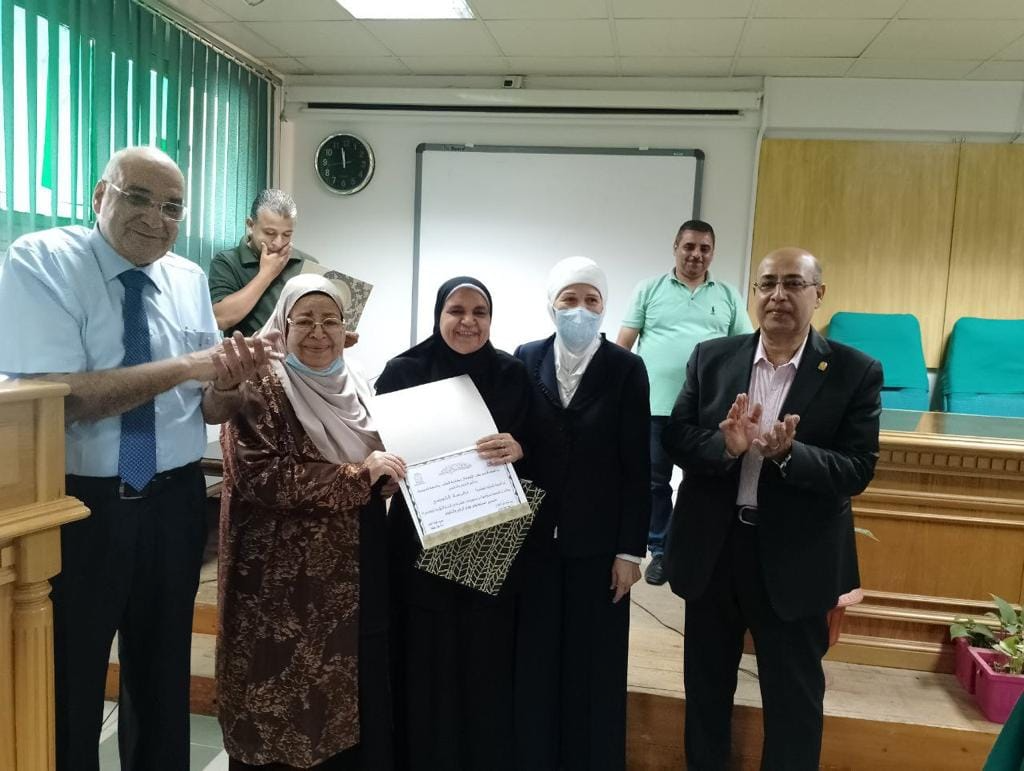
Honoring a number of faculty members from the Department of Pediatrics at Children’s University Hospital for their efforts in the tripartite committees.

تكريم عددًا من أعضاء هيئة التدريس من قسم طب الأطفال بمستشفى الأطفال الجامعى  لما  بذلوه من جهد في اللجان الثلاثية.

تحت رعاية :

الأستاذ الدكتور /أحمد المنشاوي رئيس جامعة أسيوط  

الأستاذ الدكتور/ علاء عطية عميد كلية الطب ورئيس مجلس إدارة المستشفيات الجامعية

‏الأستاذ الدكتور/ إيهاب فوزي المدير التنفيذي للمستشفيات الجامعية

‏الأستاذ الدكتور/ عماد الدالي رئيس أقسام  طب الأطفال

‏الأستاذ الدكتور/ محمد أمير فتحى مدير مستشفى الأطفال الجامعي.

قام مجلس قسم طب الأطفال المنعقد بجلسته بتاريخ الاربعاء الموافق ١٣  سبتمبر  ٢٠٢٣ فى إحدى صور التعبير عن العرفان والجميل متمثلا فى أ.د/ عماد الدالى رئيس قسم طب الأطفال واعضاء المجلس الموقرين بتكريم الساده أعضاء هيئة التدريس و توزيع الهدايا التذكارية لما بذلوه من جهد فى اللجان الثلاثية

 والتى شملت كل من:

 ??اللجنة الثلاثية لشئون الطلاب (نظام حديث )??

الأستاذ الدكتور /غادة عمر الصدفي

 الأستاذ الدكتور /ياسر فاروق

الأستاذ الدكتور/ محمد جميل

  ‏??اللجنة الثلاثية لشئون الطلاب(نظام قديم)??

الأستاذ الدكتور/ عزه الطيب

الأستاذ الدكتور/ خالد السايح

 الأستاذ الدكتور /اسماعيل لطفي

الأستاذ الدكتور/ صفوت عبد العزيز

الأستاذ الدكتور /فيصل الخطيب

           ??‏اللجنة الثلاثية للدكتوراه ??

الأستاذ الدكتور /ماهر مختار

الأستاذ الدكتور /نجوى علي محمد

الأستاذ الدكتور /هناء عبد اللطيف

الأستاذ الدكتور/ غادة عمر الصدفى

الاستاذ الدكتور /نجلاء حسن أبو فدان

الأستاذ الدكتور/ قطب عباس

الأستاذ الدكتور /نفيسة القوصى

            ‏??اللجنة الثلاثية للماجستير??

‏الأستاذ الدكتور /جعفر إبراهيم

الأستاذ الدكتور/ جمال عسكر

 الأستاذ الدكتور /حكمة سعد فرغلى

الأستاذ الدكتور /محمد أمير فتحى

الاستاذ الدكتور/دعاء رافت

 الاستاذ الدكتور / أحلام بدوى

   ‏??اللجنة الثلاثية للطلاب (تخلفات قديم)??

‏الأستاذ الدكتور/ ايمان فتح الله

الأستاذ الدكتور/ راندا عبد البديع

                    ??‏لجنة الكنترول??

الأستاذ الدكتور/ مصطفى امبابي

‏الأستاذ الدكتور/ شرين منصور

 الأستاذ الدكتور/ ميرفت أمين

   ‏??الأشراف العلمي على الأطباء المقيمين??

‏الأستاذ الدكتور /أمير محمد ابو الغيط

الأستاذ الدكتور /نجلاء سامى.

وفى الختام قدم ا.د/ عماد الدالى رئيس القسم الشكر والتقدير للساده أعضاء هيئة التدريس لما بذلوه من جهد و تمنى لهم دوام التوفيق .


The Dean of the College of Medicine inspects the start of the medical examination work for new College of Medicine students for the new academic year 2023-2024

عميد كلية الطب يتفقد إنطلاق أعمال الكشف الطبى لطلاب كلية الطب الجدد للعام الدراسي الجديد ٢٠٢٣-٢٠٢٤ الدكتور علاء عطية عميد كلية الطب ورئيس مجلس إدارة المستشفيات الجامعية، والدكتور محمد عبد الرحمن وكيل كلية الطب لشئون التعليم والطلاب بصالات الامتحانات أمام كلية الهندسة لمتابعة الكشف الطبي لطلاب كلية الطب برفقة الدكتور أحمد عبدالمولى نائب رئيس الجامعة لشئون التعليم والطلاب، وبحضور الدكتورة بثينة الفاتح مدير عام الإدارة العامة للشئون الطبية ، والدكتور رضا محمد ابو الفتوح مدير إدارة الطب الوقائى العلاجى ، والدكتورة مروة شريت مدير إدارة طب الفم والأسنان. الدكتور علاء عطية عميد كلية الطب ورئيس مجلس إدارة المستشفيات الجامعية، والدكتور محمد عبد الرحمن وكيل كلية الطب لشئون التعليم والطلاب بصالات الامتحانات أمام كلية الهندسة لمتابعة الكشف الطبي لطلاب كلية الطب برفقة الدكتور أحمد عبدالمولى نائب رئيس الجامعة لشئون التعليم والطلاب، وبحضور الدكتورة بثينة الفاتح مدير عام الإدارة العامة للشئون الطبية ، والدكتور رضا محمد ابو الفتوح مدير إدارة الطب الوقائى العلاجى ، والدكتورة مروة شريت مدير إدارة طب الفم والأسنان.

INTRA-ARTICULAR KETAMINE VERSUS INTRA-ARTICULAR NEOSTIGMINE TO ENHANCE ANALGESIA AFTER KNEE ARTHROSCOPY: A RANDOMISED CONTROLLED TRIAL

Research Abstract

ABSTRACT


Background: Intra-articular drugs and local anaesthetics are the most popular methods for pain relief after arthroscopic knee procedure. Many drugs, including opioids, non-steroidal antiinflammatory drugs, ketamine, clonidine, and neostigmine, have been used intra-articularly. Objectives: The aim of our study was to compare the analgesic effect of intraarticular injection of ketamine bupivacaine and neostigmine bupivacaine in patients undergoing arthroscopic knee surgery under intra-thecal anaethesia. Design: a randomized controlled trial included 100 Patients were randomly divided into two groups 50 patients each, setting: the study was conducted in Assuit university tertiary hospital, Egypt. Intervevtions: Neostigmine group received intra-articular 0.5mg/dose neostigmine + 20 ml 0.25% bubivacaine and ketamine group received intra-articular 0.5 mg/kg ketamine + 20 ml 0.25% bubivacaine. VAS score was used for post-operative evaluation of pain every 4 hours over a 24 hour period. The total analgesic dose and any side effects were also recorded. Results: There were no significant differences in VAS score between the two studied groups but Time to rescue analgesia was significantly longer in the ketamine group (447.70± 48.109 minutes) than in the neostigmine group (257.60± 47.243 minutes) with P value ≤ 0.000. There was a significant difference in the analgesic dose of ketorolac between ketamine group and neostigmine group. Conclusion: Injection of intra-articular ketamine bupivacaine provided better postoperative analgesia, less side effects and low supplementary analgesic dose than intra-articular neostigmine bupivacaine. Trial registration: This study is registered by the local research ethics committee and its Approval Number: IRB00008788 and registered at www.clinicaltrials.gov under number NO: NCT02720705. Key words: analgesic dose, intra-articular, ketamine, neostigmine

Research Authors
Amani H Abdelwahab, Abualauon M Abedalmohsen, Ghada M Abo Elfadl
Research Date
Research Journal
Alazhar Assiut medical journal
Research Website
AL-AZHAR ASSIUT MEDICAL JOURNAL AAMJ ,VOL 13 , NO 4 , OCTOPER 2015 SUPPL-2
Research Year
2015

Nitroglycerin Patch in Traumatic Hemorrhagic Shock to Improve Signs of Poor Peripheral Perfusion

Research Abstract

Abstract


Background: Microcirculatory function is the main prerequisite for adequate tissue oxygenation and organ function. It transports oxygen and nutrients to tissue cells, ensure adequate immunological function and, in disease, delivers therapeutic drugs to target cells. Recruiting microcirculation, i.e., non-perfused or intermittently perfused capillaries might improve tissue perfusion, mitigating the progression to organ failure and death. Nitroglycerin has been used in different shock states particularly in sepsis. The effect is variable and debatable suggesting an improvement of microcirculation.


Patients and Methods: 60 adult patients with hemorrhagic shock admitted to the Emergency Department within 6 hours of trauma event, resuscitation immediately started according to advanced trauma life support ATLS® protocol 2016 with control of the bleeding source. Nitroglycerine patch 5mg applied to patients after the first hour of resuscitation. The study period corresponded to the outcome of the first 48 hours of trauma unit or ICU resuscitation. Patients considered successfully resuscitated if they had normal lactate levels (2mmol/L).


Results: 60 patients enrolled in this study, 10 patients were excluded; 3 of them due to uncontrolled bleeding and 7 due to marked hypotension. 50 patients continued in the study (38 men, 12 women) with mean age was (29.1 ± 10.8ys); of them 45 survived (90%) and 5 did not survive (10%). Patients received mean crystalloid volume (6100 ± 1410.67ml), mean colloid volume (490 ±457.25ml), mean packed RBCs (4.34± 1.33 units), mean fresh frozen plasma (3.08± 1.65 units) and mean nor-adrenaline dose (7.94± 10.55µg/kg/minute). Baseline perfusion index was (0.37±0.21), mean heart rate (128.46± 18.18 beat/minute), systolic blood pressure (78.08 ± 7.47mmHg), diastolic blood pressure (40.20±7.39mmHg), mean arterial pressure (53.44±6.43mmHg), central venous pressure (–1 .46±2.77cmH2O) and baseline modified shock index was (2.45±0.56). Baseline serum lactate was (8.61 ± 1.86 mmol/L), base deficit was (–12.59±5.57). Perfusion index showed statistically significant increase in survivors than non survivors at 12, 18, 24, 30, 36, 42, 48 hours (p<0.001). Serum lactate level was significantly higher in non survivors group than survivor group (p<0.001). Base deficit was significantly higher in non survivors than survivors (p<0.001).


Correspondence to: Dr. Medhat Sayed Ali, E-Mail: medhat_sayed69@yahoo.com


Conclusion: Use of nitroglycerin patch 5mg improved PI at 6 to 48 hours post resuscitation and reduce mortality rate (in this study was 10%) while in other previous studies with the same sample size of hemorrhagic shock patients without use of nitroglycerin it was higher (about 30%).


This study is registered at www.clinicaltrials.gov under number NCT03235921.


Key Words: Base deficit – Nitroglycerin – Perfusion index – Serum lactate.

Research Authors
M.Sc. MEDHAT S. ALI, M.D. HASSAN I.M. KOTB, M.D. ALAA M. AHMED ATIA, M.D. and ABUALAUON M. ABD EL-MOHSEN
Research Date
Research Journal
medical journal of cairo university
Research Website
Med. J. Cairo Univ., Vol. 86, No. 3, June: 1253-1261, 2018 www.medicaljournalofcairouniversity.net
Research Year
2018

Correlation between modified shock index and severity index in predicting outcome in patients with hemorrhagic shock

Research Abstract

Introduction


Trauma is the main cause of death in age group less than 45 years. A lot of clinical parameters including heart rate, pulse rate, blood pressure, shock index (SI), and modified shock index (MSI) are used to predict the severity of hemorrhage in trauma patients. In 2012 Choi and colleagues proposed for the first time a new index (NI) based on lactate concentration and peripheral perfusion index for assessment of shock in a rat model. In this trial, we propose for the first time a new severity predicting index (NI) based on lactate concentration/peripheral perfusion ratio as an indicator of hemorrhage-related mortality in humans.


Materials and methods


This prospective trial is a single-center study of 122 consecutive adult polytraumatized patients with hemorrhagic shock admitted to trauma center within 6 h of the trauma, and underwent resuscitation according to the advanced trauma life support protocol (2016). Protocol-related measurements were obtained immediately after admission and over 48 h postresuscitation for metabolic perfusion parameters, serum lactate, perfusion index, and other hemodynamic parameters. The period of the study corresponds to the outcome after 48 h of admission. Resuscitation measures were considered successful when lactate levels were less than or equal to 2 mmol/l in addition to stable macrohemodynamic parameters at the end of this period.


Results


Characteristically, the survivors had NI of 40 ± 2.7 on admission, compared with 87.1 ± 13 of nonsurvivors with highly significant difference. MSI showed a significant difference (nearly doubled) between survivors and nonsurvivors. SI showed nearly the same change, nearly doubled. NI showed lower prediction value for mortality than MSI and SI (P = 0.05) 0.884, 0.905, and 0.908, respectively.


Conclusion


This study confirms, for the first time in humans, the validity of severity index as independent parameter in prediction of mortality in comparison with MSI.


Keywords:


hemorrhagic shock, lactate and perfusion index, modified shock index, severity index, shock index

Research Authors
Sarah Abd El Mageed Mohammed Hassan I. M. Kotb, Ayman A. Mamdouh, Abualauon M. Abedalmohsen
Research Date
Research Journal
Journal of Current Medical Research and Practice
Research Publisher
Wolters Kluwer - Medknow
Research Website
J Curr Med Res Pract 4:231–236 © 2019 Faculty of Medicine, Assiut University 2357‑0121
Research Year
2019

Effect of intrathecal dexmedetomidine on shoulder tip pain during laparoscopic ovarian cystectomy under spinal anaesthesia

Research Abstract

ABSTRACT


Background: Shoulder pain secondary to laparoscopic interventions may cause more discomfort to the patient than the incision site pain, with a reported incidence varies from 35% to 80%. Aim of the study:–To evaluate the effect of intrathecal dexmedetomidine on incidence and severity of laparoscopy-triggered shoulder tip pain.


Methods: Sixty patients, 1st patient recruited on the 1 July 2017, undergoing elective laparoscopic ovarian cystectomy under spinal anesthesia were randomly allocated to one of the two groups. Group C received intrathecal hyperbaric Bupivacaine 3.5 ml plus 0.5 ml normal saline. Group D received intrathecal hyperbaric Bupivacaine 3.5 ml plus 10 μg dexmedetomidine (0.5 ml). Measurements: Data on the severity of intraoperative shoulder pain were collected using a visual analogue scale.


Results: Twenty-four patients in Group C complained of intraoperative shoulder tip pain, 16 patients (53.3%) required fentanyl which was given in 25 μg increments, and total fentanyl consumption for 16 patients was 875 μg. Two patients were converted into general anaesthesia as pain was intolerable (≥ 4). In Group D, five patients (16.7%) experienced shoulder pain intraoperative with a mean VAS score 0.37 ± 0.9.


Conclusion: Intrathecal dexmedetomidine can effectively decrease the incidence and severity of shoulder tip pain during laparoscopic ovarian cystectomy under spinal anesthesia.

Research Authors
Rasha Hamed, Saeid Elsawy, Abualauon Mohamed Abedalmohsen, Waleed Saleh
Research Date
Research Journal
Egyptian Journal of Anaesthesia
Research Publisher
Taylor & Francis
Research Website
EGYPTIAN JOURNAL OF ANAESTHESIA 2021, VOL. 37, NO. 1, 287–294. https://doi.org/10.1080/11101849.2021.1936839
Research Year
2021
Subscribe to