 Do you have any questions?

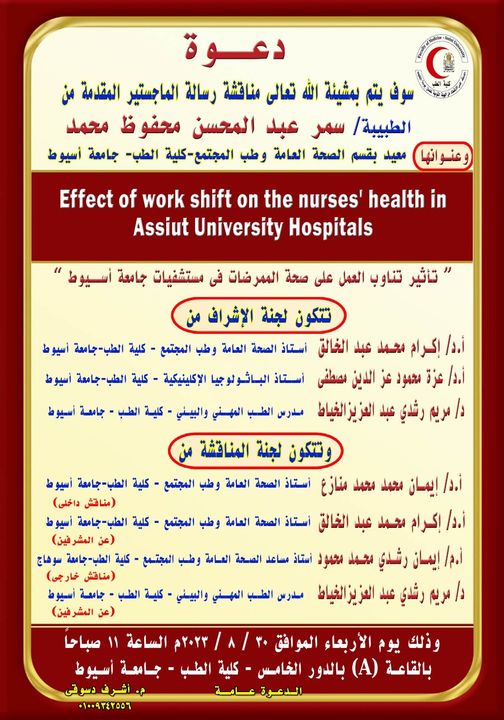
Seminar by Dr. Samar Abdel Mohsen Mahfouz Mohamed - Teaching Assistant, Department of Public Health - Faculty of Medicine - Assiut University
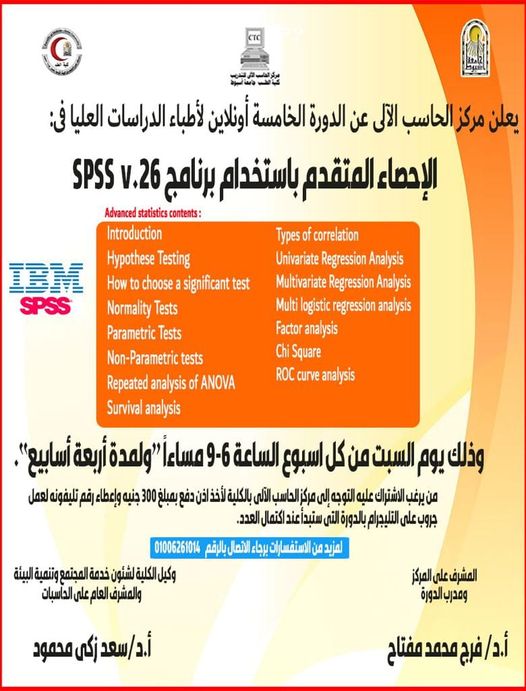
Announcement of the new course organized by the Computer Center at the Faculty of Medicine on Saturdays of every week for a period of 4 weeks.
To Bury or Not to Bury the K-wires After Fixation of Both Bone Forearm Fractures in Patients Younger Than 11 Years Old: A Randomized Controlled Trial
Research Date
Research Department
Research Journal
Journal of Pediatric Orthopedics
Research Member
FEMORAL HEAD OSTEONECROSIS POST-COVID-19 INFECTION, A PROPHECY COMING TRUE. A REPORT OF SEVEN HIPS
Research Date
Research Department
Research Journal
Journal of Musculoskeletal Research
Research Member
Femoral head avascular necrosis in COVID-19 survivors: a systematic review
Research Abstract
The current systematic review aimed to document published cases of femoral head avascular necrosis (FHAVN) post-COVID-19, to report the COVID-19 disease characteristics and management patients received, and to evaluate how the FHAVN were diagnosed and treated among various reports. A systematic literature review was performed per the Preferred Reporting Items for Systematic Reviews and Meta-Analyses (PRISMA) guidelines through a comprehensive English literature search on January 2023 through four databases (Embase, PubMed, Cochrane Library, and Scopus), including studies reporting on FHAVN post-COVID-19. Fourteen articles were included, ten (71.4%) were case reports, and four (28.6%) case series reported on 104 patients having a mean age of 42.2 ± 11.7 (14:74) years, in which 182 hip joints were affected. In 13 reports, corticosteroids were used during the COVID-19 management plan for a mean of 24.8 ± 11 (7:42) days, with a mean prednisolone equivalent dose of 1238.5 ± 492.8 (100:3520) mg. A mean of 142.1 ± 107.6 (7:459) days passed between COVID-19 diagnosis and FHAVN detection, and most of the hips were stage II (70.1%), and concomitant septic arthritis was present in eight (4.4%) hips. Most hips (147, 80.8%) were treated non-surgically, of which 143 (78.6%) hips received medical treatment, while 35 (19.2%) hips were surgically managed, 16 (8.8%) core decompression, 13 (7.1%) primary THA, five (2.7%) staged THA and three (1.6%) had first stage THA (debridement and application of antibiotic-loaded cement spacer). The outcomes were acceptable as regards hip function and pain relief. Femoral head avascular necrosis post-COVID-19 infection is a real concern, primarily attributed to corticosteroid usage, besides other factors. Early suspicion and detection are mandatory, as conservative management lines are effective during early stages with acceptable outcomes. However, surgical intervention was required for progressive collapse or patients presented in the late stage.
Research Date
Research Department
Research Journal
Rheumatology International
Research Member
Validation of a translated version of the modified Japanese Orthopedic Association (mJOA) cervical myelopathy score in an Arabic speaking population
Research Abstract
Introduction: Degenerative Cervical Myelopathy (DCM) is a growing disorder. Standardization of its assessment tools is an integral part of its management. The modified Japanese orthopedic association (mJOA) score is one of the most commonly used tools. Currently, there is no available Arabic translated version of any cervical myelopathy functional score. This study aimed to translate, culturally adapt, and measure the psychometric properties of an Arabic translated version of the mJOA. Methods: After translation of the score using the standard forward-backward translation procedure, a validation study including 100 patients was carried out from June 2019 to June 2020. The following psychometric properties were measured: feasibility, reliability, internal consistency, validity, minimal clinically important difference (MCID), ceiling, and floor effect. Results: No problems were encountered during the process of translation and cross-cultural adaptation of the score. The mJOA-AR was found to be a feasible score. It showed high inter-observer reliability (r = 0.833, P < 0.001), test-retest reliability (r = 0.987, P < 0.001) and good internal consistency using Cronbach’s alpha (0.777) and Pearson interclass correlation coefficient (r = 0.717). The score showed good convergent and divergent construct validity correlating it to the Arabic validated version of the neck disability index (NDI). The mJOA-AR had an MCID of 1.506. Both the ceiling and floor effects of the total score and the first and second domains were within the acceptable range, while the third and fourth domains had a high ceiling effect (30% and 39%, respectively). Discussion: Our translated version of the mJOA score was found to be a feasible score with acceptable psychometric properties. This score can be utilized as a good outcome measure tool in Arabic-speaking countries.
Research Date
Research Department
Research Journal
SICOT-J
Research Member
Eleven Cases of Hb J-Paris-I [HBA2: c.38C>A (or HBA1)]: A Stable α Chain Variant Elutes in the P3 Window on High-Performance Liquid Chromatography
Research Abstract
Hb J-Paris-I [HBA2: c.38C>A (or HBA1)] is a stable fast-moving hemoglobin (Hb) that elutes in the P3 window on high performance liquid chromatography (HPLC). The mutation can happen on either the α1- or α2-globin gene. Codon 12 changes from GCC to GAC to replace the alanine amino acid with aspartic acid. This change is external with no clinical significance. The elution in the P3 wave on HPLC can interfere with the glycated Hb assay by HPLC. In this study, data of 11 cases of Hb J-Paris-I were thoroughly presented. The majority of the cases were of Indian ethnicity. The mean value of Hb J-Paris-I on HPLC was 26.7 ± 2.0%. The retention time (RT) was 1.75 ± 0.03 min. The isoelectric focusing (IEF) mean value was −5.6 (range −6.1 to −4.9). Hb A2 was consistently reduced to 1.8 ± 0.3%. A fraction of 0.8% corresponding to the Hb A2-J-Paris-I (α2J-Paris-Iδ2) is likely to be concealed within the A0 …
Research Date
Research Department
Research Journal
Hemoglobin
Research Member
Research Year
2021
Prevalence and determinants of Internet Addiction among medical students and its association with depression
Research Abstract
Background
Internet addiction has been a topic of discussion in the academic literature for many years. As of April 2020, about 60 % of the world's population (nearly 4.6 billion people) were active internet user in their early adulthood. The prevalence among adolescent and college students ranged from 0.9 % to 33 %. The current study aimed to explore internet addiction's prevalence and correlates among undergraduate medical students at an Egyptian university. Also, to assess the relationship between internet addiction, depression symptoms, and socioeconomic status.
Methods
A cross-sectional study of 321 undergraduate medical students at Assiut University using the Internet Addiction Scale, Patient Health Questionnaire, and Family Affluence Scale.
Results
About 9 % of the study participants screened positive for internet addiction. The most important determinants among medical students were sex, mother's employment status, family affluence, depressive symptoms, and unmonitored internet access.
Limitations
We did not investigate another psychiatric disease, daily time of internet usage, most frequent time of usage, type of internet usage, and cost of use.
Conclusions
Internet Addiction is an important psychological problem affecting about 9 % of Assiut university medical students during their undergraduate stage, which may interfere with their lives and studies. Students with lower Internet addiction rates were female students whose mothers were employed, lived in a low affluence family, had fewer depressive symptoms, and had unmonitored internet privacy.
Research Date
Research Department
Research Journal
Journal of Affective Disorders
Research Member
Research Pages
94-102
Research Publisher
Elsevier
Research Rank
international
Research Vol
314
Research Year
2022
Relationship between time spent playing internet gaming apps and behavioral problems, sleep problems, alexithymia, and emotion dysregulations in children: a multicentre study
Research Abstract
Background
Internet gaming addiction (IGA) is a serious condition that can significantly impact personal and social functioning. Many studies of IGA have been conducted in adolescents and young adults, but there are limited data available in children. We investigated the time spent using internet gaming apps in children and its association with behavioral problems, sleep problems, alexithymia, and emotional regulation.
Methods
The research populations (N = 564) were categorized based on the number of hours spent using online gaming applications. The Strengths and Difficulties Questionnaire, the Children's Sleep Habits Questionnaire Abbreviated, the Children's Alexithymia Measure (CAM), and the Clinical Evaluation of Emotional Regulation–9 were used to assess all participants.
Results
Compared to other groups, children who used internet gaming applications for more than 6 h had a higher proportion of abnormal responses on the emotional symptoms and hyperactivity scales. Children who used internet gaming applications for more than 6 h had the poorest sleep quality (75%), while children who used internet gaming applications for 1–2 h had the best (36.7%). Participants who used internet gaming apps for 1–2 h had significantly lower mean total scores on the emotional regulation scale and total CAM, whereas those using internet gaming apps for more than 6 h had the highest mean scores in the CAM.
Conclusions
Excessive use of internet gaming apps during childhood may be associated with hyperactivity, peer problems, high socioeconomic level, alexithymia concerns, shorter daytime sleep duration, and a delayed morning wake-up.
Research Date
Research Department
Research Journal
Child and Adolescent Psychiatry and Mental Health
Research Member
Research Pages
1-11
Research Publisher
BioMed Central
Research Rank
international
Research Vol
vol 16 (1)
Research Year
2022