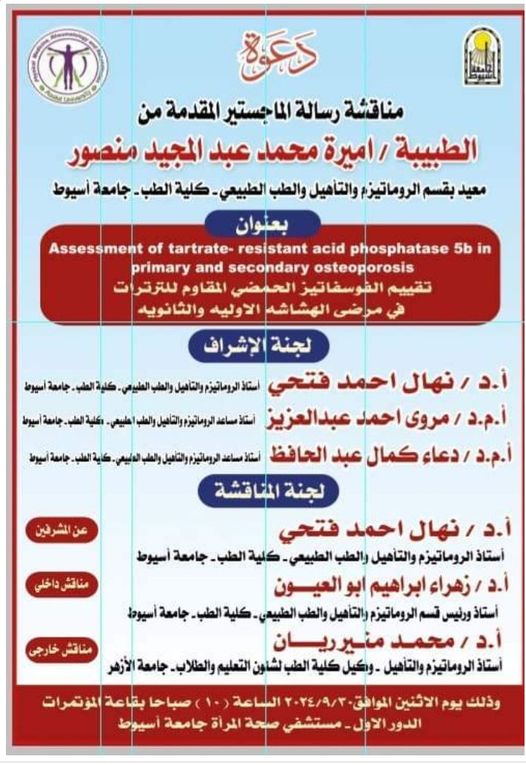
Regarding the dates of postgraduate lectures for the October 2024 session
Introduction Rheumatoid arthritis (RA) is a systemic autoimmune disease presented by inflammatory polyarthritis, affecting predominantly smaller joints such as hands and feet but can also affect large joints. Heat shock protein 70 (HSP70) is released from damaged cells after stress and has been found in the bloodstream of patients with RA. Aim To study the applicability of HSP70 serum levels as a diagnostic factor and a severity indicator in patients with RA Patients and methods The study included 59 patients with RA and 14 controls. Patients were classified according to disease activity score 28 into four groups: 10 patients in remission, 12 patients with low disease activity, 18 patients with moderate disease activity, and 19 patients with high disease activity. HSP70 and anti‑cyclic citrullinated peptide assessments were done by ELISA technique. Results Patients with RA had a higher HSP70 level than the control group (P < 0.001), irrespective of presence or absence of rheumatoid factor or anti‑citrullinated cyclic peptide. Next, diagnostic accuracy of the HSP70 in diagnosis of RA was evaluated (area under curve = 0.91). HSP70 had 89.8% sensitivity and 92.8% specificity in diagnosis of RA. In addition to diagnostic value, HSP70 can distinguish between high disease activity (76.67 ± 16.06 ng/ml) and mild (25.57 ± 7.39 ng/ml), moderate (35.17 ± 8.34 ng/ml), or remission phase (16.90 ± 4.06 ng/ml). Conclusion The study demonstrates an increase in the serum level of HSP70 in patients with RA in comparison with controls.
Background and aims
Hepatocellular carcinoma (HCC) is one of the commonest tumors and considered
the fifth most common malignant neoplasm and a major cause of death. Egypt has
increased incidence of HCC cases, as Egypt has the highest prevalence of hepatitis
C virus (HCV) infection. The aim was to study the epidemiological characteristics of
HCC in Assiut, Egypt.
Patients and methods
A descriptive observational study design was applied for the present study. The
studied population was 400 patients with HCC (288 of them were male and 112
were female) who fulfilled the diagnostic criteria for HCC. Data were analyzed for
exploring the clinical, etiological, radiological, and tumor characteristics of the
studied patients.
Results
The mean age of the patients was 59.85±9.1 years. Most cases (68%) were from
rural areas, 38% of the patients were in agricultural occupation, and 32% of the
patients were accidentally discovered to have HCC .The most frequent symptom
was abdominal pain (15%). HCV antibody was present in 63% of the patients, HBV
infection was recorded in 28%, coinfection was seen in 3%, and no viral infection
was present in 6%. Diabetes mellitus was present in 37% and obesity in 24% of the
patients. Right lobe of the liver was the most frequent affected lobe (61%), and 69%
of the cases had a single lesion.
Conclusion
HCC incidence had been increasing in the past years in Egypt. The high prevalence
of HCV infection in Egypt makes the surveillance strategies important for early
detection of HCC in these patients to provide better curative treatment modalities in
the early stages.
Keywords:
chronic liver disease, hepatitis B virus infection, hepatitis C virus infection, hepatocellular
carcinoma
ABSTRACT
Background and aim: accurate diagnosis of inflammatory bowel disease (IBD) are mandatory steps for a good outcome. Its standard method for assessment is still ileo-colonoscopy; however, many recent reports described the utility of intestinal ultrasound (IUS) and duplex US in evaluating patients with IBD. We aimed to explore the efficacy of IUS and duplex US for the accurate diagnosis and follow-up of patients with IBD.
Methods: The current study was performed for >2 years between September 2018 and September 2020. A total of 60 patients diagnosed with IBD and 51 control subjects who underwent colonoscopy for reasons other than IBD were included. The two groups underwent colonoscopy and IUS with Doppler for the diagnosis and follow-up of patients after 1 year of treatment. Results: The mean age of patients with IBD was 29.23 ± 5.62 years, and 56.7% of them were females. The majority of them presented with abdominal pain, diarrhea, and bleeding per rectum. Patients with IBD had significantly lower hemoglobin, iron, and ferritin levels with higher C-reactive protein and erythrocyte sedimentation rates. The IBD group had significantly higher wall thickness (WT), peak systolic velocity (PSV), and end-diastolic velocity (EDV). After 1 year, the IBD group showed a significant reduction of WT and PSV. The PSV had the best diagnostic performance for the prediction of histological and clinical responses. Conclusion: IUS and duplex US are considered rapid noninvasive tools for the assessment of patients with IBD. Moreover, they can be used to predict histological and clinical responses.
Keywords: Colonoscopy, End-diastolic velocity, Inflammatory bowel disease, Intestinal ultrasound, Peak systolic velocity
Background and aim: Inflammatory Bowel Disease (IBD) and Diabetes mellitus (DM) etiology are still unclear, but
both have genetic basis and share several complications. So we aimed to search for whether the two diseases are
associated with each other and whether there are risk factors that increase the incidence of diabetes mellitus in
inflammatory bowel disease patients.
Methods: This study was conducted on 130 inflammatory bowel disease patients who were diagnosed by
colonoscopy and biopsy from EL-Raghy Assiut University Hospital and were not known to have DM before the study
in the period from October 2019 to June 2021.
These patients underwent a full history, a thorough clinical examination, and routine lab investigation, especially
fasting blood sugar (FBS) and glycosylated hemoglobin (HbA1c).
Results: Out of 130 patients; 26 (20%) were found to be diabetics and the other 104 (80%) were non-diabetics. The
mean age of the studied patients was 32.45 ± 9.05 years, majority (78.5%) of them were males. And we found that
patients with DM were significantly younger than those without DM. The family history of DM was higher among
those patients with DM. The susceptibility of DM is increasing with the lengthening of IBD duration. No significant
difference was present between both groups of patients as regards the type of treatment for IBD.
Conclusion: Diabetes mellitus risk increases in patients with IBD who are younger than 30 years old, have a positive
family history of diabetes mellitus, and have had IBD for more than 3 years.
Key words: Association, Diabetes mellitus, Inflammatory Bowel Disease.
Abstract: Autoimmune hepatitis (AIH) is a chronic inflammatory disorder with complex
immunopathogenesis. Dysbiosis has been linked to many autoimmune diseases, but its detailed role
in autoimmune hepatitis (AIH) still needs rigorous evaluation, especially in Egypt. We aimed to
identify the shift in the gut microbiota profile and resultant metabolic pathways in AIH Egyptian
patients compared to healthy individuals. Stool samples were collected from 15 AIH-naive patients
and from 10 healthy individuals. The V3-V4 hyper-variable regions in16S rRNA gene was amplified
and sequenced using Illumina MiSeq platform. Significantly lower bacterial diversity in AIH patients
was found compared to the controls. A phylum-level analysis showed the overrepresentation of
Firmicutes, Bacteroides, and Proteobacteria. At the genus level, AIH-associated enrichment of
Faecalibacterium, Blautia, Streptococcus, Haemophilus, Bacteroides, Veillonella, Eubacterium, Lachnospiraceae
and Butyricicoccus was reported in contrast to Prevotella, Parabacteroides and Dilaster, which were
significantly retracted in such patients. Overall, the predicted metabolic pathways associated with
dysbiosis in AIH patients could orchestrate the potential pathogenic roles of gut microbiota in
autoimmune disease, though not in a disease-specific manner, calling for future large-scale studies.
Keywords: bioinformatics; microbiome; autoimmune hepatitis