 Do you have any questions?




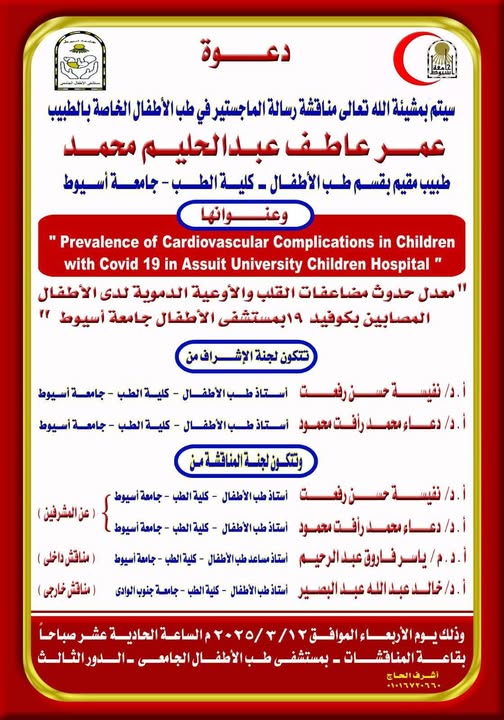
Discussion of the master's thesis in pediatrics submitted by Dr. Omar Atef Abdel Halim Mohamed, resident physician in the Department of Pediatrics, Faculty of Medicine, Assiut University.
Congratulations to Professor Dr. Dalia Galal Mahran, Professor of Public Health, on the occasion of her renewed assignment to supervise the Family Medicine Department.

Congratulations to Professor Dr. Dalia Galal Mahran, Professor of Public Health, on the occasion of her renewed assignment to supervise the Family Medicine Department.
A medical team at the Women's Health Hospital successfully performed three specialized surgeries, using the latest surgical techniques, on a girl and two women suffering from various types of cancer.

استكمالا للانجازات الطبية الفريدة التي تحققها مستشفيات جامعة أسيوط في مجال إجراء العمليات الجراحية الدقيقة، نجح فريق طبي بمستشفى صحة المرأة في إجراء ثلاث عمليات نوعية، باستخدام أحدث التقنيات الجراحية، لفتاة وسيدتين يعانون من أورام سرطانية مختلفة، ليكون هذا النوع من الجراحات أملا جديدا في تحقيق الشفاء التام لتلك السيدات، وتأكيدا على الريادة الطبية لمستشفيات جامعة أسيوط
Discussion of the master's thesis submitted by Dr. Kyrollos Talaat Saadallah, Resident Physician, Department of Orthopedics and Traumatology, Faculty of Medicine, Assiut University.

Discussion of the master's thesis submitted by Dr. Kyrollos Talaat Saadallah, Resident Physician, Department of Orthopedics and Traumatology, Faculty of Medicine, Assiut University.
Immunomodulatory Effect of Rivaroxaban Nanoparticles Alone and in Combination with Sitagliptin on Diabetic Rat Model
Research Abstract
Abstract: Background: Chronic inflammation and immune dysregulation are key drivers of
diabetes complications. Rivaroxaban (RX) and sitagliptin (SITA) are established therapies
for thromboembolism and glycemic control, respectively. This study evaluated the novel
therapeutic potential of nano-rivaroxaban (NRX) alone and in combination with sitagliptin
(SITA) in mitigating inflammation and restoring immune balance in streptozotocin (STZ)-
induced diabetic rats. Methods: Type 2 diabetes was induced in rats using a single injection
of STZ (60 mg/kg). Animals were divided into five groups: control, STZ-diabetic, RXtreated
(5 mg/kg), NRX-treated (5 mg/kg), and NRX+SITA-treated (5 mg/kg + 10 mg/kg).
After 4 weeks of treatment, blood glucose, coagulation markers, pro-inflammatory cytokines
(TNF-α, IL-1β, IL-6), and anti-inflammatory cytokines (IL-35, TGF-β1, IL-10) were
analyzed. Histopathological examination of the liver, kidney, pancreas, and spleen was
conducted. Immunohistochemistry was used to assess hepatic NF-κB expression. Results:
STZ significantly elevated pro-inflammatory cytokines (IL-1β, TNF-α, IL-6) and
anti-inflammatory cytokines (IL-35, TGF-β1, IL-10), along with increased hepatic NF-κB expression
and histopathological abnormalities in immune organs. NRX significantly reduced
inflammatory cytokines, improved histopathological changes in organs, and decreased
hepatic NF-κB expression. The combination therapy (NRX + SITA) achieved superior
immune modulation, with enhanced cytokine profile restoration, reduced hepatic NF-κB
expression, and near-complete histopathological normalization. Conclusions: This study
underscores the promise of combining nanoparticle-based drug delivery with established
therapies like sitagliptin to achieve superior immune modulation and inflammation control,
presenting a potential therapeutic strategy for managing diabetes complications.
Research Date
Research Department
Research Journal
diseases
Research Member
Research Pages
1-22
Research Publisher
MDPI
Research Rank
Q1
Research Vol
13
Research Website
. https://doi.org/10.3390/ diseases13030087
Research Year
2025
Genito-urinary reconstruction in female children with congenital adrenal hyperplasia: Favorable surgical outcomes can be achieved by contemporary techniques and a dedicated …
Research Abstract
Introduction
Congenital adrenal hyperplasia (CAH) is the most common cause of genital atypia in females. A dedicated multidisciplinary team (MDT) should be included for an optimal management. Here, we aimed to review our surgical experience and to assess long-term urinary, gynecological and endocrine outcomes after primary genitoplasty in this specific cohort.
Methods
Patients born with CAH and who underwent feminizing genitoplasty in our institution were retrospectively identified (2001–2021). We analyzed patients’ characteristics, intraoperative details, and postoperative urinary, gynecological, and endocrine outcomes.
Results
Forty patients were included and followed-up for a median (IQR) time of 7 (1–19) years. Thirty-eight (95%) had 21-hydroxylase deficiency. After multidisciplinary decision and written consent from patient and/or family, a single-stage reconstructive surgery was performed at a median …
Research Date
Research Department
Research Journal
Journal of Pediatric Surgery
Research Member
Research Pages
1851-1858
Research Publisher
WB Saunders
Research Vol
59
Research Website
https://www.sciencedirect.com/science/article/pii/S0022346824003105
Research Year
2024
Dexmedetomidine versus Propofol or midazolam in patients with abdominal sepsis regarding inflammatory response and capillary leak .
Research Date
Research Department
Research Member
Research Year
2022
Vitamin D level and its association with disease activity in Egyptian Rheumatoid Arthritis patients.
Research Abstract
Background: Rheumatoid arthritis (RA), a chronic inflammatory disease, affects around one percent of people.
Aim and objectives: To compare vitamin D concentration in serum in normal individuals & RA cases, evaluate the connection among vitamin D concentration & disease activity and follow up on the effect of vitamin D supplementation on disease activity.
Patients and methods: This case control research has been performed on 130 cases, separated into two groups: Group I involved 65 RA patients and Group II involved 65 healthy subjects at an internal medicine outpatient clinic who were admitted to the department in the rheumatology unit from August 2022–August 2023.
Results: Cases with RA showed a significantly less concentration of vitamin D compared with the control group (17.98 ± 3.45 vs. 38.09 ± 12.09 ng/ml; p< 0.001). Most (53.8%) of the RA group had an insufficient level of vitamin D, while 10 (15.4%) patients had a sufficient level and the other 20 (30.8%) patients had a deficient level. Cases with remission had a significantly greater level of vitamin D in comparison with cases with low or moderate DAS-28 (25.08 ± 4.44 vs. 14.81 ± 2.45 ng/ml; p< 0.001) & cases with high DAS-28 (25.08 ± 4.44 vs. 7.80 ± 1.09 ng/ml; p< 0.001).
Conclusion: Deficiency of vitamin D is widespread among RA cases, with disease severity inversely proportional to 25-OHD levels. In cases of vitamin D deficiencies, vitamin D supplementation appeared to enhance disease activity.
Background: Rheumatoid arthritis (RA), a chronic inflammatory disease, affects around one percent of people.
Aim and objectives: To compare vitamin D concentration in serum in normal individuals & RA cases, evaluate the connection among vitamin D concentration & disease activity and follow up on the effect of vitamin D supplementation on disease activity.
Patients and methods: This case control research has been performed on 130 cases, separated into two groups: Group I involved 65 RA patients and Group II involved 65 healthy subjects at an internal medicine outpatient clinic who were admitted to the department in the rheumatology unit from August 2022–August 2023.
Results: Cases with RA showed a significantly less concentration of vitamin D compared with the control group (17.98 ± 3.45 vs. 38.09 ± 12.09 ng/ml; p< 0.001). Most (53.8%) of the RA group had an insufficient level of vitamin D, while 10 (15.4%) patients had a sufficient level and the other 20 (30.8%) patients had a deficient level. Cases with remission had a significantly greater level of vitamin D in comparison with cases with low or moderate DAS-28 (25.08 ± 4.44 vs. 14.81 ± 2.45 ng/ml; p< 0.001) & cases with high DAS-28 (25.08 ± 4.44 vs. 7.80 ± 1.09 ng/ml; p< 0.001).
Conclusion: Deficiency of vitamin D is widespread among RA cases, with disease severity inversely proportional to 25-OHD levels. In cases of vitamin D deficiencies, vitamin D supplementation appeared to enhance disease activity.
Research Date
Research Department
Research Journal
journal of current medical research and practice
Research Member
Research Year
2024
Serum and urine monocyte chemoattractant protein-1 as a markers for lupus nephritis.
- Read more about Serum and urine monocyte chemoattractant protein-1 as a markers for lupus nephritis.
Research Abstract
Lupus nephritis (LN) is a common major organ manifestation and main cause of morbidity and mortality of the disease. We aimed to determine the level of serum and urinary monocyte chemoattractant protein1(sMCP-1 and uMCP-1) in systemic lupus erythematosus (SLE) patients with and without LN and analyze their association with different clinical and serologic parameters of disease activity. We enrolled 60 female patients with SLE (32 with LN and 28 without LN) and 20 controls.MCP-1 and anti-dsDNA were measured by ELISA. There was statistically significant increase in serum and urinary MCP-1 in all SLE patients (mean=711.59, 676.68 pg/ml respectively) as compared to the control group (mean= 635.70, 632.40 pg/ml respectively), P=0.034, 0.020 respectively. Among patients with LN there was statistically significant increase in sMCP-1 (mean=723.58) compared to the control group (P=0.038, and in uMCP-1 (mean=699.08) compared to patients without LN (mean=651.07) and control group (mean=632.40), P=0.007, 0.002 respectively. Urinary, but not serum MCP-1, positively correlated with 24 hour proteinuria, anti-dsDNA, renal SLEDAI ,biopsy activity index (r=0.362, P=0.004; r=0.303, P=0.019; r= 0.267, P=0.039; r=0.353, P=0.047 respectively) and negatively correlated with serum albumin (r=-0.329, P=0.010).There was statistically significant increase in uMCP-1 and anti-dsDNA in patients with poor response compared to patients with good response to immunosuppressant therapy (P= 0.025; P=0.034 respectively). In conclusion, uMCP-1 is associated with LN and disease activity and may be used as a useful tool for diagnosis and follow up
Research Date
Research Department
Research File
11-Rasha Madkour.pdf
(559.18 KB)
Research Journal
Egypt J Immunol
Research Member
Research Pages
97-107
Research Vol
27
Research Year
2020