 Do you have any questions?

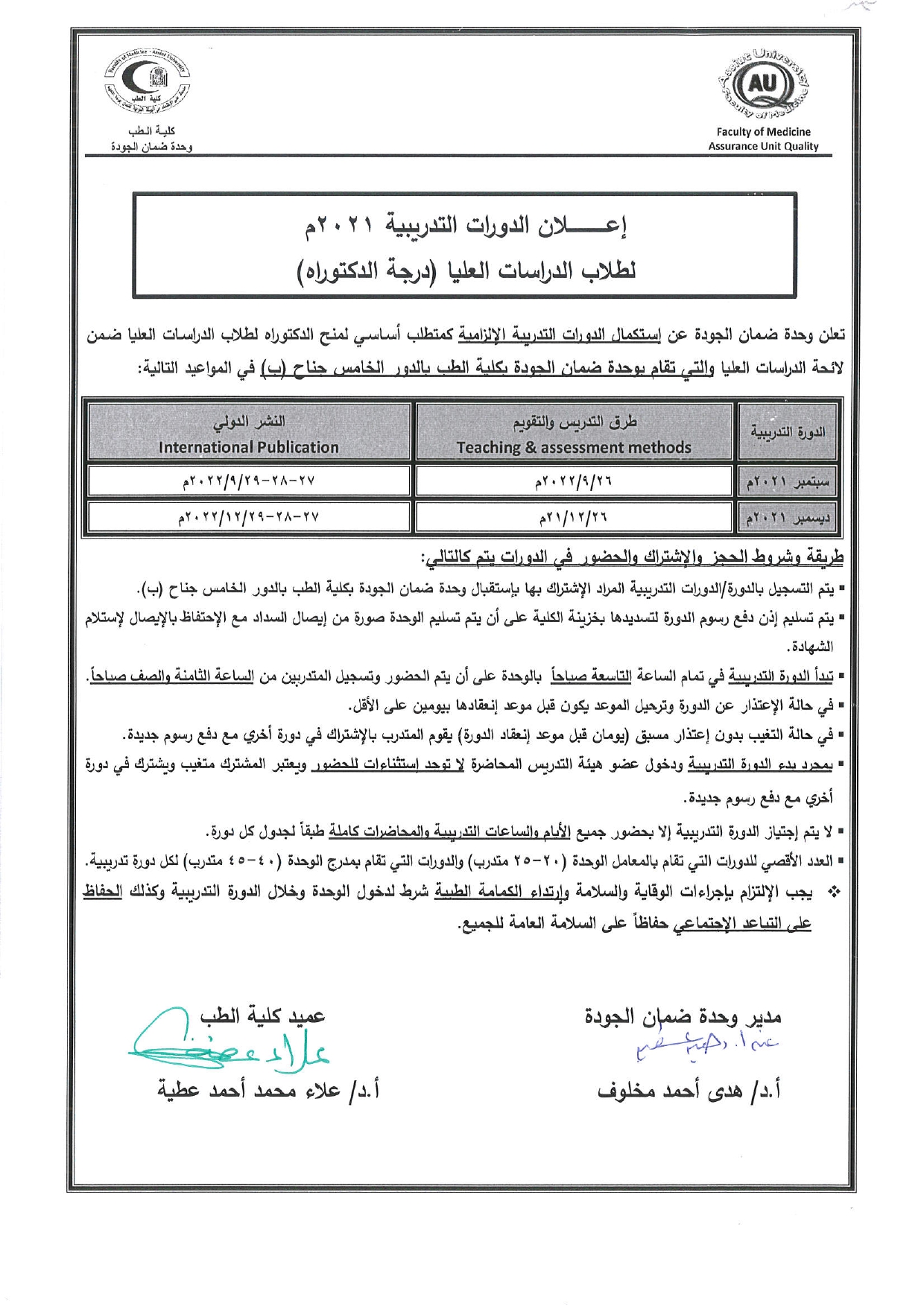
Announcement of Postgraduate Training Courses - Ph.D. - Quality Assurance Unit
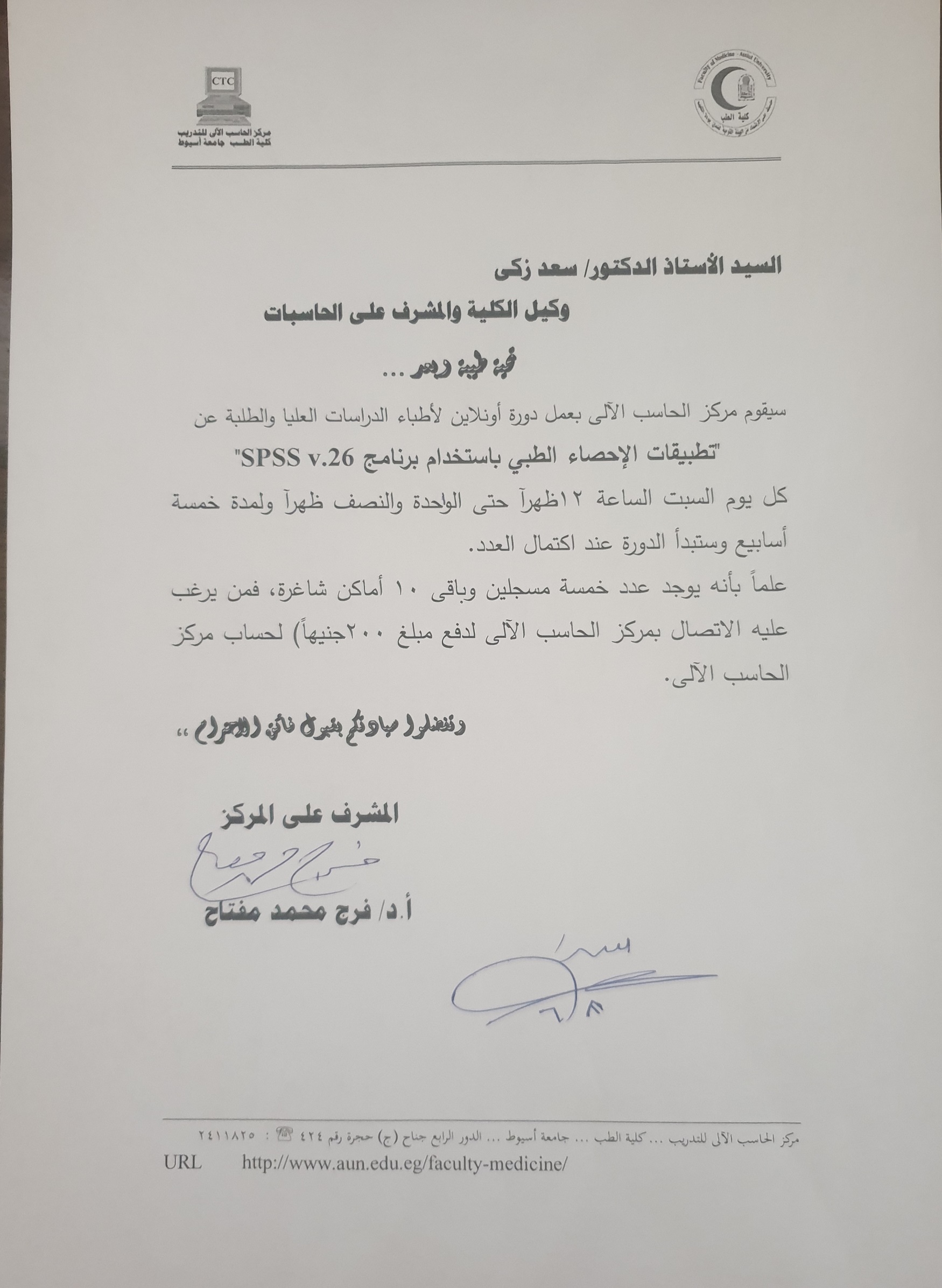
Training Course - Computer - SPSS
Celebration of infection control department in university hospitals.
The inauguration ceremony of the Union, the conclusion of activities, and honoring the first batches and distinguished students in student activities and scientific research
تحت رعاية
الاستاذ الدكتور/ طارق الجمال - رئيس الجامعة
الأستاذ الدكتور/ شحاته غريب - نائب رئيس الجامعة لشئون التعليم و الطلاب
وبحضور
الاستاذ الدكتور / علاء عطيه - عميد الكلية ورئيس مجلس إدارة المستشفيات الجامعية
الاستاذة الدكتورة/ أماني عمر - وكيل الكلية لشئون التعليم و الطلاب
الاستاذ الدكتور / يوسف صالح وكيل الكلية لشئون الدراسات العليا والبحوث
الاستاذة الدكتورة/هدي مخلوف مدير وحدة ضمان الجودة بكلية الطب
الاستاذة الدكتورة/هبة عطية نائب مدير وحدة ضمان الجودة بالكلية
حفل
تنصيب الاتحاد وختام الانشطة
وتكريم أوائل الدفعات و المتميزين في الانشطة
الطلابية والبحث العلمي
بقاعة المؤتمرات بمجمع مدرجات كلية الطب
أكد ا. د/علاء عطية - عميد الكلية على اهمية الأنشطة الطلابية حيث تعمل على توطيد الروابط الإنسانية وتوثيقها بين الطلاب وأعضاء هيئة التدريس ودمج الطلاب مع المجتمع سواء داخل الجامعة أو خارجها.
وتساهم فى بناء شخصية الطالب و تنمية روح الريادة و الابداع واكتساب العديد من المهارات وصقل خبراته فى شتى المجالات العلمية و الثقافية و الرياضية، وتغرس روح الانتماء للأسرة، والجامعة والوطن. فضلا عن المساهمة في الترفيه عن الطلاب فى فترة الدراسة .
لذلك تحرص إدارة الكلية علي تسخير كافة سبل الدعم والرعاية لتنظيم وإقامة العديد من الفعاليات داخل الكلية ، مثل النشاط الفني للطلاب والأنشطة الاجتماعية والثقافية والعلمية .
وتمتلك كلية الطب كوادر طلابية متميزه لها دور واعد و قيادى فى مختلف الأنشطة الطلابية ، حصدت من خلالها العديد من المراكز المتقدمة في كافة المحافل و المسابقات على مستوى الجامعة و الجامعات المصرية.
وعبر عن فخره بطلاب الكلية وحرصهم علي المشاركة في العديد من الأنشطة الطلابية على مستوى الجامعة وبزيادة وعيهم الثقافي والفكري والتنويري مما يساعد في عملية بناء إنسان سوي قادر علي اتخاذ القرار من أجل تخريج جيل واعد قادر علي تحمل المسئولية والانخراط في سوق العمل.
وقام بشكر كافة المشاركين في الأنشطة الطلابية بدأ من اشراف الأستاذة الدكتورة الفاضلة وكيل الكلية لشئون التعليم والطلاب/ امانى عمر واتحاد طلاب الكلية وبالسادة الموظفين بإدارة رعاية الشباب.
رحبت ا. د/اماني عمر بالسادة أعضاء هيئة التدريس والسادة الحضور والقت التحية لكل اب وام كانوا عوناً لابنائهم مشجعين لهم في الانشطة الطلابية بجانب الدراسة مما افرز خريج متميز علمياً ورياضيا وفنيا؛ واشادت بالطلاب وتفوقهم ومواهبهم في شتي المجالات التي شرفتنا علي مسنوي اسيوط والجمهورية و دوليا بمشاركة بعض الطلاب نشر ابحاث لهم في مجلات دوليا وناشدت الطلاب باحترام الاستاذ الاكبر منه والرفق بالاصغر منه وان يتقوا الله فى عملهم وتمنت للجميع دوام التوفيق.
شكر الطالب /اسلام حسين رئيس اتحاد الطلاب ادارة الكلية وحرصهم علي التواجد في هذا اليوم حيث يكلل فيه حصاد عام دراسي كامل؛ وشكر مجهوداتهم ومجهود زملائه خلاله.
وان اتحاد كلية الطب من افضل الاتحادات على مستوى جامعة اسيوط هذا العام.
وشكر الامناء وامناء مساعدين اللجان واعضاء الاتحاد علي عملهم وتمني ان يكونوا نجحوا في حمل امانة الاتحاد علي الوجه الاكمل.
وقدم الطلاب بعض الفقرات الشعرية
الطبيب/ محمود سعد
الطالب/ احمد مختار
الطالبة/ زينب احمد
وتم تكريم الطلاب اوائل الدفعا
The role of preoperative venography in predicting the difficulty of a transvenous lead extraction procedure
Research Date
Research Department
Research Journal
Journal of Cardiovascular Electrophysiology
Research Member
Research Year
2022
Atrial appendage closure in patients with heart failure and atrial fibrillation: industry‐independent single‐centre study
Research Date
Research Department
Research Journal
ESC heart failure
Research Member
Research Year
2022
Association of Epicardial Fat with Diastolic and Vascular Functions in Children with Type 1 Diabetes
Research Abstract
We aimed to examine the relationship between epicardial fat thickness (EFT) measured by echocardiography and cardiovascular functional parameters in children with type 1 diabetes mellitus (T1DM). The study included 50 type 1 diabetic children and 50 healthy subjects matched by sex, age, and body mass index. In addition to laboratory tests, all participants underwent transthoracic echocardiography for EFT, cardiac dimensions and left ventricular functions, and ultrasonographic examination for brachial artery fow-mediated dilation (FMD) response and carotid intima-media thickness (CIMT). Multivariate linear regression was used to analyze the relationship between EFT and CIMT, FMD, lateral mitral E' velocity, and mitral E/E' ratio. EFT was signifcantly increased in diabetic children compared with controls (P<0.001). In comparison with controls diabetic children had signifcantly increased mitral A, decreased lateral mitral E', decreased mitral E/A ratio, decreased lateral mitral E'/A' ratio, and increased mitral E/E' ratio (P<0.001). FMD response was signifcantly lower in diabetic group versus controls (P<0.001) and CIMT was signifcantly increased in diabetics versus controls (P=0.03). EFT was negatively correlated with lateral mitral E' velocity (r= −0.613, P<0.001), positively correlated with mitral E/E' ratio (r=0.60, P<0.001), positively correlated with CIMT (r=0.881, P<0.001), and negatively correlated with FMD (r= −0.533, P<0.001). By multivariate regression analysis, the EFT was independently and positively associated with CIMT mean and E/E' mean and negatively associated with FMD mean and E' mean. The cut-of point for EFT as predictor of endothelial dysfunction was 6.95 mm. Our fndings suggest that children with T1DM have subclinical LV diastolic and vascular endothelial dysfunctions associated with increased EFT.
Research Date
Research Department
Research Journal
Pediatric Cardiology
Research Member
Research Pages
1-12
Research Publisher
Springer US
Research Rank
1
Research Vol
10
Research Year
2022
Midkine: Utility as a Predictor of Early Diabetic Nephropathy in Children with Type 1 Diabetes Mellitus
Research Abstract
This study aimed to assess the role of serum midkine (MK) as a biomarker for early detection of diabetic nephropathy in children with type 1 diabetes mellitus (T1DM) before microalbuminuria emerges.
Methods:
A total of 120 children with T1DM, comprising 60 microalbuminuric patients (Group 1), 60 normoalbuminuric patients (Group 2), and 60 healthy participants as a control group (Group 3) were included. Detailed medical history, clinical examination, and laboratory assessment of high-sensitivity C-reactive protein (hs-CRP), hemoglobin A1c percentage (HbA1c%), lipid profile, urinary albumin to creatinine ratio (ACR), serum MK and estimated glomerular filtration rate based on serum creatinine were performed in all participants.
Results:
Both Group 1 and Group 2 had significantly higher serum MK compared to controls (p< 0.001). Additionally, significantly higher MK concentrations were present in Group …
Research Department
Research Member
Endocrinal dysfunction in children with Down syndrome
Research Abstract
Down syndrome (DS) is the most common genetic disorder in live-born infants. Children with DS are at increased risk of numerous endocrinal comorbidities. The information contained in this article will provide pediatricians with a narrative overview of different presentations, diagnoses, and management recommendations of various endocrinal disorders in children with DS. We systematically searched PubMed, Embase, Google Scholar, MEDLINE, EBSCO, and Science Direct, and potentially relevant articles were identified and retrieved from electronic and print journals.
Research Department
Research Member