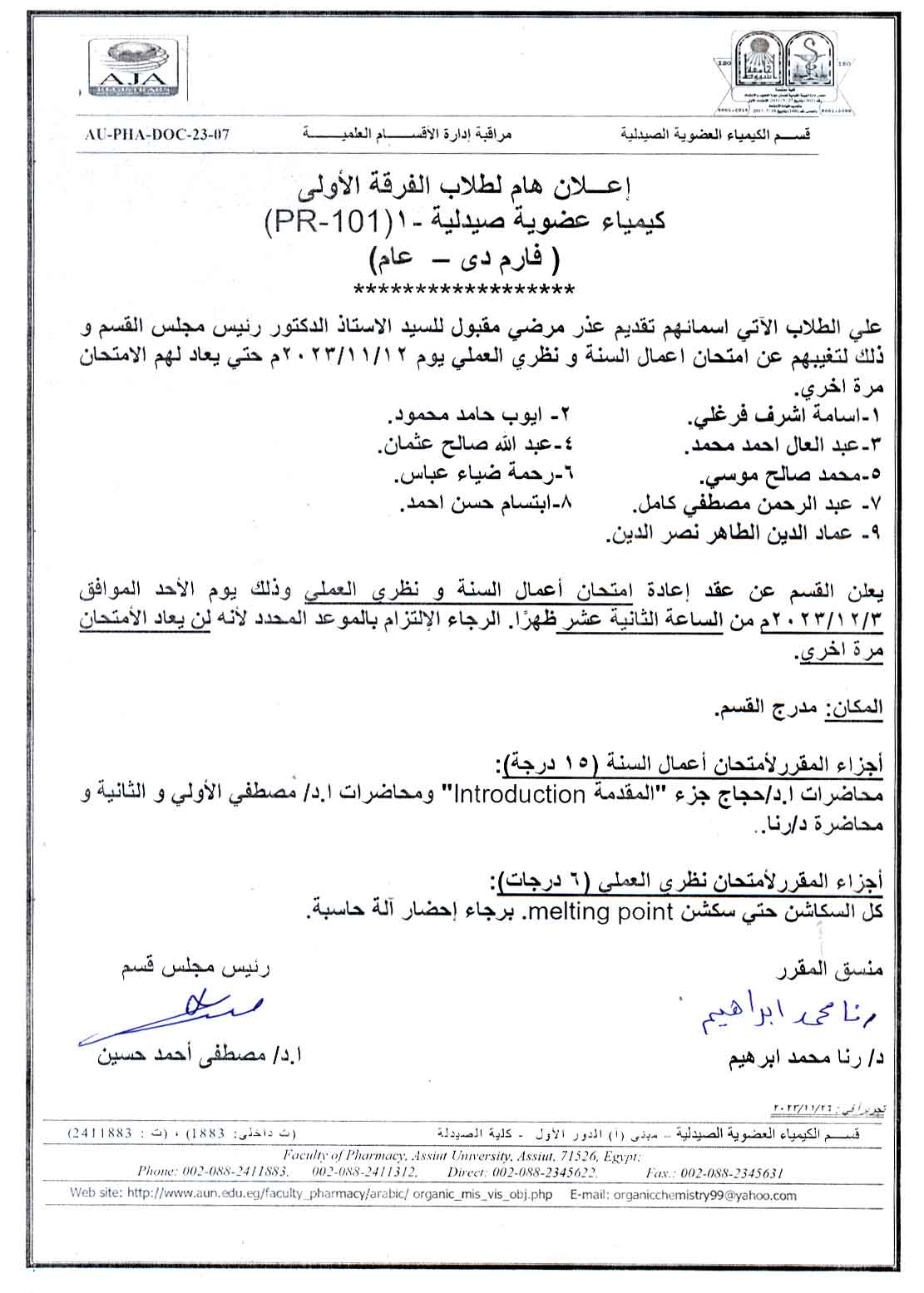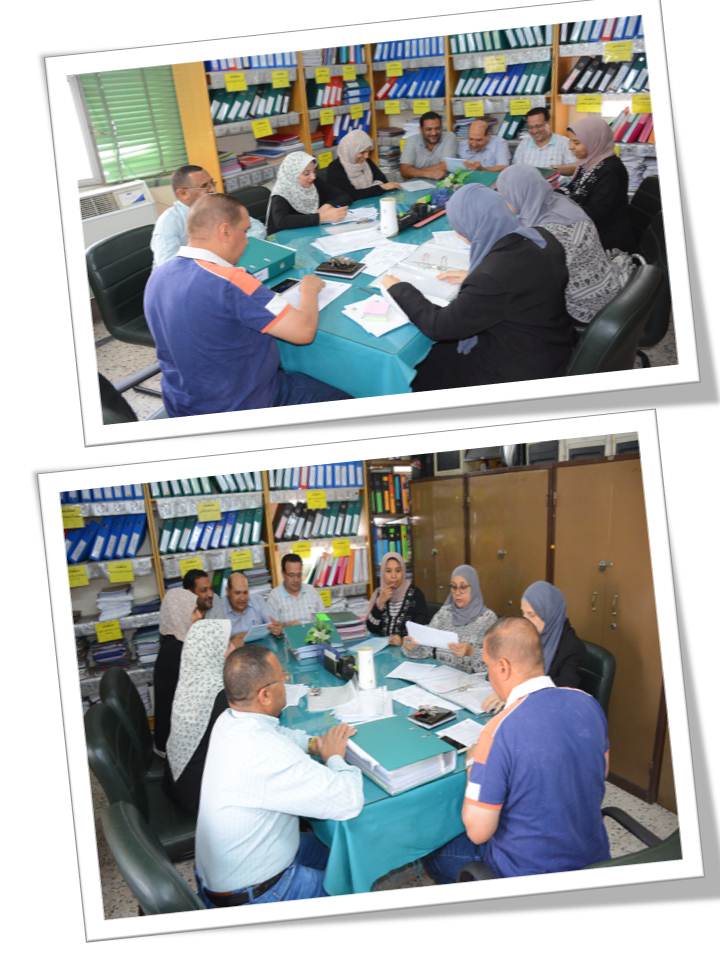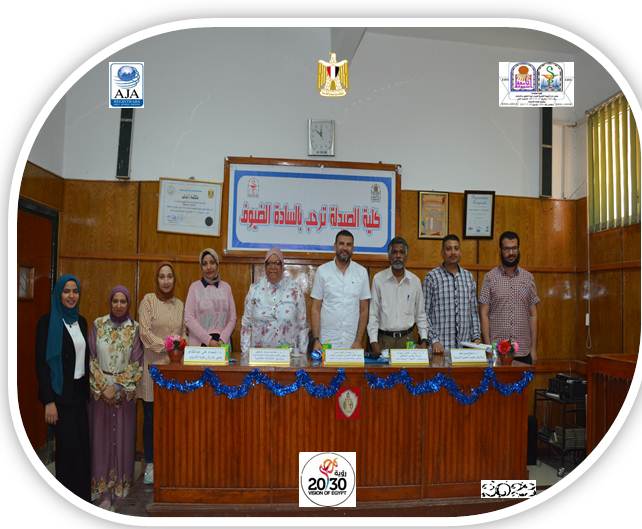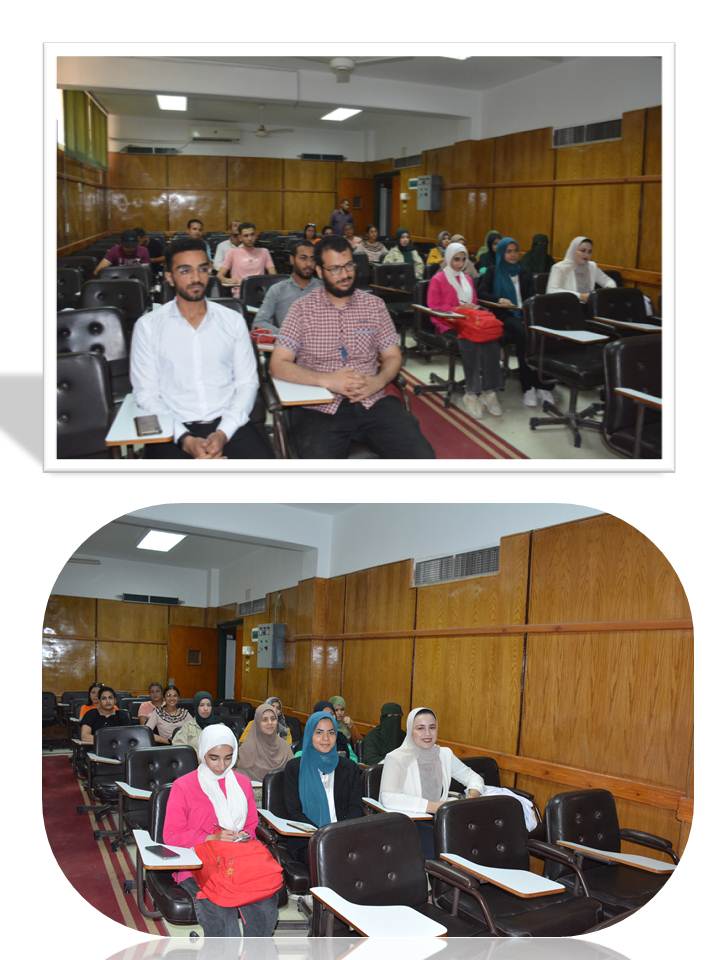

Meeting of the Council of the Pharmaceutical Organic Chemistry Department, Faculty of Pharmacy on Wednesday, September 6, 2023

God willing, the Pharmaceutical Organic Chemistry Department Council will hold its regular monthly meeting number (465) On Wednesday, September 6, 2023 at 11:00 in the morning

In the department council meeting room.

news category
خبر عام

Meeting of the Council of the Clinical Pharmacy Department, Faculty of Pharmacy on Tuesday, September 5, 2023

God willing, the Clinical Pharmacy Department Council will hold its regular monthly meeting number (93) on Tuesday, September 5, 2023, at twelve noonin

the meetings Hall of the Department - 5th floor (Building A)

In the department council meeting room

news category
خبر عام

Electrospun vancomycin-loaded nanofibers for management of methicillin-resistant Staphylococcus aureus-induced skin infections

Research Abstract

Skin damage exposes the underlying layers to bacterial invasion, leading to skin and soft tissue infections. Several pathogens have developed resistance against conventional topical antimicrobial treatments and rendered them less effective. Recently, several nanomedical strategies have emerged as a potential approach to improve therapeutic outcomes of treating bacterial skin infections. In the current study, nanofibers were utilized for topical delivery of the antimicrobial drug vancomycin and evaluated as a promising tool for treatment of topical skin infections. Vancomycin-loaded nanofibers were prepared via electrospinning technique, and vancomycin-loaded nanofibers of the optimal composition exhibited nanosized uniform smooth fibers (ca. 200 nm diameter), high drug entrapment efficiency and sustained drug release patterns over 48 h. In vitro cytotoxicity assays, using several cell lines, revealed the biocompatibility of the drug-loaded nanofibers. In vitro antibacterial studies showed sustained antibacterial activity of the vancomycin-loaded nanofibers against methicillin-resistant Staphylococcus aureus (MRSA), in comparison to the free drug. The nanofibers were then tested in animal model of superficial MRSA skin infection and demonstrated a superior antibacterial efficiency, as compared to animals treated with the free vancomycin solution. Hence, nanofibers might provide an efficient nanodevice to overcome MRSA-induced skin infections and a promising topical delivery vehicle for antimicrobial drugs.

Research Authors
Heba A Fathi, Ayat Abdelkader, Mahmoud S AbdelKarim, Ayman A Abdelaziz, Mohamed A El-Mokhtar, Ayat Allam, Gihan Fetih, Mahmoud El Badry, Mahmoud Elsabahy
Research Date
Research Department
Research Journal
International Journal of Pharmaceutics
Research Member
Research Publisher
Elsevier
Research Vol
586
Research Year
2020

Ketorolac tromethamine loaded nanoparticles for ocular delivery: formulation, in-vitro and ex-vivo evaluation

Research Abstract

The objective of the current study was preparation of ketorolac tromethamine (KT) loaded nanoparticles (NPs) based on two polymers (Eudragit RL 100 and Gelatin) for ocular applications providing a controlled drug release to improve KT bioavailability. Nanoprecipitation technique was used to prepare eudragit RL 100 NPs while gelatin NPs were prepared using two-step desolvation technique. The formulations were evaluated in terms of particle size, zeta potential, polydispersibity index (PDI) and physicochemical characterizations (DSC, FTIR, X-ray diffraction). Drug entrapment, in-vitro release, ex-vivo permeation, histological examination and stability at different conditions were also examined. The optimized parameters have been determined and were suitable for possible ocular application. NPs showed sustained drug release in-vitro and higher permeation as compared to that of Acular® solution. These preliminary results indicated that KT loaded NPs are effective in sustaining drug release and could be used for improving ocular delivery of KT.

Research Authors
Raafat Elsayed Osman, Gihan Fetih, Fawzia Habib
Research Date
Research Journal
Bulletin of Pharmaceutical Sciences. Assiut
Research Member
Research Publisher
Assiut University, Faculty of Pharmacy
Research Vol
43
Research Year
2020

DEVELOPMENT AND OPTIMIZATION OF ALBENDAZOLE NANOSUSPENSION AS LOCAL ADJUVANT THERAPY FOR TREATMENT OF ENTEROBIASIS

Research Abstract

The aim was to develop an optimized albendazole (ALB) nanosuspension to improve its solubility and therapeutic activity as an adjuvant localized therapy for treatment of the pinworm infection to enhance oral treatment outcomes using Box–Behnken design. ALB-nanosuspensions were successfully prepared by antisolvent sono-precipitation technique considering amount of Lecithin, PVP and ultrasonication time as independent variables. All the formulations were characterized regarding their particle size and PDI (dependent variables). Nanoparticle size was significantly increased by increasing lecithin and PVP concentrations while sonication time showed no influence. PDI of the nanosuspension was insignificantly decreased with increasing lecithin concentration and probe-sonication time. Optimum formulation was identified and subjected to solid phase characterization and morphological studies. ALB nanosuspension showed 10 folds increase in solubility over pure albendazole powder. Eventually, we studied the anthelmintic activity of ALB nanosuspension compared to free ALB where nanosuspension treated group showed lesser paralysis and death time than free ALB.

Research Authors
Aml I Mekkawy, Gihan Fetih, Mahmoud EL-Badry, Ayat Allam
Research Date
Research Journal
Bulletin of Pharmaceutical Sciences. Assiut
Research Member
Research Publisher
Assiut University, Faculty of Pharmacy
Research Vol
43
Research Year
2020

Development and characterization of nanostructured lipid carriers for transdermal delivery of meloxicam

Research Abstract

For transdermal delivery of meloxicam, nanostructured lipid carriers containing compritol as solid lipid, oleic acid as liquid lipid and different ratios of Pluronic F-68 were prepared. The prepared nanoparticles were characterized in terms of size, polydispersity index, zeta-potential and encapsulation efficiency. The average particle size, zeta-potential and encapsulation efficiency ranged from 134 to 491 nm, from -12.4 to -23.23 mV and from 35 to 70%, respectively. Furthermore, in vitro release for a number of selected formulations was performed using dialysis membrane in phosphate buffer saline. Drug release from free solution compared to release from nanostructured lipid carriers over a period of 48 hours was evaluated as well as release kinetic analysis was investigated. Moreover, stability of the selected formulation was studied at different time intervals. In addition, meloxicam-loaded nanostructured lipid carriers gel containing Carbopol-934 as a gelling agent was prepared. Moreover, anti-inflammatory activity of the prepared gel was evaluated using carrageenan-induced rat paw edema method. Meloxicamloaded nanostructured lipid carriers gel showed a more sustained inhibitory effect compared to free meloxicam gel. Finally, toxicity of the prepared meloxicam-loaded nanostructured lipid carriers gel was evaluated using histopathological examination.

Research Authors
Radwa Radwan, Mahmoud El-Badry, Gihan Fetih, Ayat Allam, Mahmoud Elsabahy
Research Date
Research Journal
Bulletin of Pharmaceutical Sciences. Assiut
Research Member
Research Publisher
Assiut University, Faculty of Pharmacy
Research Vol
42
Research Year
2019

PERFORMANCE OF QUERCETIN-CHITOSAN GELS AS TOPICAL DELIVERY SYSTEMS

Research Abstract

This study was designed to evaluate suitability of chitosan polymer as a vehicle for topical delivery system. Quercetin (QUT) is a natural flavonoid, was incorporated into the gel vehicles in a concentration of 0.5% w/v. Gels were prepared with three different concentrations and different molecular weights of chitosan. Viscosity, drug release from prepared gels, permeation of drug through skin rat and anti-inflammatory activity of the drug using carrageenan induced rat paw edema method were studied. In-vitro release characteristics of the drug from different gels were carried out using dialysis membrane in phosphate buffer, pH 5.5. The release data were treated with various kinetic principles to assess the relevant parameters. The general rank order of QUT release was F1 > F4 > F2 > F3 > F5. The results also showed that, the release of drug from the prepared gels obeyed the diffusion model (Higuchi’s equation). The results revealed an inverse correlation between the drug release percent and the polymer concentration used. The permeation of drug through skin rat was carried out. The flux of drug is independent on the viscosity of the formulae. The results also showed a significant anti-inflammatory activity on rat paw edema.

Research Authors
Nermin ELeraky, Gihan Fetih, Mahmoud El-Badry
Research Date
Research Department
Research Journal
Bulletin of Pharmaceutical Sciences. Assiut
Research Member
Research Publisher
Assiut University, Faculty of Pharmacy
Research Vol
42
Research Year
2019

PERFORMANCE OF CURCUMIN IN NANOSIZED CARRIERS NIOSOMES AND ETHOSOMES AS POTENTIAL ANTIINFLAMMATORY DELIVERY SYSTEM FOR TOPICAL APPLICATION

Research Abstract

Curcumin (CUR) is one of the most commonly used herbal product; it shows effective antiinflammatory
and anti-oxidant effects. However, poor aqueous solubility and low permeability
are the major challenges in therapeutic application of curcumin. One class of vesicular
nanocarriers called “Niosome and ethosome” which have proved to possess distinct advantages
were used to encapsulate curcumin and evaluated for their morphology, particle size, zeta
potential, entrapment efficiency (EE%) and drug release. They were incorporated into hydroxy
propyl methyl cellulose (HPMC15000) gel then, evaluated on the rat skin via inhibition of
carrageenan induced rat paw edema. The results showed that the particle size of curcumin
loaded niosomes and ethosomes were ranged (317.5±1.91 to 558.3±8.587 nm) and (182.1±5.3 to
354.5±30.03 nm), respectively. Skin permeation studies demonstrated that CUR permeability
coefficient through rat kin for gel formulations of loaded vesicles was ~ four times higher as
compared to free CUR. The in-vivo anti-inflammatory studies proved that gel formulations of
CUR vesicles possessed higher significant inhibition of carrageenan induced rat paw edema
when compared to pure curcumin. Accordingly, the results revealed that, curcumin loaded
nanovesicels held great potential approaches as anti-inflammatory in topical application.

Research Authors
Mona M. El-Mahdy, Abeer S. Hassan , Mahmoud El-Badry, and Gamal El-Din A. El-GiBull. Pharm. Sci., Assiut University, Vol. 43, Issue 1, 2020, pp. 105-122.ndy,
Research Date
Research Department
Research Journal
Bull. Pharm. Sci., Assiut University, Vol. 43, Issue 1, 2020, pp. 105-122.
Subscribe to