




اضغط للدخول إلى النتيجة لائحة 2018
Do you have any questions? (088) 2080369 - 2345622 Pharmacy_QAAU@pharm.aun.edu.eg

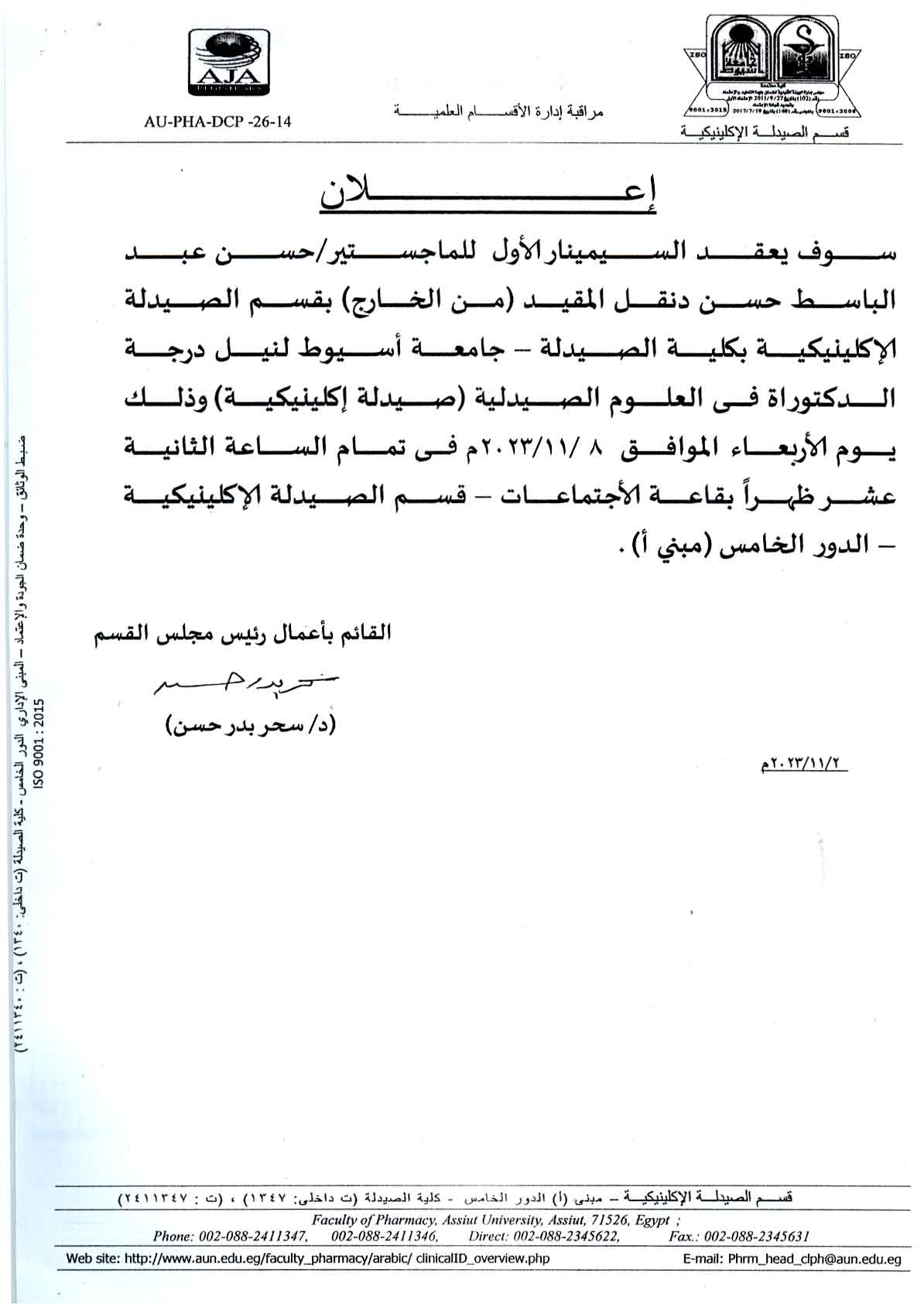
God willing, the Clinical Pharmacy Department Council will hold its regular monthly meeting number (92) on Thursday, August 3, 2023, at twelve o'clock (noon).
in the meetings Hall of the Department - 5th floor (Building A)
In the department council meeting room
Malignant transformations are dependent on an aberrant increase in tubulin and microtubule activities for cancer cell growth, migration, invasion and metastasis. The present work includes design and synthesis of a new series of lipidated 1,3-diaryl propenones and their cyclized pyrimidine derivatives as tubulin polymerization inhibitors. These derivatives harness lipophilicity, ease of synthesis and antiproliferative activity of lipidated 1,3-diaryl propenones and their cyclized derivatives. New compounds were synthesized from 4′-hydroxyacetophenone via O-alkylation, condensation with different aromatic aldehydes followed by cyclization with urea, thiourea or guanidine. Cyclization of 1,3-diaryl propenones into 4,6-diaryl pyrimidines increased their antiproliferative activity with the most potent derivative 19 achieving IC50 values at low micro molar concentration against two human cancer cell lines; MCF-7 (breast cancer) and Hep-G (hepatic cancer)
A new series of substituted aryl carboximidamide VIa-o was designed and synthesised. IR, 1H NMR, 13C NMR as well as elemental microanalysis were used to confirm the structures of the new compounds. The antiproliferative effect of the news compounds against four cancer cell lines was investigated. Compounds VIc, VIg, VIj, VIk, VIm, and VIo were the most potent ones with GI50 ranging from 34 to 48 nM, compared with erlotinib (GI50 of 33 nM). The utmost potent compounds were further examined for their efficacy as EGFR inhibitors, and the results showed that the tested compounds inhibited EGFR with IC50 ranging from 83 nM to 112 nM when compared to the reference erlotinib (IC50 = 80 nM). Moreover, the six most potent compounds had promising VEGFR-2 inhibitory activity, with IC50 ranging from 1.8 nM to 11.4 nM compared with sorafenib, (IC50 = 0.17 nM).