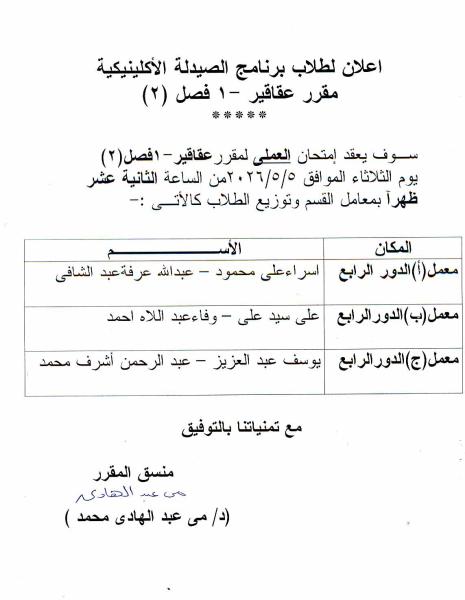


The department announces the holding of a scientific seminar to present the research project results of Excellence Program students – First Round for the academic year 2025/2026.

قسم الكيمياء العضوية الصيدليةعن عقد حلقة علمية لعرض نتائج المشروع البحثي لطلاب الامتياز – الدورة الأولى للعام الجامعى 2025/2026

The seminar will be held on Thursday, November 13, 2025, at 10:00 a.m. in the department’s lecture hall, covering the research projects conducted during the period from October 5, 2025, to November 13, 2025.

God is the Grantor of success.

news category
قسم الكيمياء العضوية

A novel nanoparticle glutathione and Lepidium sativum treatment for gentamicin-induced acute renal failure in rats

Research Abstract

Acute renal failure (ARF) is a sudden, significant, and often reversible decline in kidney function, with 25% of all hospital-administered pharmaceuticals potentially causing nephrotoxicity. The study investigates the effectiveness of a novel nanoparticle (NP) formulation of glutathione (GSH) and Lepidium sativum (LS) in improving therapeutic outcomes in a rat model of ARF. Sixty adult male albino rats were allocated into ten groups, comprising six rats each, for the study. ARF was created by daily gentamicin (GN) administration for seven consecutive days and various treatment protocols, including chitosan (CS) NPs, spanlastics NPs, as well as conventional, NP formulations of GSH, LS, and their respective combinations. The effect was evaluated through various tests, and properties of nanoparticles were confirmed through characterization processes. The NP compositions markedly enhanced renal function, as seen by reduced urine concentrations of albumin and glucose. Furthermore, the serum concentrations of creatinine (SCr), blood urea nitrogen (BUN), and cystatin C were decreased. Tissue concentrations of nitrite, superoxide dismutase (SOD), and malondialdehyde (MDA), as markers of oxidative stress, were enhanced by both conventional and NP formulations. Additionally, they decreased inflammatory markers such as kidney injury molecule-1 (KIM-1), neutrophil gelatinase-associated lipocalin (NGAL), tumor necrosis factor alpha (TNF-α), and interleukin-6 (IL-6). Histological analysis and immunohistochemical testing revealed that the combination therapy, particularly with the nanoforms, significantly decreased caspase 3 cellular immunoexpression, a sign of kidney cellular damage. The findings show that the ARF renal damage is considerably reduced when NPs containing GSH and LS are administered together. The study suggests a promising pharmacological approach for enhancing kidney regeneration and preserving renal function, potentially aiding in new therapeutic interventions for ARF treatment.

Research Authors
Mahmoud S. Sabra, Essmat A. H. Allam, Madeha H. A. Darwish, Enas A. Abdelhafez, Abeer S. Hassan, Ahmed A. N. Ahmed, Hoda S. Sherkawy & Marwa G. Gamea
Research Date
Research Department
Research Journal
Scientific Reports
Research Member
Research Vol
15
Research Year
2025

Prospective Hepatoprotective Actions of Novel Nano-formulations of Sildenafil and Neem Extract in Counteracting Oral Carbon Tetrachloride-induced Liver Injury in Rat

Research Abstract

Purpose

A multitude of inflammatory cells and chemical mediators initiate a complex cascade that ultimately leads to hepatocyte death and a systemic inflammatory response. This research aimed to investigate the potential effects of sildenafil and neem (Azadirachta indica) extract, in both conventional and nanoparticle (NP) forms, in the treatment of moderate acute liver damage induced by orogastric carbon tetrachloride (CCL4).

Methods

To induce moderate acute hepatic damage a single oral dosage of CCL4 (2.5 mL/kg body weight) was provided 24 h before euthanasia. In liver damage-induced CCL4, sildenafil and neem extract were given in conventional and nanoparticle (PLGA or niosome) forms. To find histological anomalies and hepatic changes, behavioral, biochemical, histopathological, and immunohistochemical methods were used.

Results

The findings indicated that sildenafil and/or neem extract, especially in NP combination, significantly mitigated CCL4-induced acute moderate liver damage. Indicators of liver function, including aspartate aminotransferase (AST), alkaline phosphatase (ALP), alanine aminotransferase (ALT), albumin, bilirubin and gamma-glutamyl transferase (GGT), shown improvement, particularly with the nanoparticulation of both therapies. Treatment, particularly in NP forms, improved the levels of malondialdehyde (MDA), superoxide dismutase (SOD), and glutathione peroxidase activity (GPx) in liver tissues. A significant reduction in NF-κB expression in hepatic tissue was shown in treatment groups. Also, medication resulted in lower levels of interleukin-1 beta (IL-1β), tumor necrosis factor alpha (TNF-α), caspase-3, and transforming growth factor-beta (TGF-β) in the liver tissue homogenates. Liver function was more significantly improved by the drug-NP combination.

Conclusions

This study verified the beneficial therapeutic effects of the combination of sildenafil and neem extract, particularly in NP forms, using biochemical, histological, and immunohistochemical analyses in a rat model of liver damage.

Research Authors
Mahmoud S. Sabra, Essmat A. H. Allam, Madeha H. A. Darwish, Al-Hassan Mohammed Mostafa, Abeer S. Hassan, Marwa G. Gamea, Dalia Hassan & Mohamed M. Elbadr
Research Date
Research Department
Research Journal
Journal of Pharmaceutical Innovation
Research Member
Research Publisher
Springer Nature
Research Vol
20
Research Website
https://link.springer.com/article/10.1007/s12247-025-09972-9#citeas
Research Year
2025

Training Day for the “New Beginning for Ensuring Quality Education” Initiative Faculty of Pharmacy – Assiut University

Under the generous patronage of:

  • Prof. Dr. Ahmed El-Menshawy – University President
  • Prof. Dr. Ahmed Abdel-Mouly – Vice President for Education and Student Affairs
  • Prof. Dr. Gehan Abdelrazek Abdel-Aleem – Director of the Quality Assurance Unit, Faculty of Pharmacy
  • Prof. Dr. Amani Mohamed Sherif – Initiative Coordinator, Deputy Director of the Quality Assurance and Accreditation Center
  • Prof. Dr. Ibrahim Mohamed Ismail – Director of the Quality Assurance and Accreditation Center
  • Prof. Dr. Gehan Nabil Feteih – Dean of the Faculty of Pharmacy

The Quality Assurance and Accreditation Center at the university, in collaboration with the Quality Assurance Unit at the Faculty of Pharmacy and the National Authority for Quality Assurance and Accreditation of Education (NAQAAE),
is pleased to invite you to attend the

Training Day for the “New Beginning for Ensuring Quality Education” Initiative

Date: Monday, 17 November 2025
Venue: Grand Hall (Building B) – Faculty of Pharmacy
Time: 2:00 PM

news category
خبر عام

Second Semester Results for the Academic Year 2024/2025 for the study courses of the following programs:(Master’s Degree--Doctor of Philosophy (Ph.D.)- Postgraduate Diplomas- Doctor of Pharmacy (Professional Degree)

Announcement for Students of National University – Fourth Year Midterm Exam for the Course: (Production and Manufacturing of Medicinal Plants) on Wednesday, November 19, 2025

اعلان لطلاب الجامعة الأهلية الفرقة الرابعة عقد امتحان أعمال السنة لمقرر (إنتاج وتصنيع النباتات الطبية) يوم الآربعاء 19 نوفمبر 2025

It has been decided to hold the midterm (coursework) exam for the fourth-year students of Al-Ahlia University in the course “Production and Manufacturing of Medicinal Plants” on Wednesday, November 19, 2025, from 12:00 p.m. to 1:00 p.m. in Hall (2) located below the lecture halls.


news category
خبر عام

Design and synthesis of 5-substituted-2-Iminothiazolidin-4-one Derivatives as quorum sensing inhibitors against Pseudomonas aeruginosa virulence factors: An integrated study of molecular docking, dynamics, and biological assays

Research Abstract

In this study, ten derivatives of 2-iminothiazolidin-4-one were designed and synthesized as potential antagonists of the LasR protein, guided by extensive molecular docking studies and molecular dynamics simulations (MDS). The synthesized compounds were assessed for their antimicrobial activity and the potential as quorum sensing (QS) inhibitors against Pseudomonas aeruginosa by targeting biofilm formation and associated virulence factors such as pyocyanin, rhamnolipids, protease, and hemolysin. Among these, compounds 8f, 8 g, and 8h showed significant inhibition of P. aeruginosa biofilm formation with percent inhibition of 88.87 %, 87.74 %, and 88.77 %, respectively, compared to azithromycin 66.6 %. Further studies demonstrated that 8f, 8 g, and 8h exerted QS inhibitory activity of P. aeruginosa (in sub-MIC) pyocyanin, rhamnolipid, protease, and hemolysin and rhamnolipid inhibition assays with inhibition percentages ranged from 73.86 % to 85.40 % surpassing the inhibition observed with azithromycin (54–69.91 %). Further evaluation for the most active analogs, compounds 8f, 8 g, and 8h, using an in vitro LasR inhibition assay, revealed IC₅₀ values of 1.45, 1.38 and 1.22 μM, respectively. Additionally, extensive in-silico and molecular dynamic experiments showed that compound 8f exhibited strong interactions with the LasR ligand-binding pocket, leading to the complete dissociation of the protein's dimeric form over approximately 400 ns of MDS. This confirms its action as a LasR inhibitor. These findings establish a robust functional model for LasR inhibition and highlight the potential of 2-iminothiazolidin-4-one derivatives as promising QS modulators for combating P. aeruginosa infections.

Research Authors
Rehab H. Abd El-Aleam, Amany I. Gad, Ahmed B.M. Mehany, Hamdy M. Abdel-Rahman, Ahmed M.M. Shaker
Research Date
Research Journal
Journal of Molecular Structure
Research Publisher
ELSEVIER
Research Vol
1346
Research Website
https://www.sciencedirect.com/science/article/abs/pii/S0022286025019015
Research Year
2025

Synthesis and SARs of benzimidazoles: insights into antimicrobial innovation (2018–2024)

Research Abstract

Benzimidazole derivatives have garnered significant attention in medicinal chemistry owing to their versatile pharmacological properties, particularly their potent antimicrobial activity. This review comprehensively explores the advancements in the synthesis of benzimidazoles and their antimicrobial property evaluation from 2018 to 2024. Recent synthetic methodologies emphasize green chemistry approaches including solvent-free and catalyst-driven reactions, offering improved yields, selectivity, and environmental sustainability. Structural modifications, such as functionalization at positions 2 and 5/6 of the benzimidazole ring, were extensively investigated to enhance the antimicrobial efficacy against a broad spectrum of pathogens including multidrug-resistant bacterial and fungal strains. Furthermore, we elucidate the structure–activity relationships (SARs) of benzimidazole derivatives, enabling the rational design of highly potent antimicrobial agents. The mentioned period also witnessed the integration of hybrid molecules, wherein benzimidazoles were conjugated with other bioactive scaffolds to achieve synergistic antimicrobial effects.

Research Authors
Ahmed A. Ibrahim, Eman G. Said, Asmaa M. AboulMagd, Noha H. Amin, and Hamdy M. Abdel-Rahman
Research Date
Research Journal
RSC Advances
Research Publisher
The Royal Society of Chemistry
Research Vol
15
Research Website
https://pubs.rsc.org/en/content/articlehtml/2025/ra/d5ra00819k
Research Year
2025

Novel benzimidazole hybrids: design, synthesis, mechanistic studies, antifungal potential and molecular dynamics

Research Abstract

In this study, two series of benzimidazole hybrids were developed and designed using different strategies. The target compounds were designed through straight chemistry pathways and were screened as possible antimicrobial agents. Twenty new compounds were synthesized, among which compounds 11 and 12 displayed excellent activity against Candida albicans and Cryptococcus neoformans with growth inhibition percentage ranging from 86.42% to 100%. For gaining better insights into the mechanistic ability of the active candidates 11 and 12, their inhibitory activity against lanosterol 14α-demethylase was studied. Results showed IC50 values of 5.6 and 7.1 μM for 11 and 12, respectively, which were comparable to the reference value of fluconazole (2.3 μM), indicating low drug interaction possibilities. Notably, compound 11 displayed excellent inhibition of biofilm metabolic activity. In addition, their synergistic activity against C. neoformans displayed a 2-fold increase compared with fluconazole. Furthermore, it exhibited sustained antifungal activity with time clearance of over 24 h, which was better than the time clearance of fluconazole (6 h). Moreover, compounds 11 and 12 displayed considerable safety profiles, with no cytotoxicity reported against human embryonic kidney cells or hemolysis of red blood cells. Molecular dynamics simulation (MDS) experiments over 100 ns of compound 11 showed its ability to interact with the HEM binding site as the co-crystallized ligand (fluconazole). Finally, in silico ADMET studies predicted its significant oral bioavailability as antifungal candidates

Research Authors
Ahmed A. Ibrahim, Eman G. Said, Asmaa M. AboulMagd, Noha H. Amin, and Hamdy M. Abdel-Rahman
Research Date
Research Journal
RSC Medicinal Chemistry
Research Publisher
The Royal Society of Chemistry
Research Vol
16
Research Website
https://pubs.rsc.org/en/content/articlelanding/2025/md/d5md00122f/unauth
Research Year
2025
Subscribe to