
Relation between the Time Management Skills and Nurses' Work Stress Levels

Research Abstract

Background: Using time management techniques can have a big impact on how nurses feel stressed at work in a medical setting. Aim: The study sought to ascertain the relation between the time management skills and nurses' work stress levels. Setting: The current study conducted at El-Eman General Hospital in Assiut city Sample: 250 nurses. Research design: The study employed a descriptive research design. Tools: Two tools of data collection namely, Structured Self-Administered Time Management Assessment Questionnaire and Work Related Stress Questionnaire (WSQ). Results: The highest percentage of nurses have fair time management skills (70%), and two third of nurses have high work related stress levels (67.2%), Conclusion: There are statistically significance negative correlation between work related stress levels and time management skills p≤0.001. Recommendation: Provide training programs for nurses about time management strategies and implement stress resolution techniques.

Research Authors
Mona Magdy Mohammed email 1; Samah Mohmad Abdullah2; Amal Sayed Mohamed3
Research Journal
Assiut Scientific Nursing Journal
Research Pages
Page 349-358
Research Publisher
Assiut Scientific Nursing Journal
Research Vol
Volume 12, Issue 46
Research Website
https://asnj.journals.ekb.eg/article_386036.html
Research Year
2024

Relationship between Nurses’ Risk Management and Safety Culture

Research Abstract
Abstract
Abstract: Introduction: Enhancing risk management is crucial for cultivating a strong safety culture among nurses. It improves patient care while promoting the well-being of nursing staff, ultimately contributing to a more efficient and robust healthcare system. Aim: Assess the relationship between nurses’ risk management and safety culture. Study design: descriptive correlational research design was used. Setting: The study was conducted at Main Hospital Assiut University at (General Internal Medicine & General Surgical) Units. Subject and Method: The study subject consists of 42 nurses. The data collected through First tool; Structured self-administered questionnaire sheet including:-a): Personal data sheet. b): AGRASS Questionnaire (Accept Group, Reduce, Avoid, Share, and Select the risk) to assess the risk management in health care setting. Second tool; questionnaire for Hospital Survey on Patient Safety Culture (HSOPSC) to assess levels of safety culture by nurses. Results: The majority of nurses had unsatisfactory risk management score and more than half of them had low safety culture level (83.3% & 57.1%) respectively. Conclusion: There were statistical significant relationship between risk management and safety culture (0.014*) .Recommendation: Develop and implement continues educational programs and seminars on risk management and safety culture for nurses.
Research Authors
Somia Mohamed Abdel aziz email 1; Sahar Mohamed Morsy2; Amal Sayed Mohamed3
Research Date
Research Journal
Assiut Scientific Nursing Journal
Research Pages
Page 143-152
Research Publisher
Assiut Scientific Nursing Journal
Research Vol
Volume 13, Issue 48
Research Website
https://asnj.journals.ekb.eg/article_409114.html
Research Year
2025

Bridging the Gap: Nurses Knowledge, Challenges, and Enablers in the Era of Artificial Intelligenc

Research Abstract

Abstract Background: Rapid integration of Artificial Intelligence (AI) into healthcare is reshaping clinical practice, nurses must acquire updated knowledge and skills. Understanding nurses perceived challenges, and enabling factors is essential to ensure effective use of AI. Aim of the Study: Assess nurses’ knowledge, perceived challenges, and enabling factors related to the integration of AI in nursing at AlRajhy Hospital. Subjects and Methods: A descriptive correlational design was employed with a convenience sample of 280 nurses. Data were collected using a validated, self-administered questionnaire comprising three tools: the first assessed nurses personal and job characteristics data, and knowledge regarding AI in healthcare services; the second addressed perceived challenges; and the third focused on enabling factors supporting AI integration. Results: The findings revealed that 66.8% of nurses had a satisfactory level of AI knowledge. Ethical concerns ranked highest among perceived challenges 5.12 ± 0.88, while education and training emerged as the most significant enabling factor 23.88 ± 5.57. Significant associations were observed between knowledge levels and both perceived challenges (negative correlation) and enabling factors (positive correlation). Personal and job-characteristics such as age, education, and years of experience also had a notable impact on these relationships. Conclusion: Higher levels of knowledge were associated with fewer perceived challenges and greater recognition of enabling factors, emphasizing the importance of bridging the gap between challenges and enabler in AI integration within nursing. Recommendations: Structured AI training programs should be implemented, targeting new employed nurses or nurses with lower educational qualifications.

Research Authors
Amal Sayed Mohamed & Hanaa Mohamed Ahmed
Research Date
Research Journal
Assiut Scientific Nursing Journal
Research Pages
1-10
Research Publisher
Assiut Scientific Nursing Journal
Research Vol
Volume 13, Issue 52
Research Website
https://asnj.journals.ekb.eg/article_441392.html
Research Year
2025

Relationship between Kolb’s Experiential Learning Styles and Academic Performance among Nursing Students: A Comparative Study

Research Abstract

Background Understanding how nursing students learn is essential to optimize teaching and prepare them for complex clinical roles. Kolb’s experiential learning styles theory offers insights into student’s preferences, yet their influence on academic performance remains underexplored.  Aim of the study: Assess the relationship between Kolb’s experiential learning styles and academic performance among nursing students at Faculty of Nursing and Technical Institute of Nursing Assiut University. Subject and method: A quantitative cross-sectional comparative design was utilized, involving (310) nursing students selected through simple random sampling technique. Data collection tools included a personal characteristic, academic performance (last semester score), and Kolb learning style inventory, composed of four dimensions; concrete experience, reflective observation, abstract conceptualization, and active experimentation. Result more than half of 2nd year Technical Nursing Institutes students achieve excellent score (56%) less than half of 4th  year Faculty of Nursing students achieve the same score (47.7%) the most prevalent style among nursing students was assimilating style (59%) and the lowest one was accommodating style (19.7).Conclusions: among Faculty of Nursing students converging and accommodating had significant positive association with higher performance, meanwhile among Technical Nursing Institute students, lower performance  significant linked with diverging style. And there were statistical significant association between all dimensions of Kolb’s learning styles. Recommendation: integrate Kolb’s experiential learning styles into teaching curricula.

Research Authors
Maha Muhammad Rashed Amal Sayed Mohamed
Research Date
Research Journal
Sohag Journal of Nursing Science
Research Pages
110-120
Research Publisher
Sohag Journal of Nursing Science
Research Vol
Volume 4, Issue 7
Research Website
https://sjns.journals.ekb.eg/article_440497.html
Research Year
2025

Prof. Dr. Samah Mohamed Abdullah, Dean of the College, the Vice Deans, faculty members and staff of the College extend their heartfelt congratulations to Dr. Shaima Abdel Rahim, Assistant Professor in the Department of Community Health Nursing,

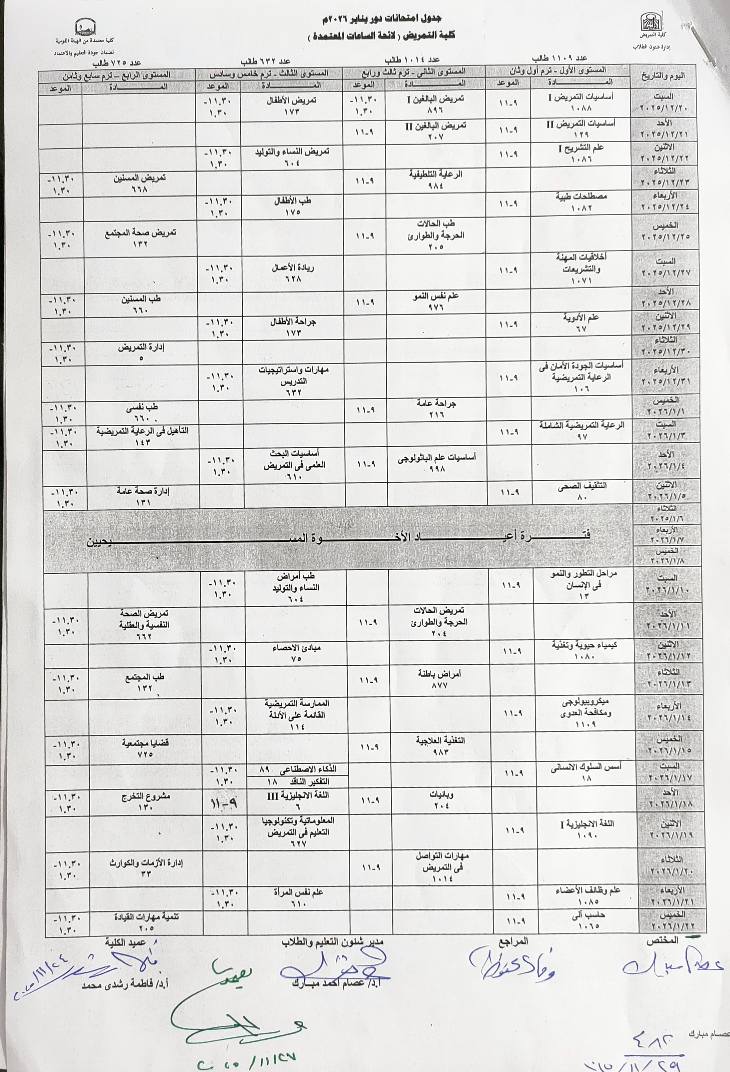
diploma /master’s/doctorate) in nursing sciences for the first , second and third semesters of the postgraduate program based on the credit hour system . Under the patronage of Prof. Dr. Ahmed El-Minshawy, President of the University

And Mr. Professor Dr. Gamal Badr, Vice President of the University for Graduate Studies and Research, and Mr. Professor Dr. Samah Muhammad Abdullah, Dean of the College

Under the supervision of Prof. Dr. Ikram Ibrahim Mohamed, Vice Dean for Graduate Studies and Research, and follow-up of the Graduate Studies and Research Administration at the College .

Today, graduate students took the master's and doctoral exams based on the credit hour system for the first, second and third semesters of June 2025 .

Professor Dr. Ekram Ibrahim Mohamed, Vice Dean for Postgraduate Studies and Research, stated that the number of students who took the June exams exceeded 292 students in all specializations .

We wish everyone good luck and continued success .

We wish everyone good luck and continued success

Today, Prof. Dr. Samah Muhammad Abdullah, Dean of the College, approved the results of the fourth level of the seventh semester.

Professor Dr. Samia Youssef Sayed, Head of Control, stated: Fourth group of students who

320 male and female students took the exam for the academic year 2024/2025 AD, with a success rate of 64.7 %.

We wish our students success, excellence and progress.


Subscribe to