invitation

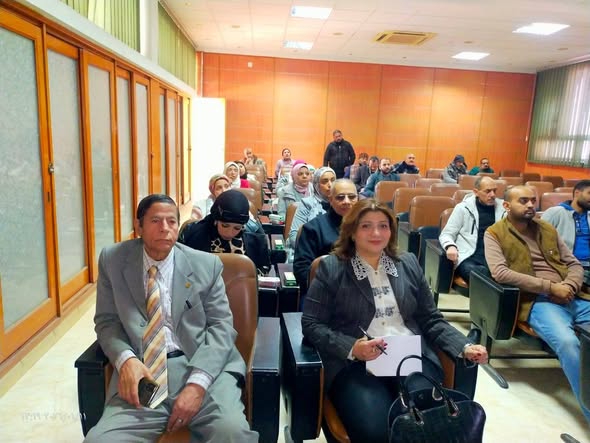
The Department of Civil Engineering is honored to invite you to attend the discussion of the master's thesis submitted by Engineer Ahmed Youssef Abdel-Aleem, on Thursday, June 26, 2025, in the discussion hall of the Civil Engineering Department (Prof. Dr. Abdel-Rahman Mujahid Hall) at 10:30 a.m.


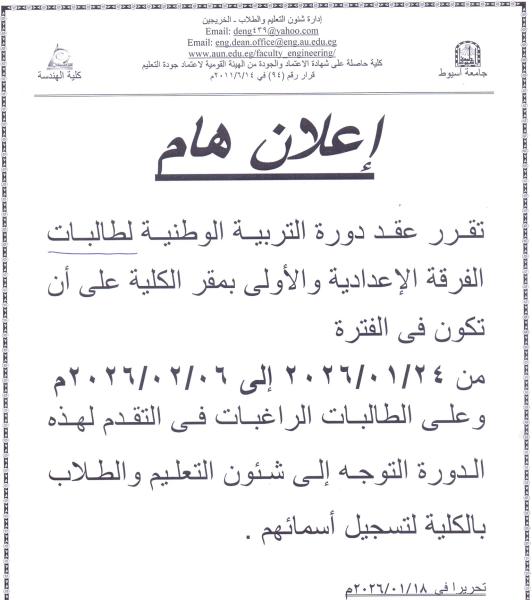
Important Notice


Students in the following grades:

- Preparatory grade

- First, second, and third years in the Department of Architecture

- First, second, and third years in the three departments of Mechanical Engineering

Who wish to file grievances regarding first and second semester subjects should contact Student Affairs to file a grievance. The deadline for grievances is two weeks from the date of the results announcement, in accordance with previous years.


Flow behavior over well-escape weirs

Research Abstract
Weirs play an important role in controlling and managing water in irrigation canal networks
through several functions, such as discharge measurements, water distribution, and lowering
the water level. Weirs also play a crucial role in protecting canals from flooding, which might
cause the earthen banks to collapse, by eliminating surplus water at the ends of the canals.
Over the previous decades, the flow over the traditional sharp-crested weirs was extensively
investigated by many researchers; however, the well-escape weirs have not received sufficient
attention. These types of weirs were mostly constructed in the form of vertical wells that may
be circular or rectangular in shape, and water may flow through the entire perimeter of the weir
or part of the perimeter. In the present research, the effect of the well-escape-weir shape on the
characteristics of flow over the weir was studied. A set of models were constructed in different
shapes, circular and square, and the entire perimeter of the weir or part of the perimeter is
working as the weir crest length. The discharge passing over the unit length of the weir crest (q)
is investigated and compared for the circular and square weirs of various crest lengths and
positions. The results indicated that the discharge capacity of the circular weirs increases by
a rate ranging between 7.5% and 15% more than that of the square weirs at the same head.
Also, results indicated that the discharge coefficient of the circular weirs increases by a rate
ranging between 9.3% and 10.3% more than that of the square weirs. This behavior can be
attributed to the interference between the orthogonal water nappes at the corners of the
square models. In addition, the flow direction has little effect on the discharge coefficient at
small discharges, and this effect becomes more obvious at higher discharges. Additionally, the
well-escape weirs of the upstream crest have a slightly higher discharge capacity than those of
the downstream crest due to the effect of the approach velocity, which increases the water
entrance velocity at the upstream crest. The results of flow patterns around the weir showed
that the locations of maximum flow velocities (u, v, w) are mostly near the weir crest and
depend entirely on the crest length and position
Research Date
Research Department
Research Journal
Water Science
Research Pages
140-157
Research Publisher
Taylor and Francis
Research Rank
Q2
Research Vol
38
Research Website
https://doi.org/10.1080/23570008.2024.2307223
Research Year
2024

Numerical simulation of flow over tail-escape weirs

Research Abstract
weirs play an important role in controlling and managing water in irrigation canal networks through
several functions such as discharge measurements, water diversion, lowering the water level, and
removing excess water at the ends of canals to protect them from water flooding that may lead to the
collapse of the earthen banks of these canals. Over the previous decades, the flow over the linear
sharp-crested weirs was extensively investigated by many researchers; however, the tail-escape-weirs
have not received sufficient attention. These types of weirs were mostly constructed in the form of
vertical wells that may be circular or rectangular in shape, and water may flow through the entire
perimeter of the weir or part of the perimeter. In the present research, the effect of the tail escape-weir
shape and flow direction on the flow characteristics over the tail escape-weirs were studied
numerically and experimentally. For this purpose, a set of models were constructed in different
shapes, circular and square, and the entire perimeter of the weir or part of the perimeter is working as
the weir crest length. The turbulence model RNG k-ε Ansys Fluent software was used to simulate flow
over the tail escape-weir physical models. The verification of the numerical model was based on the
profiles of the water surface and the velocity profile above the weir crest, which both showed
acceptable agreement. The comparison of the experimental and numerical results for the water head
over the weir crest showed acceptable agreement with minimum and maximum absolute percentage
errors (0.17% ─ 6.5%) for all models. The results showed that the crest position has a significant
impact on the vortex intensity and irregularity of the flow streamlines behind the weir; these
characteristics significantly increase behind weirs with a partial crest length upstream compared to
those with a full-length crest and two-thirds of the perimeter crest downstream. In addition, the
decrease in weir crest length increases the maximum magnitude velocity value that occurs directly
above the weir crest and decreases the main velocity value inside the channel.
Research Date
Research Department
Research Journal
3rd International Conference on Civil Engineering: (Development & Sustainability),24-27 October, Hurghada, Egypt
Research Pages
113-127
Research Publisher
Assiut University
Research Year
2023

Assiut University's Faculty of Engineering workshops are a promising model for the circular economy and achieving sustainable development goals.

ت

The Faculty of Engineering workshops at Assiut University represent a promising model for the circular economy and achieving sustainable development goals. They represent the first center of expertise in applying circular economy principles within the university. Their activities are not limited to manufacturing, education, training, and providing technical consulting, but also extend to the maintenance and renewal of products (such as furniture and research equipment) through refurbishment and refurbishment processes.

This extends the useful life of consumables, preventing depreciation (depreciation of assets) and reducing waste.

Practical Example: Refurbishing Dilapidated Seats:

As shown in the images, a set of seats that were on the verge of depreciation in one of the university's faculties was revived through:

1. Repairing the structure (in the metalworking and bodywork workshops).

2. Adding aesthetic touches (in the metalworking and painting workshops).

3. Returning them to service more efficiently and at a lower cost compared to purchasing new seats.

This model achieves Goal 12 of the Sustainable Development Goals (SDGs):

"Ensure sustainable consumption and production patterns"

- by reducing waste (Target 12.5).

- Promoting reuse (Target 12.6).

Tangible benefits:

- Cost reduction: Reducing the university's annual purchasing bill.

- Environmental protection: Reducing the carbon footprint resulting from the manufacture of new products.

- Empowering students and researchers: Practical application of sustainability and circular economy concepts in engineering education.

Finally, the Faculty of Engineering workshops at Assiut University are not merely manufacturing units; they are incubators for sustainable innovation, translating the principles of the circular economy into action and providing a model for integrating academic, environmental, and economic goals into a single framework.

. ♻️

1

2

3

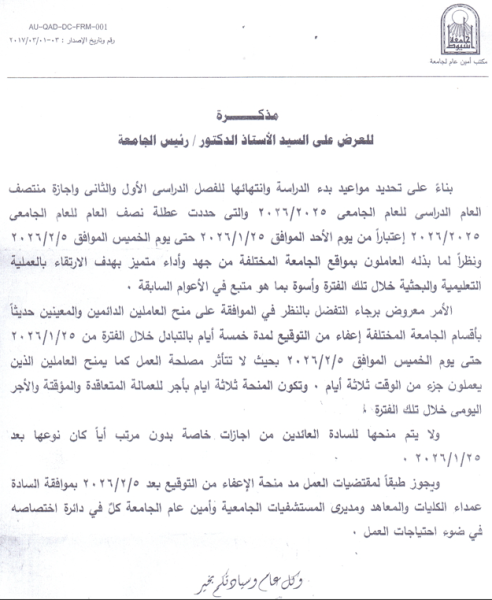
The Supreme Council of Universities announces the timetable for the new academic year 2025/2026:

ا

The Supreme Council of Universities announces the schedule for the new academic year 2025/2026:

- September 20: Start of classes for the new year at universities and institutes

- January 1: Beginning of final exams for the first semester

- January 24: Beginning of the mid-year break for the new academic year

- February 7: Beginning of the second semester

- May 21: End of the second semester

For more details:

https://scu.eg/news/academic-year-2025-2026-timeline/

May be an image of text


المجلس الأعلى للجامعات

June 3 at 8:22PM  · 

The Supreme Council of Universities announces the schedule for the new academic year 2025/2026:

- September 20: Start of classes for the new year at universities and institutes

- January 1: Beginning of final exams for the first semester

- January 24: Beginning of the mid-year break for the new academic year

- February 7: Beginning of the second semester

- May 21: End of the second semester

For more details:

https://scu.eg/news/academic-year-2025-2026-timeline/

Discussion of the master's thesis submitted by Eng. Mina Maged Agaby, Bachelor of Civil Engineering, Civil Engineering Department, Minya University, entitled "Evaluation of risk factors causing delays and cost overruns in road construction in Egypt"

The Department of Civil Engineering is honored to invite you to attend the defense of the master's thesis submitted by Eng. Mina Maged Agaby, Bachelor of Civil Engineering, Department of Civil Engineering, Minia University, entitled "Evaluation of Risk Factors Causing Delay and Cost Overrun in Road Construction in Egypt" on *Wednesday* corresponding to 6-11-2025.. at 12 noon in the hall of Professor Dr. Abdel Rahman Megahed for scientific discussions in the Department of Civil Engineering.

Egyptian Student Participation Survey

1

The Supreme Council of Universities has launched the second edition of the Egyptian Student Engagement Survey, targeting final-year students for the 2024/2025 academic year. The survey includes a follow-up assessment of the quality of educational services at Egyptian universities through the following link:

الاستبيان المصري للمشاركات الطلابية

Please note that the survey website will be closed at the end of July 2025.

Smart Max Electronics donates mineral exploration equipment to the college. We wish you success and prosperity, God willing.

Professor Dr. Khaled Salah, Dean of the College, received Engineer Mohamed Abdel Rahman Awad, Chairman of the Board of Directors of Smart Max Electronics, to honor him for donating scientific equipment for mineral exploration to the Department of Mining and Metallurgy Engineering. He also presented a scientific symposium on mineral exploration and the equipment used.

The reception was attended by Professor Dr. Jamal Yahya Baghdadi, Head of the Department of Mining and Metallurgy Engineering, and Dr. Masoud Ali Hussein, an instructor in the department.


Subscribe to