

Important instructions for answering Bubble sheet exam

Announcement for students
news category
student
Important announcement
"New insights into sperm rheotaxis, agglutination and bundle formation in Sharkasi chickens based on an in vitro study."
Research Abstract
Fertility in birds is dependent on their ability to store adequate populations of viable sperm for extended durations in sperm storage tubules (SSTs). The exact mechanisms by which sperm enter, reside, and egress from the SSTs are still controversial. Sharkasi chicken sperm showed a high tendency to agglutinate, forming motile thread-like bundles comprising many cells. Since it is difficult to observe sperm motility and behavior inside the opaque oviduct, we employed a microfluidic device with a microchannel cross-section resembling close to that of sperm glands allowing for the study of sperm agglutination and motility behavior. This study discusses how sperm bundles are formed, how they move, and what role they may have in extending sperm residency inside the SSTs. We investigated sperm velocity and rheotaxis behavior when a fluid flow was generated inside a microfluidic channel by hydrostatic pressure (flow velocity = 33 µm/s). Spermatozoa tended to swim against the flow (positive rheotaxis) and sperm bundles had significantly lower velocity compared to lonesome sperm. Sperm bundles were observed to swim in a spiral-like motion and to grow in length and thickness as more lonesome sperm are recruited. Sperm bundles were observed approaching and adhering to the sidewalls of the microfluidic channels to avoid being swept with fluid flow velocity > 33 µm/s. Scanning and transmission electron microscopy revealed that sperm bundles were supported by a copious dense substance. The findings show the distinct motility of Sharkasi chicken sperm, as well as sperm's capacity to agglutinate and form motile bundles, which provides a better understanding of long-term sperm storage in the SSTs.
Research Date
Research Department
Research Journal
scientific reports
Research Member
Research Publisher
https://www.nature.com/articles/s41598-022-17037-x
Research Rank
Sci Rep(q1)
Research Vol
Sci Rep. 2022; 12: 13003. Published online 2022 Jul 29. doi: 10.1038/s41598-022-17037-x
Research Website
https://www.nature.com/articles/s41598-022-17037-x
Research Year
Scientific Reports 12, no. 1 (2022): 1-15.doi: 10.1038/s41598-022-17037-x
Congratulation

تتقدم اسرة كلية الطب البيطرى متمثلة في السيدة عميد الكلية / ا.د مديحة درويش والسادة الوكلاء ا.د/ مؤمن عبد العظيم وكيل الكلية لشئون التعليم والطلاب وا.د/ حسن عبد الصبور وكيل الكلية لشئون خدمة المجتمع وتنمية البيئة وا.د/ أيناس عبد الحافظ وكيل الكلية لشئون الدراسات العليا والبحوث والسادة رؤساء الأقسام والسادة أعضاء هيئة التدريس ومعاونيهم والسادة العاملين بالكلية بخالص التهاني لابنائنا الطلاب بمناسبة تنصيبهم لمجلس اتحاد طلاب الكلية لسنة ٢٠٢٢/٢٠٢٣ متمنين لهم مزيد من التقدم والازدهار
news category
student
Exogenous gonadotropin-releasing hormone counteracts the adverse effect of scrotal insulation on testicular functions in bucks.
Research Abstract
This study determined the effects of scrotal insulation on testicular functions in bucks and evaluated the impact of exogenous gonadotropin-releasing hormone (GnRH) administration before scrotal insulation on sperm production and testicular vascular dynamics. Twelve bucks were randomly divided into three groups: scrotal-insulated animals without GnRH treatment (INS), scrotal-insulated animals treated previously with GnRH (GnRH + INS), and animals without insulation as controls (CON). Doppler ultrasonography was used to evaluate testicular vascular changes, and semen samples were collected to assess seminal parameters. Testicular samples were collected from slaughtered bucks at the end of the experiment for histological investigations and immunohistochemical analysis for caspase 3 (apoptotic marker), and a vascular endothelial growth factor (VEGF; hypoxic marker) evaluation. Sperm motility drastically decreased (33%) in the INS group on day 8 compared with those in the GnRH + INS and CON groups (58% and 85%, respectively). Testicular blood flow significantly decreased for 3 and 2 weeks in the INS and GnRH + INS groups, respectively. The pulsatility index (PI) reached pretreatment values at 5 and 4 weeks after insulation in the INS and GnRH + INS groups, respectively. The resistance index (RI) values increased in both insulated groups for the first 2 weeks and decreased to control values 4 weeks after insulation. However, the maximum velocity (VP) started to increase reaching pretreatment values by the 5th and 3rd weeks after insulation in the INS and GnRH + INS groups, respectively. Histological investigations showed a marked reduction in lipid inclusions in Sertoli cells in the GnRH + INS group compared with those in the INS group. The distributions of both caspase 3 and VEGF decreased in the GnRH + INS group compared with those in the INS group. This study showed that the administration of a single dose of GnRH delayed the negative effects of scrotal insulation on different seminal traits and revealed the pivotal role of GnRH in compensating testicular insulation in bucks.
Research Department
Research Journal
Scientific Reports, 12(1), 1-15.
Research Member
Research Pages
1-15.
Research Publisher
https://www.nature.com/articles/s41598-022-11884-4
Research Rank
Scientific reports Q1
Research Vol
12 , DOI: 10.1038/s41598-022-11884-4
Research Website
www.nature.com › articles › s41598/022/11884-4
Research Year
Sci Rep 12, 7869 (2022).May 2022
Training course announcement
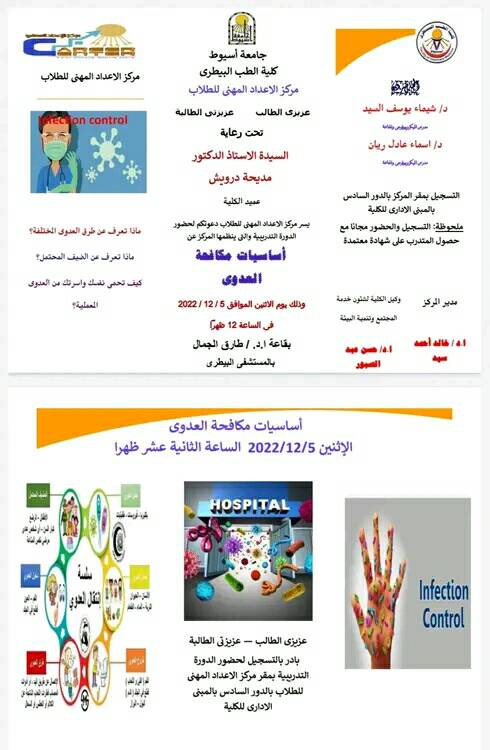
تحت رعاية السيد الأستاذ الدكتور/ مديحة درويش عميد الكلية
والسيد الأستاذ الدكتور/ حسن عبدالصبور وكيل الكلية لشئون خدمة المجتمع وتنمية البيئة
ينظم مركز الإعداد المهنى للطلاب دورة تدريبية لطلاب الكلية بعنوان " أساسيات مكافحة العدوى" وذلك يوم الاثنين الموافق ٢٠٢٢/١٢/٥ بقاعة ا.د/ طارق الجمال بالمستشفى البيطرى
التسجيل لحضور الدورة التدريبية بمقر مركز الإعداد المهنى للطلاب بالدور السادس بالمبنى الإدارى للكلية.
ملحوظة :- التسجيل والحضور مجانا وشهادة معتمدة لكل متدرب.
مدير المركز
ا.د/ خالد أحمد سيد
news category
student
Anatabine attenuates ovalbumin-induced asthma via oxidative stress and inflammation mitigation and Nrf2/HO-1 signaling upregulation in rats
Research Abstract
Aims: Asthma affects a large number of people worldwide and is characterized by chronic allergic airway
inflammation. Anatabine is a natural alkaloid that is structurally similar to nicotine and found in the Solanaceae
family of plants, with anti-inflammatory properties. Consequently, this study aimed to evaluate the potential
therapeutic effect of anatabine against asthma.
Main methods: Ovalbumin was used to induce asthma in rats. Two asthmatic groups were treated with low and
high doses of anatabine.
Key findings: Asthmatic animals experienced increased total leukocyte count and inflammatory cytokines in
bronchoalveolar lavage fluid (BALF), bronchitis, and bronchopneumonia associated with mast cell infiltration.
Additionally, inducible nitric oxide synthase immunostaining was observed, with decreased pulmonary antioxidant capacity and enzymes and decreased Nrf2 and HO-1 gene expression while increased NFκB-P65 expression.
Interestingly, asthmatic animals treated with anatabine at both doses showed dose-dependently decreased inflammatory cells and cytokine levels within BALF reduced inflammation in the airways through decreased mast
cell infiltration within lung tissues and increased antioxidant enzymes and Nrf2 and Ho-1 expression levels.
Significance: Our results highlight the potential beneficial effect of anatabine against asthma through antiinflammatory and antioxidant mechanisms. Therefore, anatabine is a promising candidate for pulmonary
asthma treatment.
Research Date
Research Department
Research Journal
Life Sciences 308Volume 308, 1 November 2022, 120954
Research Member
Research Pages
120954
Research Publisher
https://www.sciencedirect.com/science/article/pii/S0024320522006543
Research Rank
Life Sciences is listed(q1) in JCR CATEGORY PHARMACOLOGY & PHARMACYMEDICINE, RESEARCH & EXPERIMENTAL
Research Vol
Volume 308, 1 November 2022, 120954
Research Website
https://www.sciencedirect.com/science/article/pii/S0024320522006543
Research Year
Life Sciences Volume 308, 1 November 2022, 120954
Detection of food fraud of meat products from the different brands by application of histological methods
Research Abstract
Abstract
In Sohag City, 400 samples were collected from different food markets of different
meat products from two companies with high and low prices (e.g., minced meat, kofta
sausage, beef burger, and luncheon meat) for determining food fraud. Light, fluorescence, and scanning electron microscopy (SEM) were used to examine the samples.
“Special histochemical stains” permit the microscopic examination of different cell
types, structures, and/or microorganisms. Histological examination revealed variant
tissue types, besides skeletal muscles. Nuchal ligaments, bones, hyaline cartilages,
white fibrocartilages, large and medium arteries, cardiac muscles, tendons, and collagenous connective tissues comprised the capsule of a parenchymatous organ. Additionally, a crystal of food additives was recognized using light microscopy and SEM.
SEM allows the visualization of bacterial contamination. Using different microscopic
anatomy techniques is an efficient methodology for qualitative evaluations of various
meat products. No difference in quality was observed between low- and high-priced
meat products.
Research Date
Research Department
Research Journal
Microscopy research and techniques
Research Member
Research Pages
1538–1556.
Research Publisher
Microscopy Research and Technique
Research Rank
Journal Citation Reports (Clarivate, 2022): 5/21 (Anatomy & Morphology)47/94 (Biology)3/9 (Microscopy) Online ISSN:1097-0029
Research Vol
85(4)
Research Website
https://analyticalsciencejournals.onlinelibrary.wiley.com/journal/10970029
Research Year
2022
Characterization of the primo vascular system in rabbit vagina
Research Date
Research Department
Research Journal
Microscopy Research and Technique
Research Member
Research Pages
799-806
Research Publisher
John Wiley & Sons, Inc.
Research Year
2021