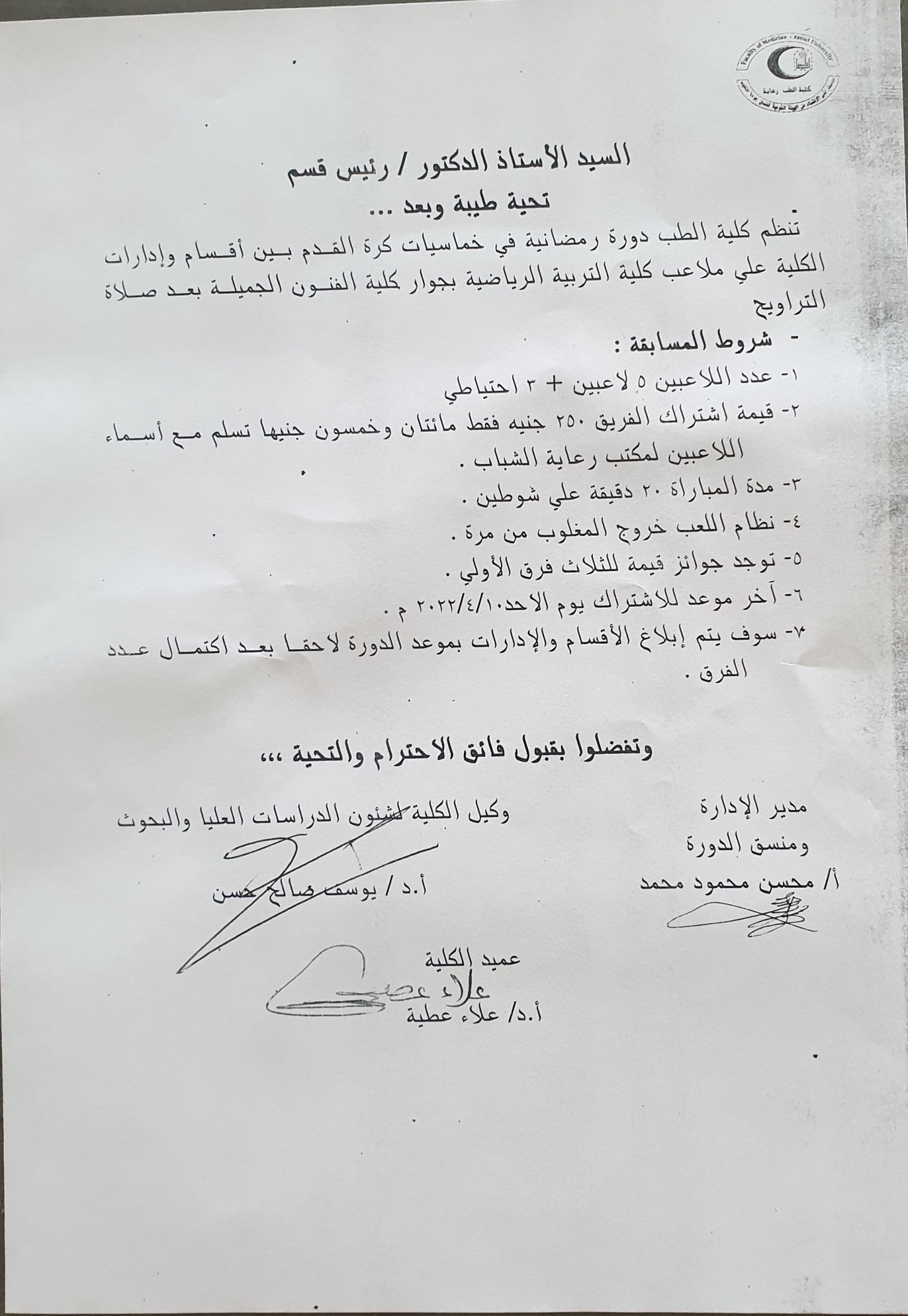
The visit of Prof. Dr. / Ahmed El-Minshawy - to follow up on the prosecution registration of new doctors at the Faculty of Medicine

زيارة السيد الأستاذ الدكتور / أحمد المنشاوى - نائب رئيس الجامعة للدراسات العليا والبحوث

والسيد الأستاذ الدكتور / يوسف صالح حسن - وكيل الكلية لشئون الدراسات العليا 

لمتابعة تسجيل النيابات للأطباء الجدد بكلية الطب  ،

والتى تتم تحت إشراف السيده الأستاذه الدكتورة / أمانى عمر - وكيل الكلية لشئون التعليم والطلاب 

بوحدة الخدمات التكنولوجية - كلية الطب 

001


World Pediatric Nephrology Day - in cooperation with the Pediatric Urology Unit

نظمت مستشفى الاطفال الجامعى فاعليات

اليوم العلمي لوحدة امراض كلى الاطفال

بالتعاون مع وحدة المسالك البولية للاطفال يوما عن (أمراض كلي الأطفال) بمستشفى الاطفال  الجامعي.

تحت رعاية :

ا. د/ طارق الجمال رئيس الجامعة

ا. د/  علاء عطية عميد كلية الطب ورئيس مجلس إدارة المستشفيات الجامعية

ا. د/ ايهاب فوزي المدير التنفيذي للمستشفيات الجامعية

ا. د/ عماد حماد الدالي مدير عام مستشفى الأطفال

ا. د/ احلام بدوى      رئيس وحده كلى الاطفال

و حاضر فيها كل من :

ا.د/ احلام بدوى

محاضرة بعنوان

 المتلازمة الكلوية: ما الذي يجب أن يعرفه طبيب الأطفال؟

ص/ رانيا سعد

محاضره بعنوان:

الادويه  التي تسبب إصابة الكلى الحادة

ا.د/ احمد عبد الحميد

محاضرة بعنوان  

كيفيه التعامل مع الحصوات المتكرره لدي الاطفال.

اد/ احمد عبد العزيز الدروى

محاضرة بعنوان:

دور  جراحه المسالك البولية للأطفال في علاج حالات التبول اللاإرادي

و محاضرة  ثانية بعنوان:

علاج حالات ارتجاع البول لدي الاطفال.

23456789

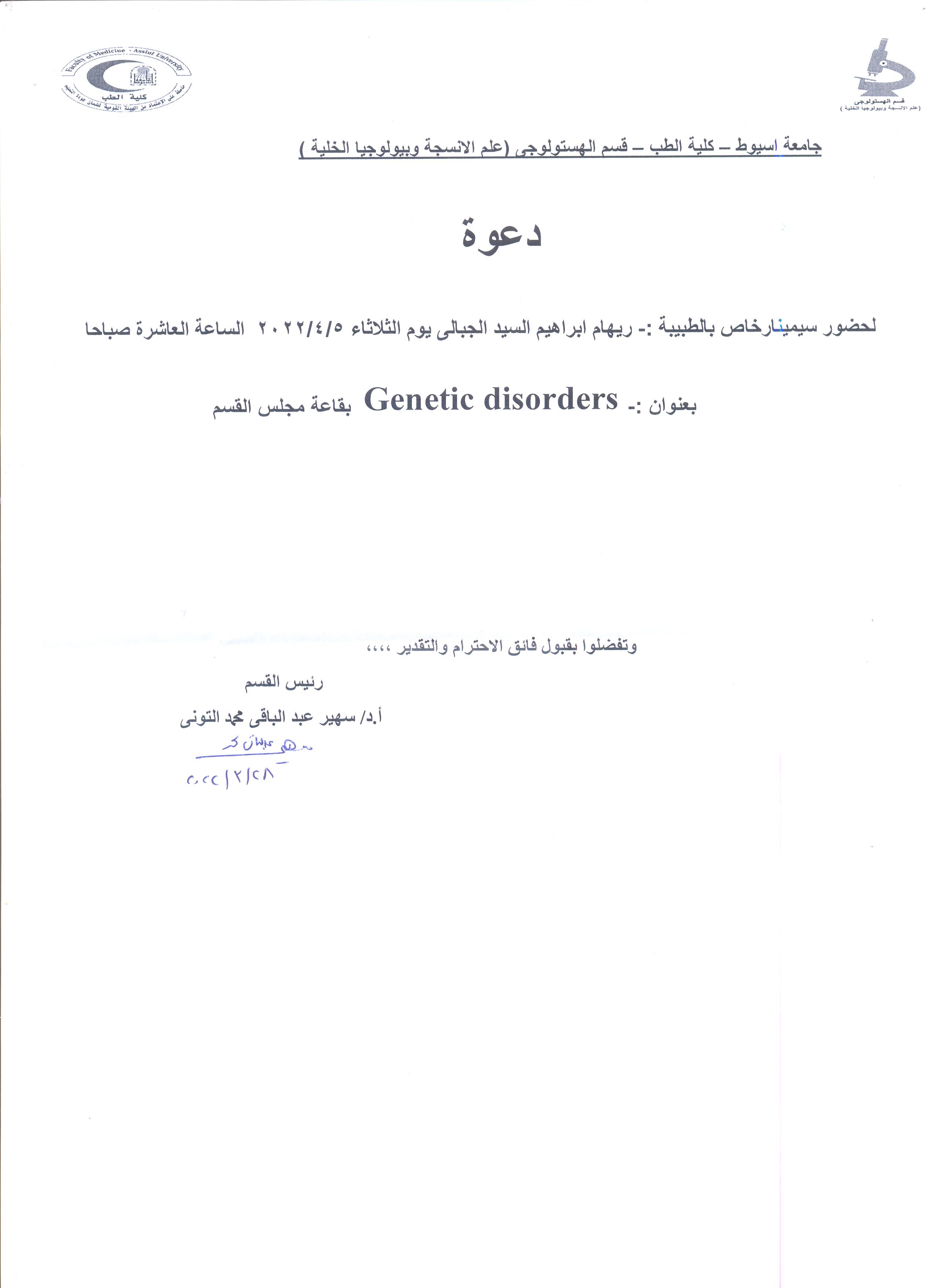
The Thirteenth Conference - Department of Clinical Pathology - Faculty of Medicine - Assiut University

افتتاح المؤتمر الثالث عشر لقسم الباثولوجيا الإكلينيكية

                                 بعنوان

                 الجديد في الطب المعملي

بحضور....

أ. د/ طارق الجمال رئيس الجامعة

ا. د/ احمد المنشاوي نائب رئيس الجامعة لشئون الدراسات العليا والبحوث

أ. د/ مها كامل غانم نائب رئيس الجامعة لشئون خدمة المجتمع وتنمية البيئة

ا. د/ علاء عطية   عميد كلية الطب ورئيس مجلس إدارة المستشفيات الجامعية

ا. د/ اماني عمر   وكيل الكلية لشئون التعليم والطلاب

ا. د/ إيهاب فوزي     المدير التنفيذي للمستشفيات

 الجامعية

ا. د/ علاء عبدالمنعم       مدير مستشفى الرئيسي

ا. د/ عزة عزالدين      رئيس القسم ورئيس المؤتمر

ا. د/ اسامة بكر.               رئيس شرف المؤتمر

ا. د/ لبني تاج الدين         رئيس شرف المؤتمر

ا. د/هبه راشد                  مقرر الموتمر

يتناول المؤتمر كل ما هو جديد في الطب المعملي ومنها:

* تسمم الدم و مقاومة الميكروبات للمضادات الحيوية ويشترك فيها القسم مع الاقسام الاكلينيكية المختلفة.

* عن نقل الدم في الاطفال والاورام ومشتقات الدم المختلفة.

*الامراض المناعية واسباب حدوثها.

* الجديدفي تشخيص امراض الدم.

*تطوير اعمال الجودة بالمعامل للتأكيد علي الوصول لخدمة صحية متميزة لكل المواطنين

وحاليا يتم دخول جميع الوحدات بالمعامل للحصول علي الاعتماد الدولي ١٥١٨٩ للايجاك.

2345678910111213141516171819

Longitudinal stent elongation or shortening after deployment in the coronary arteries: which is dominant?

Research Abstract

Background: Stent manufacturers always record stent shortening data while they do not record stent elongation data. The aim of this study is to identify both stent shortening and elongation occurring after deployment in the coronary arteries and know their percentage.

Results: The length of coronary stents was measured by intravascular ultrasound (IVUS) by (1) edge-to-edge (E-E) length, measured from the appearance of the first distal strut to the last proximal strut, and (2) area-to-area (A-A) length, measured from the first distal struts seen at more than one IVUS quadrant to the last proximal struts seen at more than one IVUS quadrant. Stent shortening was defined as both E-E and A-A lengths were shorter than the manufacturer box-stated length (shortened group). Stent elongation was defined as both E-E and A-A lengths were longer than the manufacturer box-stated length (elongated group), otherwise unchanged group. Consecutive 102 stents deployed in ischemic patients were included. Stent elongation was detected in 67.6% (69 stents), and shortening was detected in 15.7% (16 stents), while unchanged stents were detected in 16.7% (17 stents). Although the 3 groups had similar box-stated length and predicted foreshortened length, they had significantly different measurements by IVUS, p<0.001 for each comparison. Differences from box-stated length were 1.9±1.4mm, -1.4±0.4mm, and 0.4±0.3mm, respectively, p<0.001. The elongated group had significantly longer differences from the corresponding box-stated and predicted foreshortened lengths, while the shortened group had significantly shorter differences from the corresponding box-stated length and similar foreshortened length. By multinomial regression analysis, the plaque-media area and stent deployment pressure were the independent predictors of the stent length groups, p=0.015 and p=0.026, respectively.

Conclusions: Change in stent length is not only shortening-as mentioned in the manufacturer documents-but also stent elongation. Stent elongation is dominant, and the most important predictors of longitudinal stent changes are plaque-media area and stent deployment pressure.

Keywords: IVUS; Stent elongation and shortening; Stent length.

Research Authors
Magdy Algowhary , Mohammed Aboel-Kassem F Abdelmegid
Research Date
Research Department
Research Journal
Egypt Heart Journal
Research Member
Research Pages
1-11
Research Publisher
Egypt Heart J. 2021 May 17;73(1):46. doi: 10.1186/s43044-021-00170-9. PMID: 34002293; PMCID: PMC8128949.
Research Rank
Q3
Research Vol
Egypt Heart J. 2021 May 17;73(1):46. doi: 10.1186/s43044-021-00170-9. PMID: 34002293; PMCID: PMC8128949.
Research Website
Egypt Heart J. 2021 May 17;73(1):46. doi: 10.1186/s43044-021-00170-9. PMID: 34002293; PMCID: PMC8128949.
Research Year
2021

Association between age and infection in patients with acute ST-elevation myocardial infarction

Research Abstract

Background: ST-elevation myocardial infarction (STEMI) in young patients has a unique risk profile. We aimed to detect bacteria in aspirate of infarct artery in young versus old patients.

Results: Aspirates of consecutive 140 patients who underwent a primary coronary intervention were taken for bacteriological, microscopical, and immunohistochemical (for bacterial pneumolysin) examinations. Their results were calculated in young (≤ 50 years) versus old (> 50 years) patients. Median age (interquartile range) was 45 (38– 48) years in young (60 patients) and 59 (55–65) years in old (80 patients) patients, p < 0.0001. Both groups had similar baseline data except age, males, diabetes, hyperlipidemia, family history, lesion length, and ectatic vessel. Different bacteria were cultured in 11.3% of all patients involving 22.6% of young and 2.8% of old patients [hazard ratio 8.03 (95% CI 1.83–51.49), p = 0.002]. By multivariate analyses, age groups and leukocytic count were independent predictors of infection (bacteria and pneumolysin), p = 0.027 and p < 0.0001, respectively. Optimal cutoff value of leukocytic count was 12,250 cells/μl [ROC curve sensitivity 85.7%, specificity 86.4%, and AUC 0.97 (95% CI 0.95–1.0), p < 0.001]. Infection was an independent predictor of STEMI in young versus old patients, p < 0.001. Nevertheless, in-hospital events occurred insignificantly different and neither age groups nor infection was predictor of in-hospital events.

Conclusions: Young patients had significantly higher percentage of bacteria in their infarcted artery than old patients. High leukocytic count in patients below 50 predicts infection that causes acute myocardial infarction. Antibacterial trials directed toward this group are required for secondary prevention.

Research Authors
Magdy Algowhary, MD., Ph.D.
Research Date
Research Department
Research Journal
The Egyptian Heart Journal
Research Member
Research Pages
1-8
Research Publisher
The Egyptian Heart Journal 2021 Jan 30;73(1):12. doi: 10.1186/s43044-021-00137-w.
Research Rank
Q3 in Scopus, Q4 in WOS
Research Vol
The Egyptian Heart Journal 2021 Jan 30;73(1):12. doi: 10.1186/s43044-021-00137-w.
Research Website
The Egyptian Heart Journal 2021 Jan 30;73(1):12. doi: 10.1186/s43044-021-00137-w.
Research Year
2021
Subscribe to