Do you have any questions?

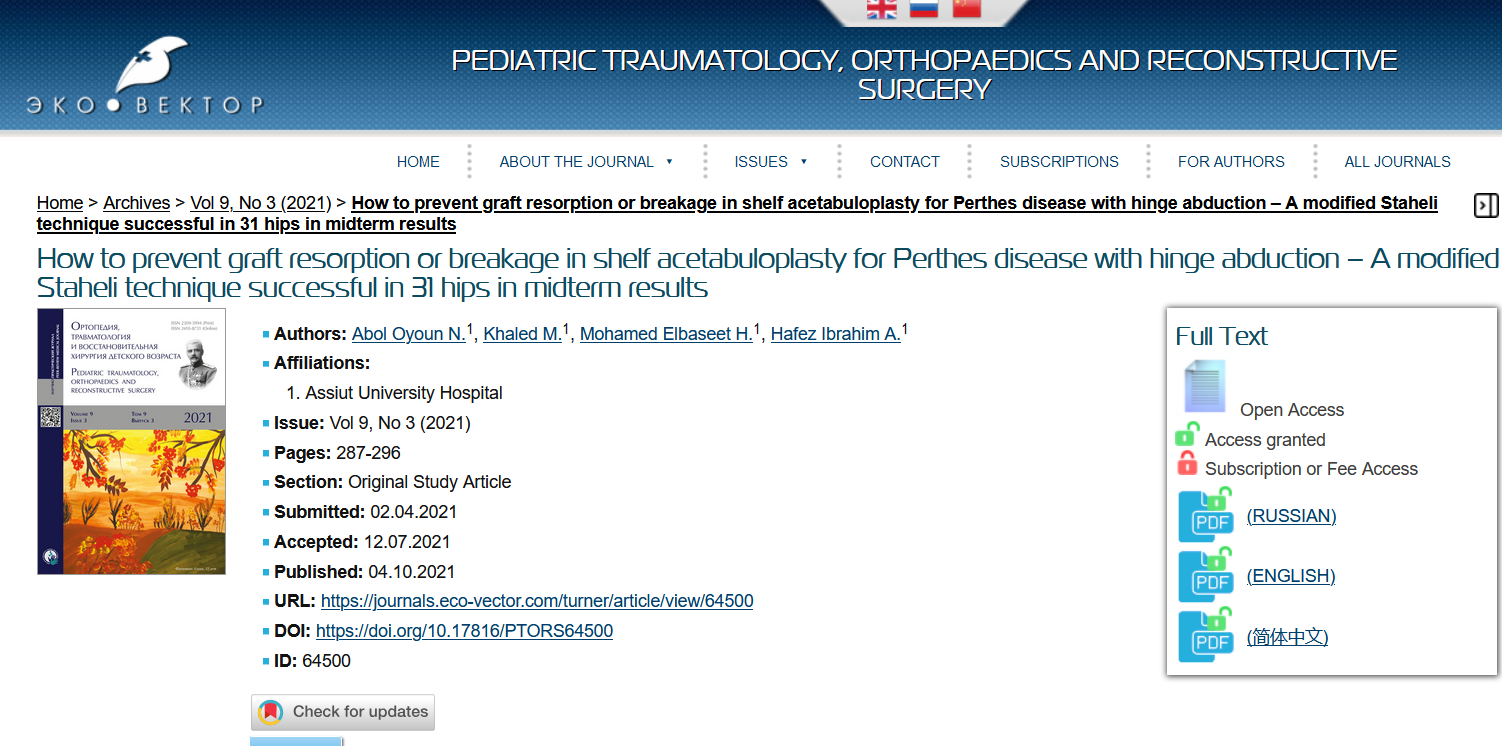
How to prevent graft resorption or breakage in shelf acetabuloplasty for Perthes disease with hinge abduction–A modified Staheli technique successful in 31 hips in midterm results
Research Abstract
BACKGROUND: Shelf acetabuloplasty covers the hip and allows remodeling in hips with Legg-Calvé-Perthes disease and hinge abduction. Graft resorption or breakage is a bad complication that necessitate another surgical procedure.
AIM: Our report evaluates a modified Staheli technique for graft resorption or breakage.
MATERIALS AND METHODS: Case series study of 31 hips (29 patients) with mean age at operation was 8.1 (range 6-14 years). Duration of complaint ranged between one year and up to three years with the mean duration 1.52±0.76 years. The different parameters evaluating the hip as: Tönnis angle, Sharp angle, center-edge angle, and acetabular coverage percentage were measured. For unilateral cases only, medial joint space ratio and epiphyseal height ratio were evaluated.
RESULTS: The mean postoperative follow-up was 47.8±9.8 months. All studied joints had Catterall type IV, Salter-Thompson classification type B. Seven joints were in Fragmentation stage whereas 24 joints were in re-ossification stage. Based on Lateral Pillar classification; only two joints were classified as B/C and 29 joints were classified as C. Final follow up internal rotation, abduction, center-edge angle, and acetabular coverage percentage were found to be significantly higher. In contrast, Tönnis angle and Sharp’s angle were significantly decreased. For unilateral cases, it was found that medial joint space ratio and epiphyseal height ratio were significantly decreased. None of the hips had resorbed or broken graft till final follow up.
CONCLUSIONS: This modified Staheli technique prevent graft resorption or breakage. Shelf provides a good
Research Date
Research Department
Research File
SHELF Perthes.pdf
(676.91 KB)
Research Image
Research Journal
Pediatric Traumatology, Orthopaedics and Reconstructive Surgery
Research Member
Research Pages
10
Research Publisher
Eco-Vector LLC
Research Rank
q4
Research Vol
Issue: Vol 9, No 3 (2021) Pages: 287-296
Research Website
https://journals.eco-vector.com/turner/article/view/64500
Research Year
2021