Ileus is a frequent complication following abdominal surgery that can cause a delay in recovery. Ileus onset is thought to be complex, and several prevention strategies have been researched. According to the study’s hypotheses, chewing gum promotes quicker recovery of gastrointestinal function, which reduces the risk of postoperative ileus.
Aim
To investigate the impact of chewing gum on hospital stay and bowel movement in individuals undergoing whipped surgery.
Abstract
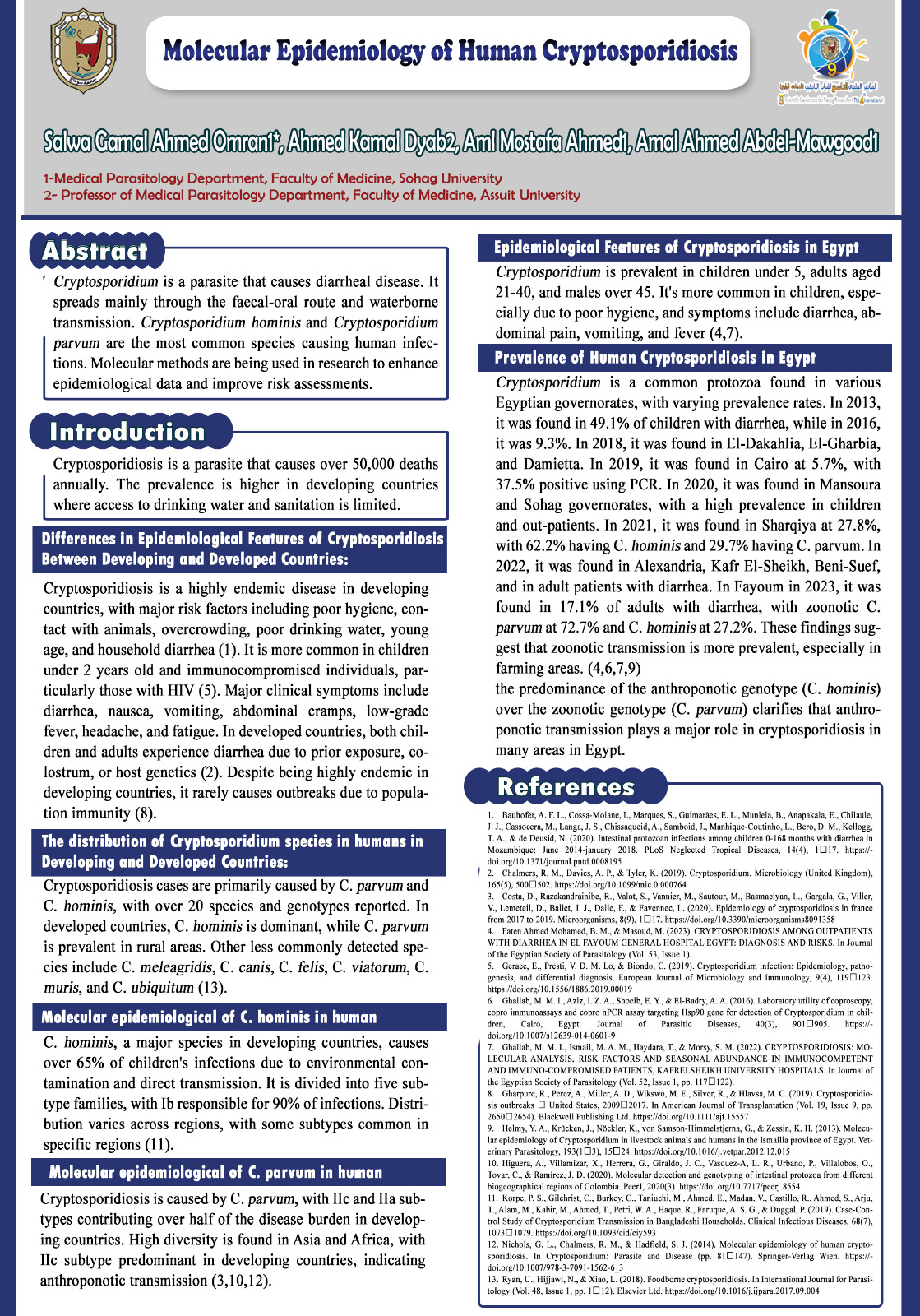
Cryptosporidium is a parasite that causes diarrheal disease, Cryptosporidiosis, affecting humans and animals. It belongs to the Apicomplexan protozoan family and has a complex life cycle. There are around 25 species and several genotypes, with Cryptosporidium hominis and Cryptosporidium parvum being the most common species causing human infections. Cryptosporidiosis spreads primarily through the faecal-oral route, consuming viable oocysts, which are excreted with feces that contaminate food or water. Waterborne transmission is also common, making drinking water and recreational water the most likely sources of infection. The infection is more common in developing countries, causing 10-15% of severe diarrheal illness cases. In industrialized countries, the prevalence is lower, but it remains a significant public health concern. Cryptosporidium infection is a significant health concern worldwide, causing diarrhoea in both immune-compromised and immune-competent individuals. Molecular methods are being increasingly used in research to enhance epidemiological data and improve risk assessments for managing Cryptosporidium.
Keywords: Cryptosporidium, molecular epidemiology.
Psychosocial correlates are one of the crucial determinants for the uptake of colorectal cancer (CRC) screening by the pre-eligible population. The present study aimed to identify the psychosocial correlates of colorectal cancer screening and determine their associated factors among the Saudi population in the Najran region, Saudi Arabia. Using a validated questionnaire, we assessed five constructs of psychosocial correlates of CRC screening among 790 participants aged 45 years and above. The five constructs were salience and coherence, cancer worries, perceived susceptibility, response efficacy, and social influence. Of the studied population, less than 50% agreed with most of the five constructs’ statements, and 27.5% preferred to follow their family members’ advice. Significantly higher mean scores (±SD) were identified for the male gender (7.38 ± 2.15, p = 0.027) and participants working in government sectors (7.60 ± 2.03, p = 0.027) in the cancer worries construct, while the mean (±SD) scores of perceived susceptibility were significantly higher among married participants (14.38 ± 4.10, p = 0.023) and smokers (14.95 ± 3.92, p = 0.041). Our survey results could help policymakers to implement focused health education programs for the pre-eligible population on the importance of the uptake of CRC screening. Furthermore, it is recommended to carry out exploratory mixed-method surveys in other regions of Saudi Arabia to understand the region’s specific psychosocial correlates towards CRC screening
Globally, binge eating behavior has emerged as a significant public health concern, especially among female adolescents. Body shape concerns in female adolescents can lead to body dissatisfaction and other mental health issues. Using a cross-sectional study design, we evaluated the frequency of binge eating behavior, body shape concerns, and associated factors among 400 female adolescents. We utilized a pretested Arabic binge eating scale (BES) and a body shape questionnaire—shorter version (BSQ-8C) to collect the required data. We performed Spearman’s correlation analysis to find the strength and direction of the correlation between the BES and BSQ-8C scores. Finally, we applied binomial logistic regression analysis to identify the predictors of body shape concerns. Of the studied participants, 5.5% and 6.2% had medium and severe binge eating behavior. We found a significant positive correlation between the BES and BSQ-8C scores (rho = 0.434, p < 0.001). Also, we found that body shape concerns were significantly higher among the monthly family income category of 5000 to 7000 SAR (p = 0.005), the severe binge eating categories (p = 0.009), and obese adolescents (p = 0.001). The present study results can be applied to the development of focused interventions and strategies to address these concerns in this group
Initial small, uncontrolled studies suggested a beneficial effect of azithromycin in individuals with COVID-19. However, subsequent studies have not confirmed its effectiveness. We assessed azithromycin usage before and during the pandemic in a national healthcare system in Qatar and the impact of implementation of evidence-based guidelines upon prescription rates.
Using electronic medical records, we retrieved all azithromycin prescriptions from 2019 to 2022 at the public healthcare system in Qatar which provides over 85 % of healthcare in Qatar. Azithromycin prescription numbers and rates/100,000 population were calculated and compared over time. A course was defined as any azithromycin prescription for ≥5 days with no gap of >10 days. Courses were considered COVID-19-related if prescribed −3 to +10 days post positive SARS-CoV-2 PCR. Prescription rates before and after the pandemic, and before and after evidence-based guidelines implementation (in June 2020) were compared.
During the study period, 203,806 azithromycin courses were prescribed to 166,062 individuals. Overall number of courses increased in the first 2 quarters of 2020 (average 12,857/quarter in 2019 to average of 19,297 in Q1-Q2 of 2020) and then dropped to 9881/quarter over the next 6 quarters. COVID-19 related azithromycin courses peaked in.
2020-Q2 (13,691) and dropped to 2836 for 2020-Q3, 1410 for 2020-Q4; 5465 for 2021-Q1, and 4288 for 2021-Q2. Stringent COVID-19 guidelines in June 2020 rapidly reduced azithromycin usage.
Azithromycin prescriptions increased immediately after the COVID-19 pandemic, but rapidly declined immediately after implementing evidence-based guidelines.