 Do you have any questions?

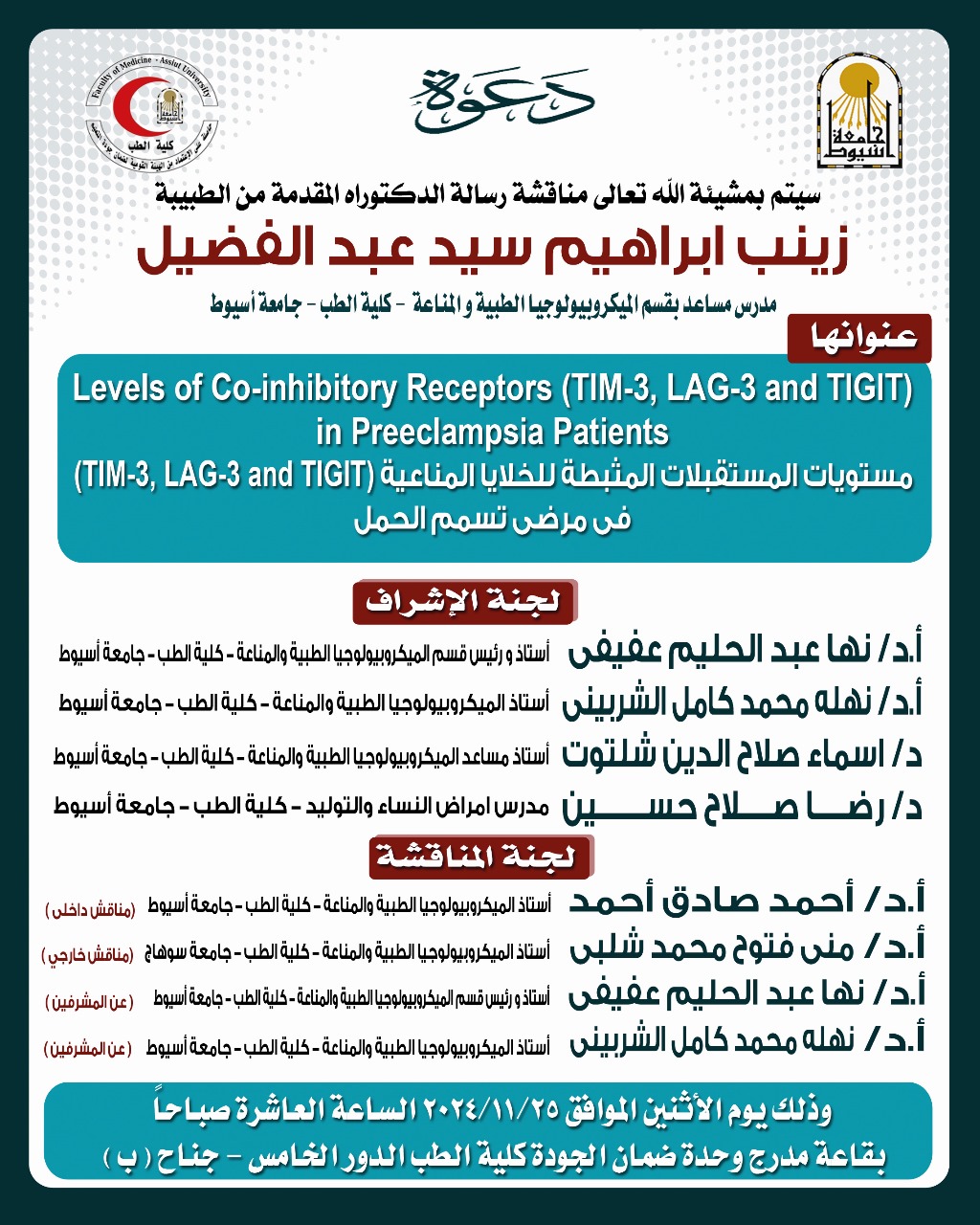
Discussion of the doctoral thesis of Dr. Zainab Ibrahim Sayed Abdel Fadil - Assistant Lecturer, Department of Microbiology - Faculty of Medicine - Assiut University
Introduction: Trichomoniasis remains one of the most significant sexually
transmitted disease (STDs) for public health. The disease is caused by parasitic
protozoa, Trichomonas vaginalis (T. vaginalis), which is often underestimated in
tropical medicine. Despite its public health importance, the epidemiology and
molecular characteristics of trichomoniasis in Egypt remains poorly understood,
particularly in the southern part of the country (Upper Egypt). This study targeted
exploring the genetic variability of T. vaginalis infections in Egyptian women
living in Upper Egypt using restriction fragment length polymorphism (RFLP).
Patient and techniques: This cross-sectional study included 150 female patients,
who visited the gynaecology and obstetrics outpatient clinics at Sohag General
Hospital between 2019 and 2022, exhibiting symptoms of trichomoniasis.
Vaginal washout samples were collected from each patient and analyzed using
three diagnostic techniques: direct wet mount microscopy, culture on TYM
Diamond’s medium, and PCR amplification and Polymerase Chain Reaction-
Restriction Fragment Length Polymorphism (PCR-RFLP) targeting the actin
gene, which was applied to all 16 samples that tested positive in culture. The
PCR-RFLP results were then visualized through agarose gels electrophoresis to
detect DNA fragments.
Results: Out of 150 vaginal washout samples, 12 cases (8%) tested positive for
T. vaginalis trophozoites via direct wet mount microscopy, while 16 samples
(10.6%) were positive in culture. Additionally, PCR-RFLP analysis of the 16
culture-positive samples revealed that 13 samples were confirmed positive
using this molecular method. The amplified products were digested with the
restriction enzyme Hind II, yielding three DNA fragments of 60, 213, and 827 bp,
which were then detected by agarose gel electrophoresis. Digestion with RsaIproduced five fragments measuring 87, 103/106, 236, and 568 bp, while MseI digestion resulted in three distinct fragments of 204, 315, and 581 bp.
Conclusion: This study provides robust baseline data on the prevalence and microscopic characteristics of T. vaginalis in Upper Egypt, while also presenting, for the first time, molecular detection and genotyping and revealed that genotype E is the only prevalent genotype in the region.
Aim: This research is a descriptive epidemiological study aimed to investigate the patient reported outcomes and expression of chronic pelvic pain of different etiologies and difference between males and females regarding the impact of pain on different life aspects including social and economic aspects.
Patient & method: This study was a descriptive analysis including patients diagnosed with chronic pelvic pain who visited pain management clinic at Assiut University hospital between 2018 and 2023. Five hundred patients diagnosed with CPP were allocated into two groups: 140 males and 360 females. All cases were monitored to assess the visual analog scale (VAS), PESQ, and health VAS scores. During the follow-up, the patients' efficacy evaluation and the administration of analgesics were documented.
Results: Regarding the type of pelvic pain in females, it was gynecological in 46.11% of patients, urological in 24.44% of patients; VAS was not significantly different between both patients. PSEQ was markedly elevated in male cases in comparison to female cases, with a P value of less than
Russell–Silver syndrome (RSS) is an uncommon but well-known imprinting condition primarily characterized by postnatal development failure and idiopathic intrauterine growth retardation (IUGR) and an inverted triangular face and a prominent forehead with relative macrocephaly that distinguish it from idiopathic IUGR and other causes of postnatal growth failure. Few case reports of RSS with cleft palate have been published and those who have perioperative issue such difficult intubation owing to trismus and difficulty to use a mouthpiece due to mandibular development failure.
Case presentation
Female child with RSS was subjected to cataract surgery performed under general anesthesia. Despite limited mouth opening and short thyro-mental distance, the intubation was relatively easy. The patient was extubated and moved to the postoperative care area. Postoperative interval passed uneventful …
Infective endocarditis (IE) is defined as an infection of the endocardium, or inner surface of the heart, most frequently affecting the heart valves or implanted cardiac devices. Despite its rarity, it has a high rate of morbidity and mortality. IE generally occurs when bacteria, fungi, or other germs from another part of the body, such as the mouth, spread through the bloodstream and attach to damaged areas in the heart. The epidemiology of IE has changed as a consequence of aging and the usage of implantable cardiac devices and heart valves. The right therapeutic routes must be assessed to lower complication and fatality rates, so this requires early clinical suspicion and a fast diagnosis. It is urgently necessary to create new and efficient medicines to combat multidrug-resistant bacterial (MDR) infections because of the increasing threat of antibiotic resistance on a worldwide scale. MDR bacteria that cause IE can be treated using phages rather than antibiotics to combat MDR bacterial strains. This review will illustrate how phage therapy began and how it is considered a powerful potential candidate for the treatment of MDR bacteria that cause IE. Furthermore, it gives a brief about all reported clinical trials that demonstrated the promising effect of phage therapy in combating resistant bacterial strains that cause IE and how it will become a hope in future medicine.
An emerging multidrug-resistant pathogenic yeast called Candida auris has a high potential to spread quickly among hospitalized patients and immunodeficient patients causing nosocomial outbreaks. It has the potential to cause pandemic outbreaks in about 45 nations with high mortality rates. Additionally, the fungus has become resistant to decontamination techniques and can survive for weeks in a hospital environment. Nanoparticles might be a good substitute to treat illnesses brought on by this newly discovered pathogen. Nanoparticles have become a trend and hot topic in recent years to combat this fatal fungus. This review gives a general insight into the epidemiology of C. auris and infection. It discusses the current conventional therapy and mechanism of resistance development. Furthermore, it focuses on nanoparticles, their different types, and up-to-date trials to evaluate the promising efficacy of nanoparticles with respect to C. auris.
The severe acute respiratory syndrome coronavirus-2 (SARS-CoV-2) pandemic is still difficult to be controlled. The spread of this virus and the emergence of new variants are considered a great challenge worldwide. Disturbance in infection control guidelines implementation, use of steroids, antibiotics, hospital crowdedness, and repeated use of oxygen masks during the management of critically ill COVID-19 patients lead to an increase in the rate of opportunistic infections. So, patients need to fight both the virus with its different variants and opportunistic pathogens including bacteria and fungi especially patients with diabetes mellitus, malignancy, or those who undergo hemodialysis and receive deferoxamine. During the pandemic, many cases of Mucormycosis associated with COVID-19 infection were observed in many countries. In this review, we discuss risk factors that increase the chance of infection by opportunistic pathogens, especially fungal pathogens, recent challenges, and control measures.
Background
Hepatitis C viral (HCV) infection is associated with systemic inflammation and metabolic complications that might predispose patients to cerebrovascular atherosclerosis and may report neurocognitive complaints.
Objective
This case-control study aimed to assess cerebrovascular and cognitive changes in patients with chronic hepatitis C (CHC) infection.
Patients and methods
Transcranial color Doppler assessment of cerebrovascular reactivity and cognitive abilities screening instruments (CASI) was conducted in 100 CHC patients and 100 healthy controls. All enrolled patients were evaluated by Fibroscan and the current study employed a cut-off of ≤12.5 kPa for excluding cirrhosis.
Results
Compared to controls, CHC patients had significantly lower scores on CASI and its components. Patients had significantly lower-middle carotid artery (MCA) intimal media thickening (IMT), peak systolic velocity (PSV), end-diastolic velocity (EDV), and mean flow velocity (MEV) than controls. Additionally, the total CASI score significantly correlated with PSV and EDV of MCA and negatively correlated with IMT, pulsatility index (PI), and resistance index (RI).
Conclusion
CHC patients have impaired cognitive function that may be associated with cerebrovascular affection in absence of cirrhosis. Future multi-center studies with the evaluation of the effect of antiviral on cerebrovascular reactivity and cognitive function in such patients are warranted.