
Effect of Adding Different Nano Particles on Antimicrobial Properties of Heat Cured Acrylic Resin

Research Abstract

ABSTRACT

Aim: This study was performed to examine the anti-microbial effect of different percentages of titanium dioxide and chitosan nanoparticles to heat cured poly methyl meth acrylate.

Subjects and methods: 120 specimens of heat cure acrylic resin were grouped according to nano additives concentrations for testing anti-microbial effect.

Results: the addition of chitosan nano particles to PMMA in 0.3% and 0.5% decreased the microbial biofilm formation in comparison to the control (PMMA without chitosan). the addition of Tio2 nano particles in concentrations 1% and 2% decreased the microbial biofilm formation more than the chitosan nano particles concentrations 0.3 and 0.5.

Conclusion: The addition of chitosan nano particles to PMMA in 0.3% and 0.5% decreased the microbial biofilm formation in comparison to the control (PMMA without chitosan). the addition of Tio2 nano particles in concentrations 1% and 2% decreased the microbial biofilm formation more than the chitosan nano particles. The higher concentrations of the chitosan and Tio2 nano particles resulted in stronger antimicrobial effect.

Research Authors
Ali Sayed*1, Ahmed Mohamed Moharram2 , Mohamed Mahmoud Elsokkary
Research Date
Research Department
Research Journal
AL-AZHAR Assiut Dental Journal
Research Member
Research Pages
75:84
Research Publisher
AL-AZHAR Assiut Dental Journal
Research Rank
Local
Research Vol
7
Research Website
https://journals.ekb.eg/article_356319.html
Research Year
2024

EFFECT OF ADDING TIO2 NANOPARTICLES ON THE MECHANICAL PROPERTIES OF HEAT CURED ACRYLIC RESIN BEFORE AND AFTER THERMOCYCLING

Research Abstract

Objective:

The aim of this study was to evaluate the effect of different concentrations of titanium dioxide nanoparticles on the mechanical properties of heat polymerized acrylic resin before and after thermocycling. The tested parameters were flexural strength and hardness.

Material and Methods: 120 specimens were prepared according to the specific dimension for each test (flexural strength and micro hardness) and distributed into: - Before thermocycling (control, (TiO2) nanoparticles with concentration (0.1% and 0.2%). - After thermocycling (control, (TiO2) nanoparticles with concentration (0.1% and 0.2%). Thermal cycles were performed in a thermocycling machine consisted of 5000 cycles at 5°C and 55°C. Results: Flexural strength and micro hardness were tested for both groups. The data was collected and statistically analyzed. Both Flexural strength and micro hardness were decreased by adding TiO2 nano particles concentrations.

Conclusion: adding (TiO2) nanoparticles to methyl methacrylate adversely affects the flexural strength and micro hardness before and after thermocycling.

Research Authors
Bayiumy Ali Sayed, and Elsokkary Mohammad Mahmoud
Research Date
Research File
Research Pages
675:681
Research Publisher
EGYPTIAN DENTAL JOURNAL
Research Rank
Local
Research Vol
69
Research Website
https://edj.journals.ekb.eg/article_282947.html?fbclid=IwAR0m0DSGNRxnCgt8g0lD5a4s_etaMD5OH9q00qoOZRUDRCp-HYCnMicHPVA
Research Year
2023

EFFECT OF ADDING CHITOSAN NANOPARTICLES ON FLEXURAL STRENGTH AND HARDNESS OF HEAT CURED ACRYLIC RESIN BEFORE AND AFTER THERMO CYCLING

Research Abstract

ABSTRACT


Objective: The aim of this study was to evaluate the effect of two concentrations of chitosan
nanoparticles on the mechanical properties of heat polymerized acrylic resin before and after thermocycling.
The tested parameters were flexural strength and hardness.


Material and Methods: 120 specimens were prepared according to the specific dimension for
each test (flexural strength and micro hardness) and distributed into:
- Before thermocycling (control, chitosan nanoparticles with concentration 0.3% and 0.5%)
- After thermocycling (control, chitosan nanoparticles with concentration 0.3% and 0.5%)


Results: Flexural strength and micro hardness were tested for both groups. The data was collected
and statistically analyzed. Flexural strength was non-significantly increased for ratio of 0.3%
chitosan nanoparticles in comparison to control before and after thermo cycling and significantly
decreased for 0.5% chitosan nanoparticles before thermocycling and non-significant decrease after
thermocycling in comparison to control. For hardness showed non-significant decrease for both
concentrations and significant decrease for control after thermocycling


Conclusion: Adding chitosan nanoparticles to heat cured acrylic resin increased the flexural
strength for 0.3% ratio and non-significantly decreased for 0.5, while decreased non-significantly
micro hardness for both concentrations.


Research Authors
Ali Sayed* and Mohamed Mahmoud El Sokkary**
Research Date
Research Department
Research File
Research Journal
EGYPTIAN DENTAL JOURNAL
Research Member
Research Pages
1181:1187
Research Publisher
EGYPTIAN DENTAL JOURNAL
Research Rank
Local
Research Vol
69
Research Website
https://edj.journals.ekb.eg/article_294092.html
Research Year
2023

EFFECT OF ADDING CHITOSAN NANOPARTICLES ON FLEXURAL STRENGTH AND HARDNESS OF HEAT CURED ACRYLIC RESIN BEFORE AND AFTER THERMO CYCLING

Research Abstract

ABSTRACT


Objective: The aim of this study was to evaluate the effect of two concentrations of chitosan
nanoparticles on the mechanical properties of heat polymerized acrylic resin before and after thermocycling.
The tested parameters were flexural strength and hardness.


Material and Methods: 120 specimens were prepared according to the specific dimension for
each test (flexural strength and micro hardness) and distributed into:
- Before thermocycling (control, chitosan nanoparticles with concentration 0.3% and 0.5%)
- After thermocycling (control, chitosan nanoparticles with concentration 0.3% and 0.5%)


Results: Flexural strength and micro hardness were tested for both groups. The data was collected
and statistically analyzed. Flexural strength was non-significantly increased for ratio of 0.3%
chitosan nanoparticles in comparison to control before and after thermo cycling and significantly
decreased for 0.5% chitosan nanoparticles before thermocycling and non-significant decrease after
thermocycling in comparison to control. For hardness showed non-significant decrease for both
concentrations and significant decrease for control after thermocycling


Conclusion: Adding chitosan nanoparticles to heat cured acrylic resin increased the flexural
strength for 0.3% ratio and non-significantly decreased for 0.5, while decreased non-significantly
micro hardness for both concentrations.

Research Authors
Ali Sayed* and Mohamed Mahmoud El Sokkary**
Research Date
Research File
Research Journal
EGYPTIAN DENTAL JOURNAL
Research Pages
1181:1187
Research Publisher
EGYPTIAN DENTAL JOURNAL
Research Rank
Local
Research Vol
69
Research Website
https://edj.journals.ekb.eg/article_294092.html
Research Year
2023

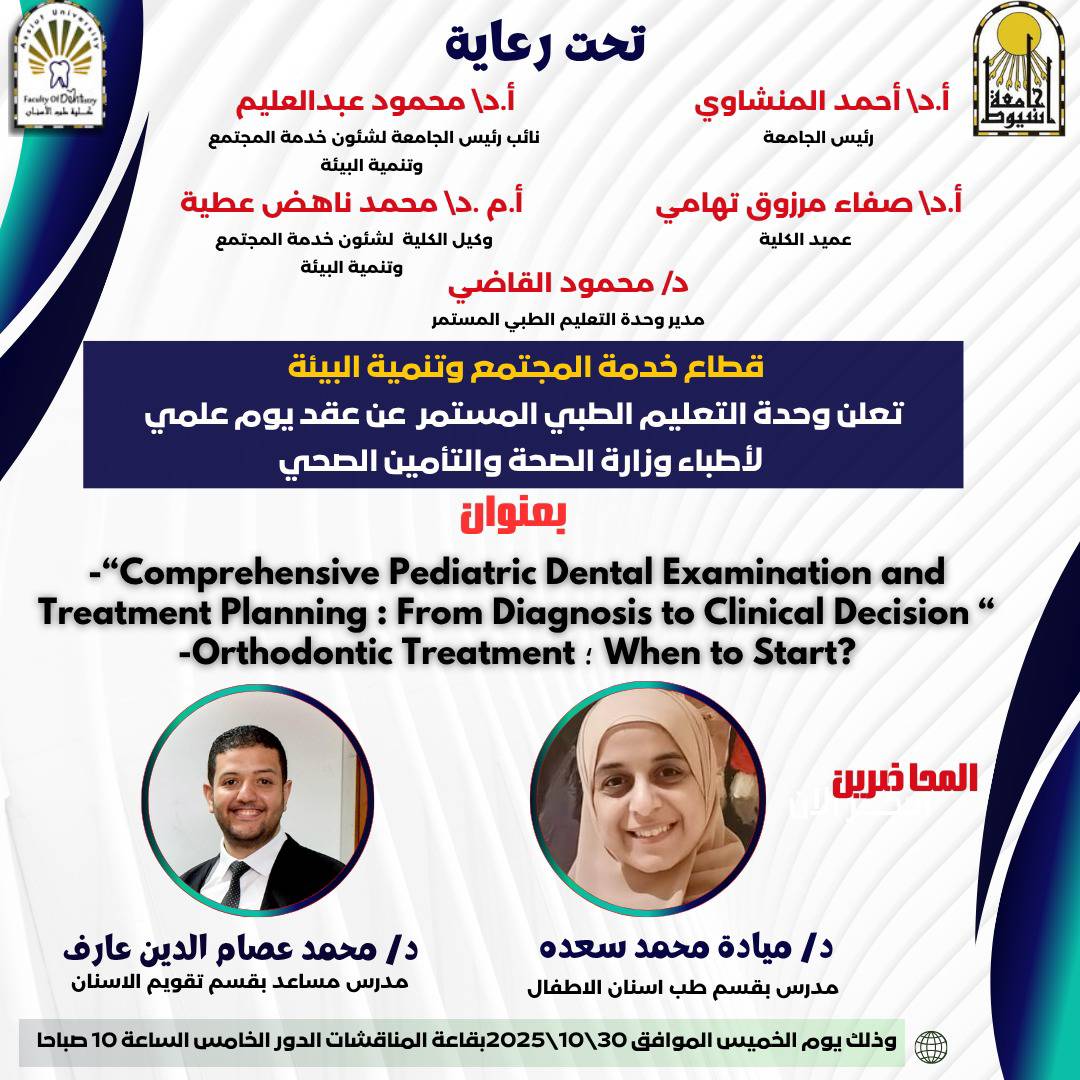
The fourth awareness day for parents of children visiting the outpatient clinics at the Dental Hospital.

تحت رعاية أ.د أحمد المنشاوي - رئيس الجامعه أ.د محمود عبد العليم - نائب رئيس الجامعه لشئون خدمة المجتمع و تنمية البيئة أ.د صفاء تهامي - عميد الكلية أ.م.د محمد ناهض عطيه - وكيل الكلية لشئون خدمة المجتمع و تنمية البيئة نظم قسم طب أسنان الأطفال بالتعاون مع قطاع خدمة المجتمع و تنميه اليوم التوعوي الرابع لأولياء أمور الأطفال المترددين علي العيادات الخارجيه بذات القسم يوم الأربعاء الموافق ٩ إبريل و ذلك ضمن سلسله من الأيام التوعويه التي يتم انعقادها الأسبوع الأول من كل شهر تضمنت المحاضرة توعية لأولياء الأمور بالعادات الخاطئه الي تؤثر بالسلب علي صحة الفم للأطفال و طرق الوقايه بالإضافة قام بإلقاء المحاضره ط / ياسمين رمضان - معيد طب أسنان الأطفال دمتم في حفظ الله و امنه

0000


Effectiveness of low-level laser therapy and topical steroid therapy in the management of oral lichen planus

Research Abstract

Corticosteroids are the most common treatment for oral lichen planus, a long-term immune-related condition, which is considered the most effective treatment. Photobiomodulation is a viable alternative treatment that can successfully treat various pathological disorders by relieving pain, decreasing inflammation, and facilitating tissue healing. Unlike steroid medications, photobiomodulation does not have any associated disadvantages. This study aimed to assess and compare the effects of topical application of 0.1% triamcinolone acetonide and photobiomodulation on erosive oral lichen planus. Methods: A randomized controlled clinical trial was conducted in this investigation, which involved 20 patients who were suffering from erosive oral lichen planus. The control group (n= 10) was administered a 0.1% topical solution of triamcinolone acetonide 3 times daily and a miconazole oral gel once daily, for 4 weeks. The patients in the second group (n = 10) engaged in laser therapy twice a week for 8 sessions over 4 weeks, utilizing a 980 nm diode laser with an output power of 300 mw. Pain and clinical scores of patients were evaluated at the start and 4 weeks postoperatively. Results: Both groups were not significantly different from one another, and both had substantial improvements in pain and clinical scores. Conclusions: Low-Level Laser therapy showed potential as a therapeutic approach for treating erosive oral lichen planus, offering an alternative to steroid therapy without the associated adverse effects.
 

Research Authors
Omar H. Soliman, Eisa M. Hegazy, Eman M. Abdulhady, Asem M. Kamel, Mahmoud A. Attia, Nicola Baldini, Hayder R. Abdulbaqi, Ahmed M. Fekry, Rahma G. Mostafa, Ahmed M. Hussein
Research Date
Research Department
Research Journal
Journal of Baghdad College of Dentistry
Research Pages
1817-1869
Research Publisher
Baghdad College of Dentistry
Research Vol
37 (1)
Research Website
https://jbcd.uobaghdad.edu.iq/index.php/jbcd/article/view/3914
Research Year
2025

Effect of fig on relapse during retention period after orthodontic treatment (animal study)

Research Abstract

Abstract

Objective: to evaluate the effect of fig on relapse during retention phase after orthodontic treatment in animals.

Materials and methods: Twenty rabbits were divided into two groups, Group 1 (control group): normal diet. Group 2: Fig added to the normal diet. Each rabbit received orthodontic appliance to apply force on the lower incisors in order to create a 3–4 mm space. Following space opening, the device served as passive retainer for six weeks, during which the animals got fig with regular diet. The appliance was removed after six weeks, and an impression was taken. The teeth then allowed to relapse for four weeks, then another impression was taken for postrelapse measurement. The space between incisors was measured. Animals were sacrificed and blocks were taken and prepared for histological study.

Results: Relapse was significantly lower in Fig group than in the control group.

Conclusion: Fig increases osteoblastic activity while decreases osteoclastic activity, both of which are beneficial consequences on bone health, which decreases the amount of post orthodontic relapse

Research Authors
Mohamed E. Mohamed 1 , Wael M. Refai 2 , Mostafa A. Mohammed 3
Research Date
Research Department
Research File
Research Journal
Egyptian Orthodontic Journal
Research Member
Research Pages
12-18
Research Publisher
Egyptian Orthodontic Journal
Research Rank
Local
Research Vol
66
Research Website
https://eos.journals.ekb.eg/article_391602.html#:~:text=Conclusion%3A%20Fig%20increases%20osteoblastic%20activity,amount%20of%20post%20orthodontic%20relapse%20.
Research Year
2024
Subscribe to