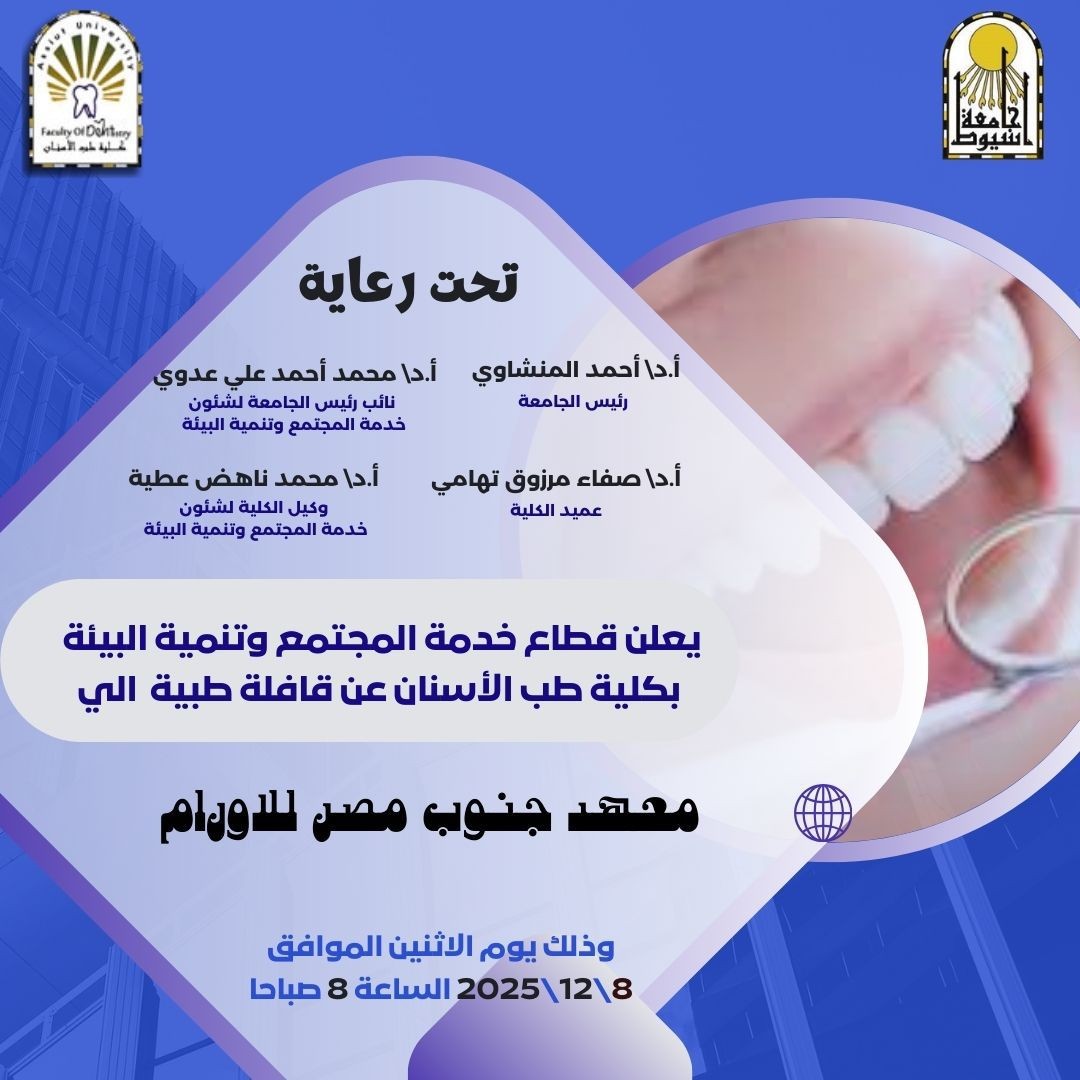

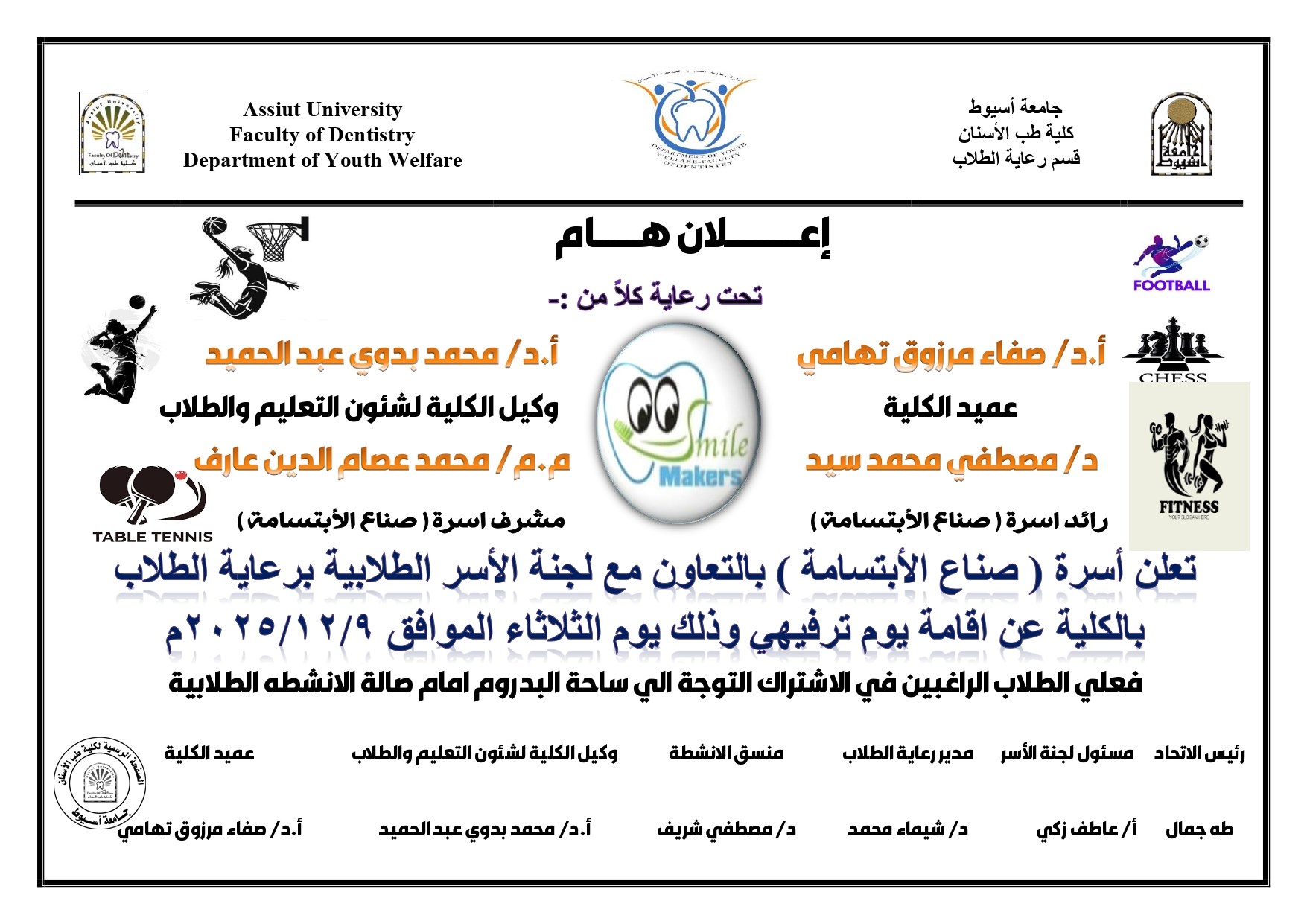

بالتعاون مع قطاع خدمة المجتمع و تنمية البيئة بكلية الطب
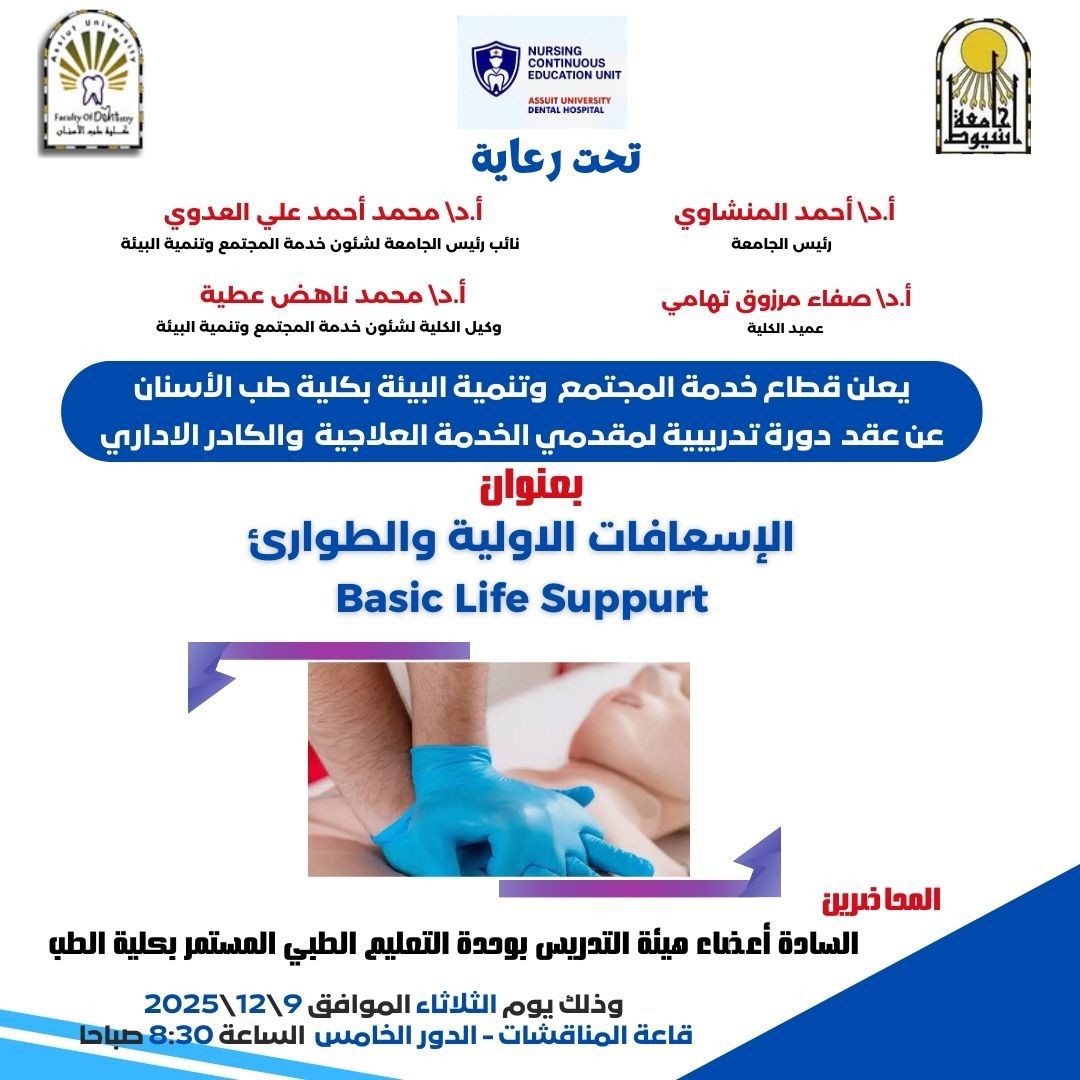
يعلن قطاع خدمة المجتمع و تنمية البيئة بكلية طب الأسنان بالبدء في تنفيذ برنامج تدريبي متكامل للعاملين من مقدمي الخدمة الطبيه و الكادر الإداري و ذلك بهدف رفع كفاءتهم بما يسهم في تطوير جودة الخدمات الطبية و الإدارية
Abstract:
Aim: The purpose of this study was to investigate the fracture resistance and marginal gap of two
different designs of occlusal veneers made of two different ceramic materials.
Materials and Methods: In this study, sixty recently extracted maxillary premolars were utilized. Two groups
of teeth were randomly selected based on the type of occlusal veneer material. (n =30 each). The
teeth in the first group were fixed using occlusal veneers made of advanced Lithium Disilicate,
(CEREC Tessera™, Dentsply Sirona, Germany)(T), whereas the polymer-infiltrated hybrid
ceramic was used for the occlusal veneer in the second group. (Vita Enamic, Vita Zahnfabrik,
Germany) (E). Each group was further subdivided into 2 subgroups (n =15 each) according to the
preparation design. Traditional occlusal reduction was used to prepare the teeth in the first
subgroup. (planner preparation)(P). In the second subgroup, the reduction of teeth included the
occlusal surface and 1 mm axial reduction with rounded shoulder finish line (modified = M). The
veneers were designed and manufactured using CAD/CAM technology. A universal testing
machine was used to measure the fracture resistance. A single static compressive load was applied
to each restoration along the tooth's long axis until fracture occurred. A single static compressive
load was applied to each restoration along the tooth's long axis until fracture occurred.
Results: The findings demonstrated that there was a statistically significant difference in the
fracture resistance of the two preparation designs of the two materials. (P≤ 0.05), the subgroups
of CEREC Tessera™, recorded, higher significant difference than Enamic in the two
preparations. The results of the statistical tests demonstrated that the relationship between the
2
preparation designs and materials, found to have a substantial impact on the fracture resistance
difference.
Conclusions: Selecting a particular preparation design should be linked to a thorough
understanding of the occlusal veneers' material properties. Both substances could be applied to
restorations involving occlusal veneers.. CEREC Tessera had a fracture resistance that gave better
values, qualitatively and quantitatively.
Aim: The current research intended to assess the efficiency of mechanical and/or chemical cleaning methods (Ultrasonic and/or Acetone) of endodontic sealer remanent on the pulp chamber dentine and its outcome on the bond strength with composite restoration to the pulp chamber by the micro tensile bond strength (μ-TBS), and its failure modes by stereomicroscopy.
Method: 40 human permanent lower molars were selected to be used in this study. Every tooth has decoronated to 4 mm coronal to cementoenamel junction. The root canals were prepared via ProTaper Gold. ProTaper Gold obturators #F3 and AH Plus sealer were used for filling the canals. 2 mm apically of the occlusal gutta percha was removed to make a space for liner material. Glass ionomer restorative was used as liner material over the gutta percha to the level pulp chamber floor. The obturated teeth were then randomized divided into four identical test groups with 10 molars in every group. Group 1(Ultrasonic Cleaning) the sealer remnant was cleaned by Ultrasonic tip ET 20D, Group 2 (Acetone) the sealer remnant was cleaned by Acetone. Group 3 (Acetone / Ultrasonic) the sealer remnant was cleaned by both Acetone / Ultrasonic, and the Group 4 (Control) was not comminated with the sealer. All teeth were received Bulk Fill Restorative composite to fill the pulp chamber, the preparing the teeth for the μ-TBS test and determining the types of failure modes.
Results: Group 1 (Ultrasonic Cleaning) had the greatest reported μ-TBS (38.50 ± 7.91), while the least μ-TBS was reported in Group 2 (Acetone) 31.80 ± 7.42 with statistically significant different (p = 0.007).On other hand Group 1(Ultrasonic Cleaning), and Group 3 (Acetone / Ultrasonic) showed results similar to the results of Control Group with non-statistically significant different (P > 0.05). In concerning the distribution of failure mode, showed that the mixed-type failure mode (54%) was the most common one seen in Group 1 (Ultrasonic Cleaning), (51%) recorded in Group 4 (Control), (50%) recorded in Group 3 (Acetone / Ultrasonic), and the lowest was (39%) recorded in Group 2 (Acetone). While the distribution of adhesive failure mode was (45%) recorded in groups Group 2 (Acetone), (37%) recorded in Group 3 (Acetone / Ultrasonic), and (30%) recorded in both Group 1(Ultrasonic Cleaning) & Group 4 (Control).
Conclusion: Mechanical removal of resin sealer remanent by Ultrasonic Cleaning gives good condition for increasing the μ-TBS of composite restoration to the pulp chamber dentine of endodontically treated molars.
The study aimed to develop and validate the functional empathy educational scale (FEES), a novel instrument designed to assess empathy among dental educators.
A web-based questionnaire, including a cover letter and consent form, was distributed to dental educators across three countries. Statistical analyses were conducted to assess the scale's validity, reliability, and variations in empathy based on demographic and professional variables.
The FEES demonstrated strong internal consistency (Cronbach's alpha = 0.80). Empathy levels varied significantly by gender, country, teaching experience, and dental specialty. Notably, 11% of educators exhibited the highest empathy levels, while 5% displayed the lowest. The majority (84%) showed moderate empathy. Female educators scored significantly higher in empathy compared to males (p < 0.001). Among the countries, the Kingdom of Saudi Arabia showed the highest empathy levels (p < 0.001), followed by Egypt and India (p = 0.76). No significant differences were identified concerning teaching experience (p = 0.184) or dental specialty (p = 0.377).
The FEES showed acceptable reliability and validity, positioning it as a valuable tool for evaluating empathy in dental and medical education settings.
ABSTRACT
Aim: to quantify the effect of presence of enamel wall and thermocycling on
marginal microleakage of class V cavities restored with preheated bulk-fill or preheated
nano-filled composite.
Methods: Class V cavities were prepared on the buccal surface
of forty-eight extracted maxillary first premolars. The teeth were divided into two groups
according to the type of preheated composite used (either bulk-fill or Nano-filled) and
further subdivided according to thermocycling or no thermocycling. The teeth were
immersed in 0.5% methylene blue dye solution for 24 hours at room temperature
and then sectioned buccolingually to examine the extent of microleakage by dye
penetration. Microleakage was assessed by a stereomicroscope at 40x magnification
and measured in micrometers depending on the extent of dye penetration for both
occlusal and gingival walls separately. Statistical analysis was done by Kruskal-Wallis
test for comparison between groups and Mann-Whitney test for comparing occlusal
and gingival dye penetration in each group.
Results: preheated Nano-filled composite
subjected to thermocycling showed more significantly microleakage than other groups
(P < 0.05). Microleakage was significantly more (P < 0.05) in gingival (cervical)
walls of teeth compared to occlusal walls in all groups except preheated Nano-filled
composite directed to thermocycling which showed no significant difference between
gingival and occlusal walls (P > 0.05).
Conclusions: thermocycling of preheated Nanofilled
composite produced more microleakage than thermocycling of preheated bulkfilled
composite. More microleakage was recorded in cervical areas than occlusal areas
of class V cavities.
Abstract:
Objectives: The disinfection of fabricated prostheses is crucial to prevent crossinfection
between dental laboratories and clinics. However, there is a lack of information
about the effects of chemical disinfection on 3D-printed denture base resins. This study
aimed to evaluate the impact of different disinfectants on the flexural strength, elastic
modulus, micro-hardness, surface roughness (Ra), and change in color of 3D-printed and
conventional heat-polymerized (HP) denture base resins (DBRs).
Methods: A total of
240 specimens (80 bar-shaped (64 × 10 × 3.3 mm) and 160 disk-shaped (10 × 2 mm))
were made from HP and 3D-printed DBRs. For each resin, the specimens were divided
into four groups (n = 10) according to the disinfectant solution. One remained in water
without disinfection as a control group, while the other three groups were disinfected
using 1% sodium hypochlorite, 2% glutaraldehyde, or 10% Micro 10+ for 30 min. The
flexural strength, elastic modulus, micro-hardness, Ra, and color change were measured.
The collected data were statistically analyzed using a two-way ANOVA and Tukey’s post
hoc test (α = 0.05).
Results: A significant decrease in flexural strength, elastic modulus, and
hardness was found with sodium hypochlorite (p < 0.05). When comparing the resins per
solution, the 3D-printed resin showed a significant decrease in flexural strength, elastic
modulus, and hardness compared with PMMA (p < 0.001), while no change was found in
the Ra of both resins with all disinfectants (p > 0.05). Disinfecting with sodium hypochlorite
resulted in a significant increase in color change for both resins (p < 0.05); however, all the
changes were within clinically acceptable limits. Sodium hypochlorite showed the highest
color change, while 2% glutaraldehyde and 10% Micro 10+ showed no significant changes
in the tested properties (p > 0.05).
Conclusions: Neither resin showed a change in surface
roughness with immersion in disinfectants. Sodium hypochlorite had an adverse effect on