




Do you have any questions? (088) 2080369 - 2345622 Pharmacy_QAAU@pharm.aun.edu.eg

The kidney is considered the main site for the net release of Tyrosine (Tyr) to the circulation through hydroxylation of Phenylalanine (Phe) using phenylalanine hydroxylase enzyme. In chronic kidney disease (CKD) patients the enzyme activity is impaired, therefore the serum concentration ratio of Tyr/Phe is reduced compared to healthy individuals. This motivates us to develop a cost effective, green, simple, sensitive, and selective HPTLC method to measure the levels of Tyr and Phe in serum samples. The analysis was carried out using acetonitrile: ethanol: 25% ammonia solution: ethyl acetate (6.5: 1.5: 1: 0.5) as a mobile phase. Rf values were 0.55 ±0.05 for Phe and 0.39 ±0.05 for Tyr. Densitometry scanning was performed using UV detector and dual wavelengths of 210 and 225 nm were obtained. A linear correlation was observed between the levels of Phe and Tyr, ranging from 50 to 700 ng band- 1 and 50 to 600 ng band- 1, respectively, under the optimum conditions. The method selectivity, linearity, precision, accuracy, and robustness were all confirmed in accordance with ICH recommendations. Calculations of the separation and resolution factors, number of theoretical plates, and height equivalent to theoretical plates prove to the chromatographic system accuracy and high separation efficiency. The developed method exhibits an acceptable eco-scale when measuring the method greenness using AGREE and GAPI softwares. It was applied for the determination of Phe and Tyr concentrations in human serum samples.
In recent years, there has been considerable interest in using amino acids like tryptophan (Trp) and tyrosine (Tyr) as biomarkers for various diseases, including type 2 diabetes mellitus (T2D). In diseases like T2D, the metabolism of Trp and Tyr is altered. The activity of enzymes involved in Trp metabolism increases, leading to a decrease in its serum level. On the other hand, the serum level of Tyr increases due to the suppressed activity of its metabolizing enzymes. These observations suggest that Trp and Tyr metabolism may play a crucial role in the pathophysiology of type 2 diabetes. Our study highlights the potential utility of Trp and Tyr as biomarkers for the early detection, prognosis, and monitoring of this metabolic disorder. Given these observations, we aimed to develop a high-performance thin-layer chromatographic (HPTLC) method that is sensitive, selective, rapid, and environmentally friendly for esti‑ mating the concentrations of Trp and Tyr in biological fluids, particularly serum samples. To evaluate the method, we performed analysis using serum samples from controlled and streptozotocin-induced diabetic rats. Our main objec‑ tive was to develop a method that is sensitive and selective for precisely determining Trp and Tyr serum levels, which could serve as potential biomarkers for T2D. Fluorescence and absorption modes were employed for densitometry scanning. We assessed the precision and high separation efficiency of the chromatographic system by calculating parameters such as separation and resolution factors, number of theoretical plates, and height equivalent to theo‑ retical plates. To evaluate the environmental impact of our proposed method, we employed the AGREE (Analytical GREEnness metric) and GAPI (Green Analytical Procedure Index) greenness assessment tools. The results confirmed that our method is environmentally friendly and exhibits superior eco-friendliness and greenness compared to other reported methods.
The immune system is essential for the defense against infections and is critically implicated in various disorders, including im munodeficiency, autoimmunity, inflammation and cancer. The current study includes a new design of palmitoylated derivatives of thioglycolic acids (PTGAs) capable of triggering innate immune responses. The new series were accessible through a three- step synthetic route, including N- palmitoylation, Claisen–Schmidt condensation and thia- Michael addition. Their structures were elucidated using different 1D and 2D NMR spectroscopic techniques and their purity was confirmed by elemental analysis. The most active PTGAs induced a 12–26- fold increase in the expression of TNF- α and IL- 1β mRNA and triggered a marked re lease of NO in isolated macrophages. These levels were comparable to the responses elicited by heat- killed E. coli and S. aureus. The position of the palmitamide chain and aryl substitution had a significant effect on the TNF- α and IL- 1β mRNA expression and NO release. Simulations of molecular dockings showed that the new PTGA derivatives occupy the same TLR2/TLR6 het erodimer active binding site of the microbial diacylated lipoproteins. The new immunomodulators may have a profound impact on various clinical disorders associated with dysfunctional innate immunity.
L-Tyrosine (L-Tyr), an amino acid, has emerged as a potential biomarker for the detection and monitoring of liver cirrhosis (LC) and hepatocellular carcinoma (HCC). By analysing the serum levels of L-Tyr, healthcare pro fessionals can gain insights into the progression and development of these liver diseases. The utilization of L-Tyr as a biomarker holds potential for early detection and timely intervention, improving patient outcomes and treatment options. In this study we developed a novel nanocomposite based on eggshell waste and copper nanoparticles to modify carbon paste electrode (CPE) using chitosan gel as a binder for sensitive estimation of LTyr in human serum samples. The use of chitosan gel avoids the insulating effect of paraffin oil that was usually used for fabrication of CPE and enhance the sensitivity and selectivity of the modified electrode. Square wave voltammetry (SWV) was used to optimize the electrochemical parameters of the oxidation of L-Tyr onto the surface of the fabricated electrode (CuNPs@ESh/CS/CPE). The prepared composite was characterized using Xray diffraction (XRD), Fourier Transform - Infrared spectroscopy (FT-IR), UV–VIS spectroscopy and scan elec tron microscopy (SEM) and electrochemical impedence spectroscopy (EIS). The fabricated biosensor could es timate L-Tyr levels in controls, LC and HCC patients’ serum with high accuracy and sensitivity. The obtained results demonstrated the presence of significant difference in L-Tyr levels in the three studied groups. This in dicates that L-Tyr amino acid may serve as a crucial biomarker for the evaluation of such liver diseases.
Prof. Dr. Gihan Nabil Hassan Fetih– Dean of the Faculty
The Vice Deans, Department Heads, and the Faculty Secretary
Extend their heartfelt congratulations to the Faculty family on the occasion of the blessed Eid al-Fitr.
May Allah return it to the Islamic Ummah with goodness, blessings, and prosperity.
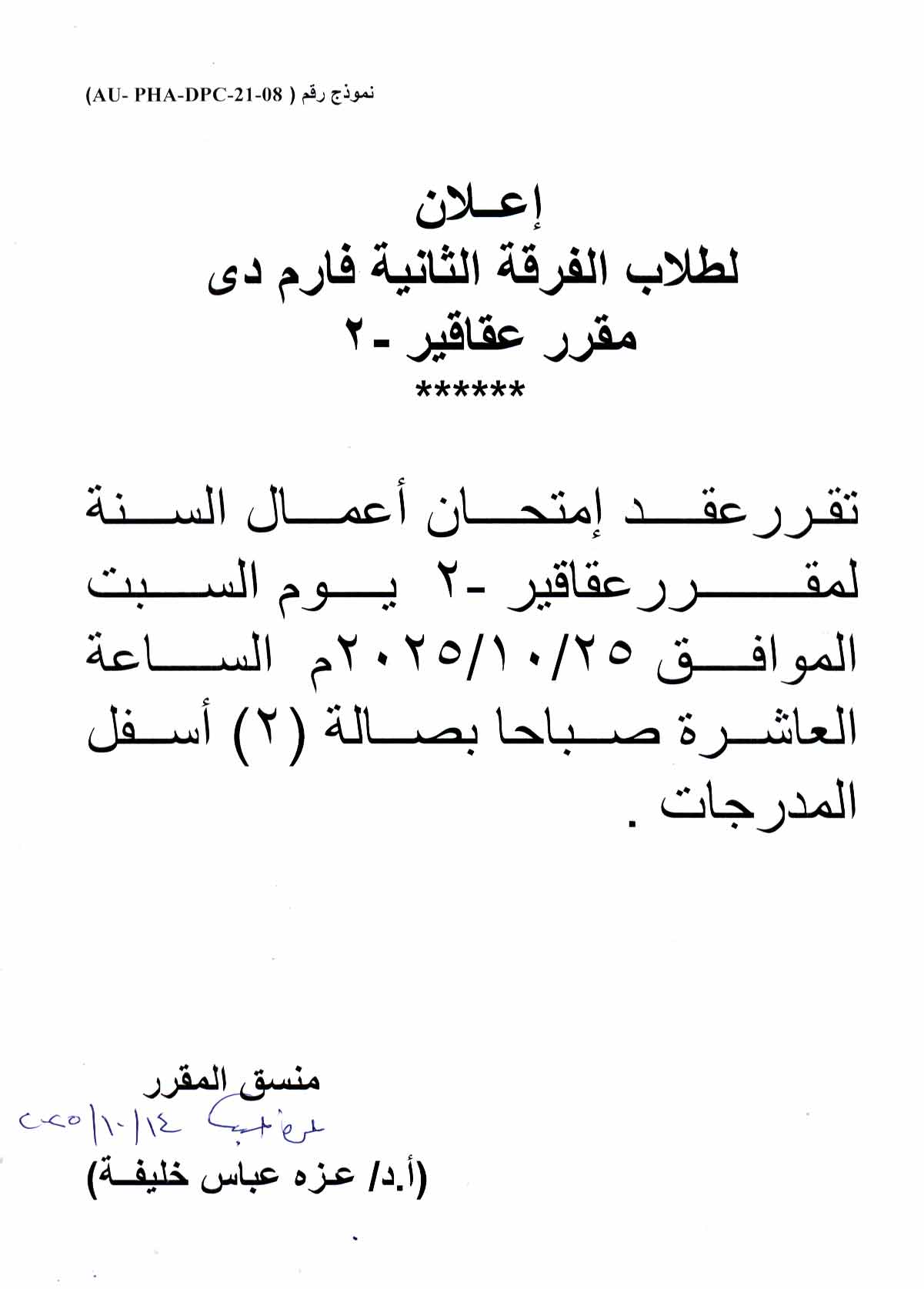
Mid-term exam for First-Year Students at the National University (Pharmacognosy-1 course) will be held on Thursday, April 10, at 4:00 PM in Halls No. (1, 2) below the lecture halls.
Student distribution is as follows:
|
Location |
Seat numbers: |
|
Hall (1) |
From 2404020001 to 2404020151 |
|
Hall (2) |
From 2404020152 to the last |

The seminar will take place at 1:00 PM in the Department Council Hall, Building (A), Fifth Floor.
The seminar title is:
Tacrolimus level Monitoring after living Donor Kidney Transplantation: Short-Term Evaluation
God willing, The Industrial Pharmacy Department Council will hold its regular monthly meeting No. (540), and that will be on Wednesday, April 9, 2025, at 11:00 AM
in the department’s meeting room.