Do you have any questions?

Schedule of the training program for master's students 2021 - in the elective subject - Department of Forensic Medicine
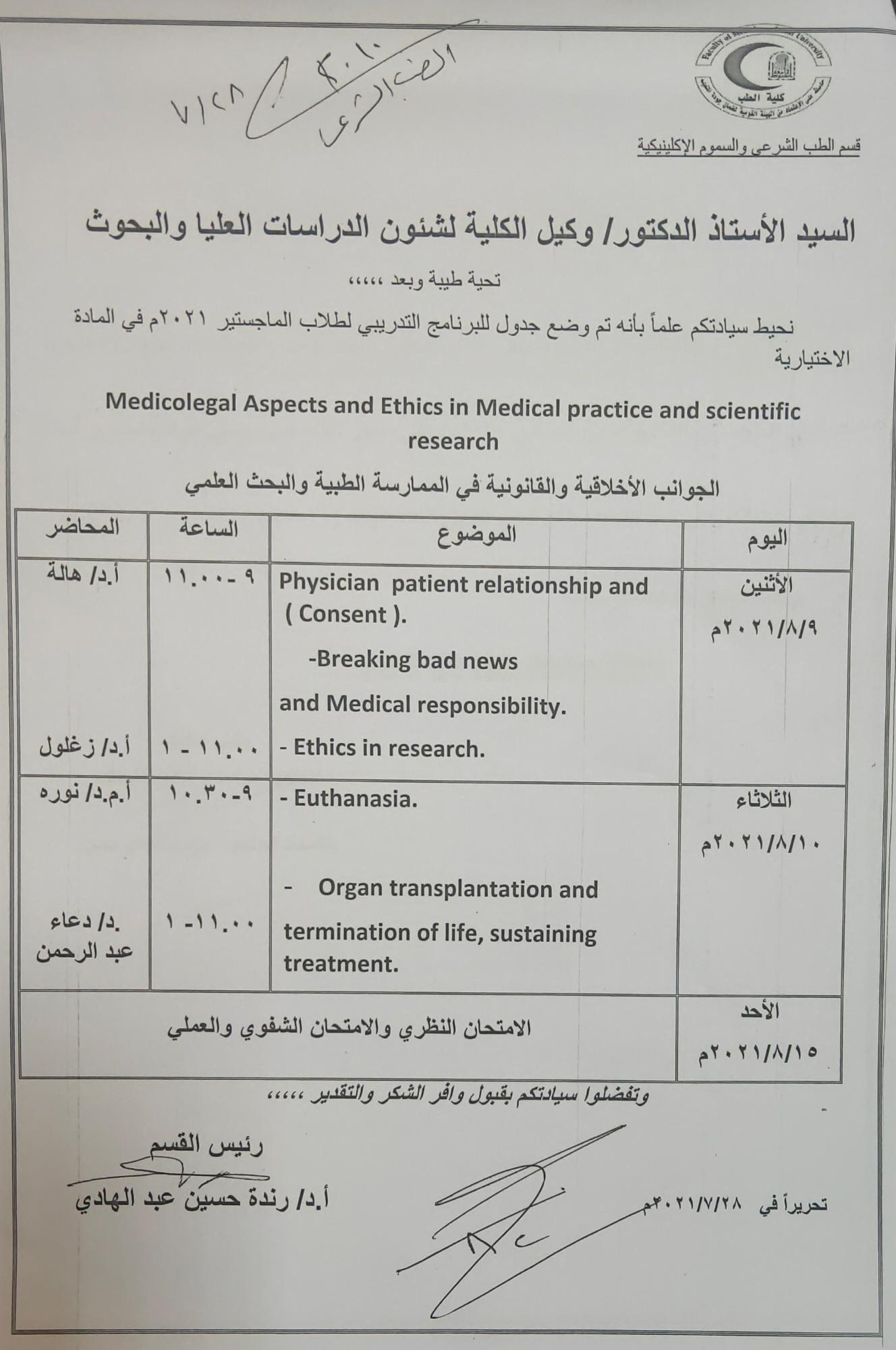
Schedule of the training program for master's students 2021 - in the elective subject - Department of Forensic Medicine
Schedule of the training program for master's students 2021 - in the elective subject - Department of Forensic Medicine
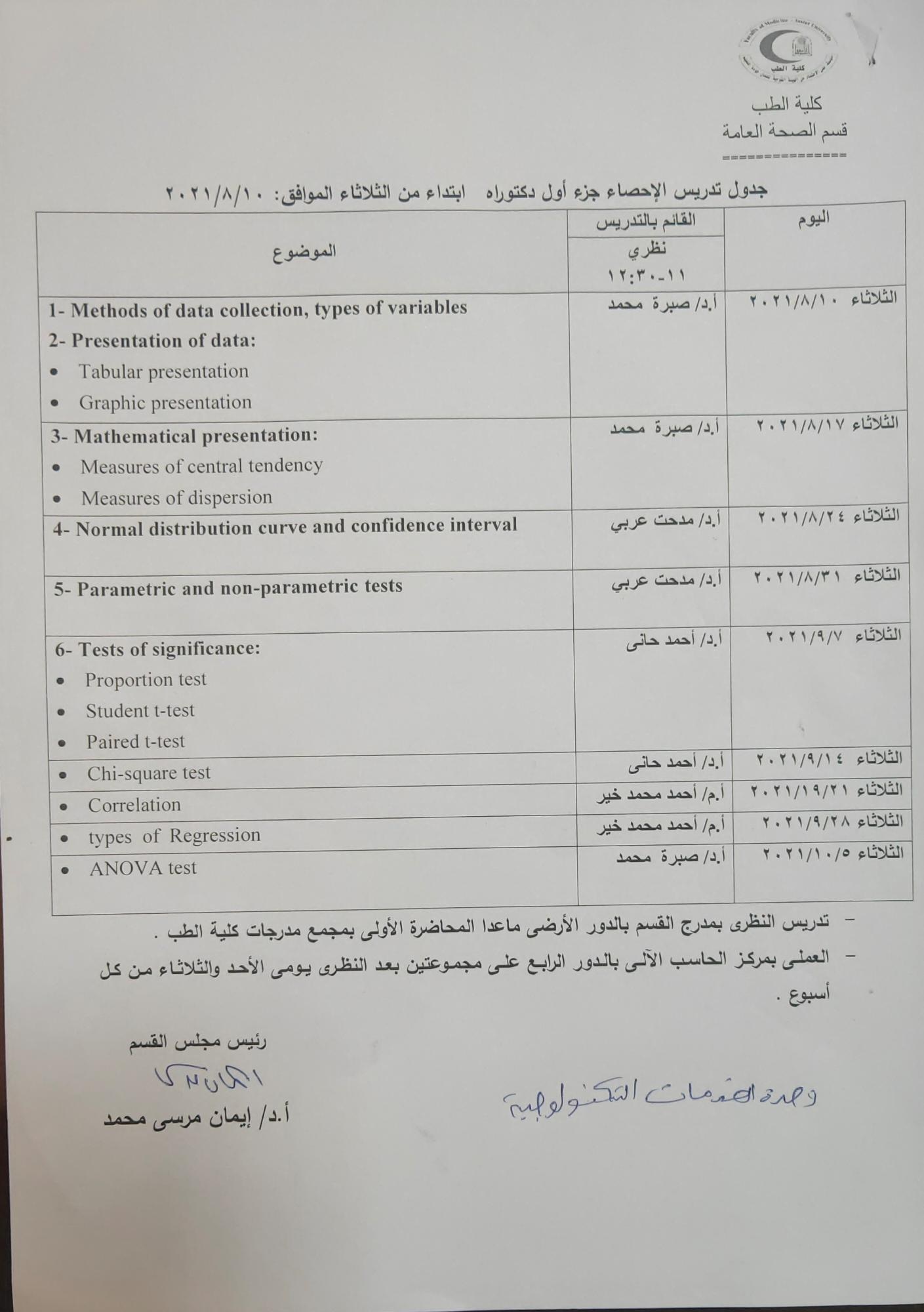
Statistics Teaching Schedule, Part One, Ph.D. - Department of Public Health
Arteriovenous malformations (AVMs) are vascular lesions that present as a direct communication between an artery and a vein without capillary connections but with a tangle of intervening vessels, known as the nidus {1, 2}. Extra-cranial AVMs are most commonly found in the head and neck region, more specifically in the scalp, cheek, ear and nose {1, 3}. The clinical presentations include cosmetic defects, pain, bleeding and ischemic ulceration {4}. The management of these lesions is challenging because of their unpredictable biologic behavior and high incidence of recurrence if not...
Large craniofacial high-flow malformations are rare, and there is no consensus on their treatment. Embolization has become an integral part of the treatment of these malformations. Cure of these lesions may be attained by embolization alone or embolization followed by surgical removal
Abstract
Background: Trichomonas vaginalis (T.vaginalis) is one
of the most common parasitic non viral Sexually Transmitted
Infections (STI) in the world. The World Health Organization
(WHO) has estimated that 160 million trichomoniasis cases
are acquired annually worldwide [1].
Aim of Study: Evaluate different direct laboratory methods
used in diagnosis of vaginal trichomoniasis.
Material and Methods:The cross sectional study was
carried out on 200 female patients, suffering from vaginal
discharge, aged between 20-50 years old. Two vaginal swabs
were taken from every patient after taking a concent. All the
samples were examined by wet mount, stained by Giemsa,
rapid test and Culture on modified Diamond's medium and
ELIZA.
Results:This study showed that ELIZA is the gold standered among diagnostic techniques as it detected T. vaginalis
in 15% of suspected patients followed by 13.5% by culture,
then 12.5% by rapid test and lastly wet mount which detected
only 5% of cases. ELIZA and Culture gave the highest sensitivity, specificity, accuracy, NPV and PPV followed by rapid
test. The least sensitive was wet mount. The least specific
was Giemsa stain.
Conclusion: The study showed that wet mount method is
simple and cheap. Wet mount microscopy is the preferred
option for prompt diagnosis of trichomoniasis. It is proved
that rapid test is relatively simple to carry out, shows reasonable
sensitivity and culture remains the most accurate single method
for detecting the presence of T. vaginalis in patient samples.
and Diamond's medium is a suitable culture method and is
considered as the gold standard of diagnosis of trichomoniasis.
Key Words:Trichomonas – Vaginalis rapid test vaginal
discharge – ELIZA – Diamond’s medium – Aswan
Abstract
Trichomoniasis is an infectious disease caused by Trichomonas vaginalis. It inflicts severe complications to human genitourinary system. The devastating negative effects and resistance emerged to known medication impose the search for effective and safer alternatives. This study evaluated the effect of curcumin and garlic as well as combination between their effective doses
with Metronidazole
®
& Tinidazole
®
. So, vaginal swabs were obtained from the symptomatic
patients, and cultured on modified Diamond's medium. Assessment of the herbs various concentrations at different follow-up periods was done by counting dead T. vaginalis trophozoites
by using hemocytometer and trypan blue staining.The results showed that curcumin 400mg/ml
gave a promising anti-Trichomonas especially when combined with garlic 90mg/ml that showed a
high synergistic effec
Breast carcinoma is the commonest malignancy in females. Folate is required for the biosynthesis of nucleotide bases, amino acids, and other cellular methylation reactions in proteins and phospholipids. The high affinity folate receptor alpha (FRα) has been shown to be expressed in several kinds of human cancers.
In this descriptive-analytic study, sections from formalin-fixed paraffin-embedded tissue blocks of 50 cases of invasive ductal breast carcinoma (IDC) as well as 15 cases of non-neoplastic breast specimens were immunohistochemically stained with FRα antibody. Histopathological evaluation for various clinicopathological parameters was done and was correlated with FRα expression.
Positive FRα expression was more frequently detected in IDC (64%) compared to non-neoplastic breast specimens (20%). In IDC, Positive FRα expression was significantly associated with high tumor grade (p = 0.007), large tumor size (p < 0.001), high lymph node stage (p = 0.004), presence of angiolymphatic emboli (p = 0.001), presence of perineural invasion (p = 0.001). Significant association between FRα positivity and negative hormone receptors (estrogen and progesterone) (p < 0.001) and triple negative cases (p = 0.0021).
Our work demonstrates that FRα is over expressed in IDC compared to non-neoplastic breast tissue. Folate receptor α expression was associated with poor clinicopathological perspective. This work suggests that FRα may be an independent prognostic factor and supports the possibility of using FRα-targeted therapies of breast carcinoma. However, our work requires validation on larger cohort with correlation with survival data of patients.
Purpose: To evaluate the ocular manifestations of post-acute COVID-19 syndrome.
Methods: A retrospective, comparative study included 100 patients who had recovered from COVID-19 and 100 controls who were recruited by stratified randomization from hospital registration system and analyzed regarding history, full ophthalmological examination, general examination including internal medicine and neurological evaluation. Laboratory tests were done.
Results: Mean±SD of age were 55.5 ± 6.2 in COVID group vs 56.5 ± 5.8 in control group; P value = 0.7. In COVID group, 57 patients (57%) were males vs 51 patients (51%) in control group (P value = 0.39), the other compared parameters including history and risk factors showed non-significant difference except for ESR and D-dimer which were elevated in COVID group. In COVID group, 5 patients (5%) were having retinal vascular occlusion, 2 patients (2%) were having anterior ischemic optic neuropathy AION, 3 patients (3%) were having uveitis and 2 patients (2%) were having central serous chorioretinopathy CSCR. While in control group, 2 patients (2%) were having retinal vascular occlusion, and none had AION, uveitis or CSCR (P value = 0.006).
Conclusion: Post-acute COVID-19 syndrome could affect the eyes in the form of coagulation problems, neurological morbidities, and other manifestations. This necessitates meticulous follow-up of recovered patients from COVID-19.
Background
Asthma is one of the most common chronic respiratory diseases. Despite advances
in asthma management, acute exacerbations continue to occur and impose
considerable morbidity and mortality on patients and constitute a major burden
on healthcare resources.
Objective
This study aimed to determine the associations between bacterial infections
and adult asthma exacerbations, together with detection of antibiotic resistance
patterns in clinical practice.
Patients and methods
Sputa were collected from 60 adult asthmatic patients recruited from both Internal
Medicine Department and Chest Disease Department and their critical care units
during exacerbation attacks. Patients underwent thorough clinical examination,
laboratory investigations, and pulmonary function tests. Bacterial isolates were
identified using the standard diagnostic methods. Susceptibilities of the isolated
bacterial strains were determined using disk diffusion method.
Results
Significant bacterial growth was detected in 47 (78%) patients. Single etiological
agent was detected among 44 (73%) patients, whereas mixed infection was
found in three (5%) patients. A total of 52 bacterial strains were isolated from
our asthmatic patients. The predominant bacterial strains were as follows
in decreasing order: Streptococcus pneumoniae, Haemophilus influenzae,
Moraxella catarrhalis, Klebsiella pneumoniae, Staphylococcus aureus,
Acinetobacter baumannii, and Pseudomonas aeruginosa. Gram-negative bacilli
constituted 52% (27 isolates) of the total bacterial isolates during the exacerbation
attacks. Non-multidrug-resistant bacteria were 15 (30%) in number, 22 (44%)
bacterial isolates were multidrug resistant, six (12%) bacterial isolates were
extensively drug resistant, and seven (14%) isolates were pandrug resistant.
Conclusion
Acute exacerbation of asthma was associated with infection in most patients. Gramnegative
bacteria and S. pneumoniae form a relevant part of the microbial pattern of
exacerbation of asthma. Antibiotic resistance among bacterial strains remains a
challenge for the management of asthma exacerbations in clinical settings.