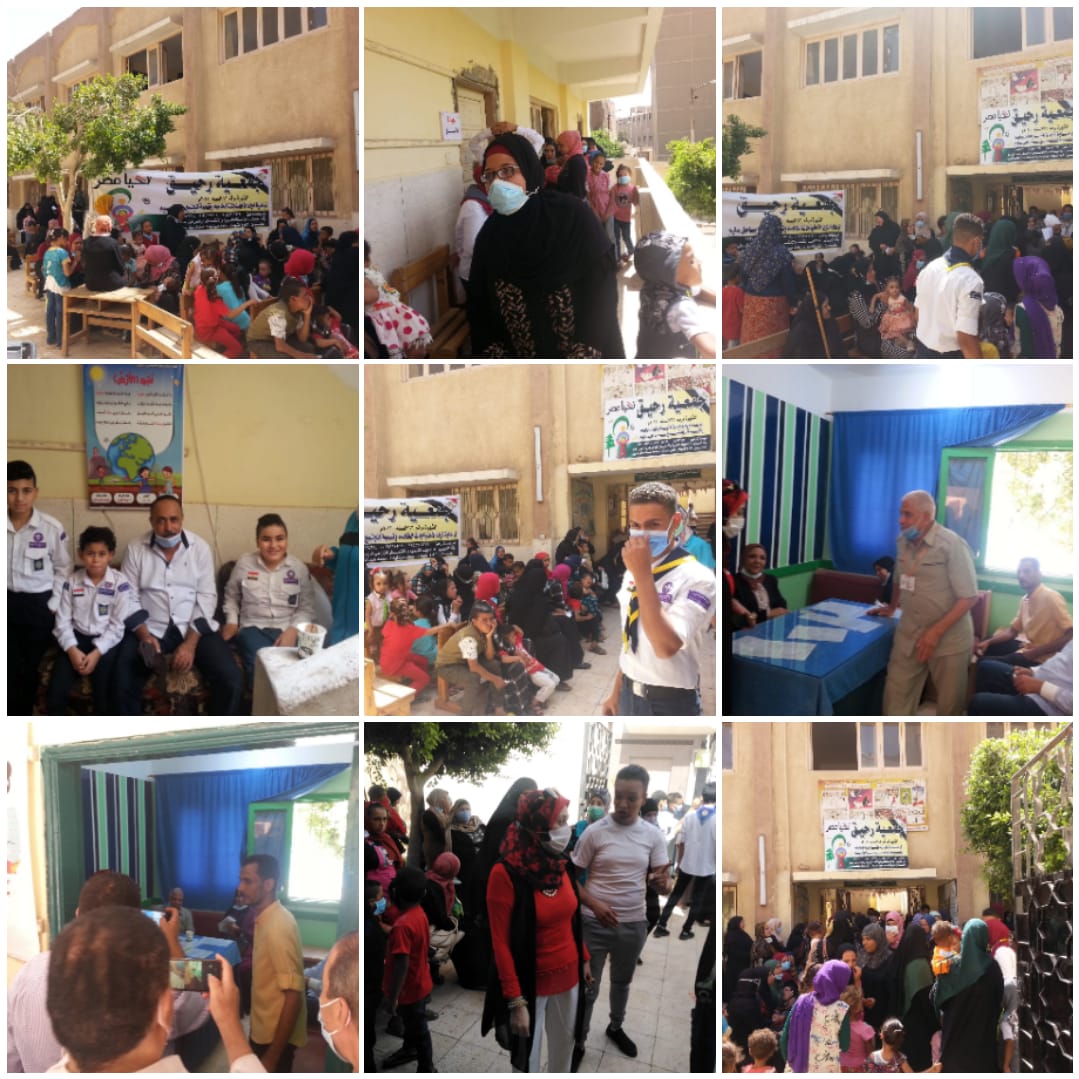
A medical treatment convoy for the Sahel Saleem Center for the Association for the Care of the Handicapped
تحت رعاية
أ. د/ طارق الجمال رئيس الجامعة
أ. د/ مها كامل غانم نائب رئيس الجامعة لشئون تنمية البيئة وخدمة المجتمع 
ا. د/ علاء عطية عميد كلية الطب ورئيس مجلس إدارة المستشفيات الجامعية.
أ. د/سعد زكي محمود وكيل الكلية لشئون تنمية البيئة وخدمة المجتمع والمشرف العام علي القوافل الطبية وذلك ضمن مبادرة الرئيس لحياة كريمه 
ود/عمرو محمد عبد المجيد المشرف على مركز القوافل الطبية؛ تم عمل قافلة طبية علاجية لمركز ساحل سليم لجمعية رعاية المعاقين وذلك يوم الجمعة الموافق ٢٠٢١/٩/٢٤ بمشاركة:
ط/ محمد رجب                       الباطنة العامة
ط/ سارة محمد محروس.        الجهاز الهضمي
ط/ مارلين سامح عبدالملاك.    الجلدية و التناسلية
ط/ سعد عبدالحفيظ               الأطفال
ط/اسماء جمال عبدالحميد.     الامراض الصدرية
ط/ محمد حامد محمد            جراحة العظام
ط/ عبدالله محمد عمر.           أنف وأذن وحنجرة
ط/ سارة حسين العطار           جراحة العيون
ط/ احمد محمد علاءالدين.      العصبية والنفسية

قام مركز القوافل الطبية بعمل عدد أربع قوافل طبية من خلال الجدول الزمني لعام ٢٠٢١ 
وجارى التجهيز لعدد ٥ قوافل طبية ٣ منهم بالتعاون مع وزارة الشباب والرياضة و٢ بالتعاون مع الجمعيات الخيرية.
صور من بعض القوافل الطبية السابقة
The effect of Ketamine infusion on post mastectomy pain syndrome: a randomized controlled study

Research Abstract

Abstract

Background: Acute postoperative pain after breast surgery is one of the major factors contributing to prolonged hospital stay. In addition persistent post mastectomy pain (PPMP) is rated as the most important cause of suffering in those patients.

Objectives: The objectives of this study are to investigate the efficacy and safety of ketamine infusion on the incidence of acute postoperative and chronic post-mastectomy pain in female patients undergoing modified radical mastectomy.

Patients and methods: 40 Patients were included in this study, divided into 2 groups (20 patients for each): Group 1 (G1): Control group in which patients received I.V. saline infusion before skin incision and for 24 hours after surgery. Group 2 (G2): In which patients received pre-emptive I.V bolus 0.5 mg / kg ketamine before skin incision followed by a continuous infusion of 0.25 mg / kg per hour for 24 hours post-operative. We measured hemodynamic variables, Visual Analogue Score at rest and movement of the limb or cough (VAS-R and VAS-M respectively) at zero line, 2, 4, 8, 12, 16, 24 hours postoperatively, time to the first request of analgesia, total morphine consumption, sedation score and development of side effects. LANSS (Leeds Assessment of Neuropathic Symptoms and Signs) score was assessed at 1, 2, 3, 6 months postoperatively.

Results: There was a significant reduction in VAS-R and VAS-M (p<0.05), total morphine consumption (p<0.01) with significant delay in the 1st analgesic request (p<0.001) at all time points in ketamine group. LANSS score was significant reduced (p<0.05) in ketamine group compared to control group at all time points.

Conclusion: Perioperative use of ketamine in patients undergoing modified radical mastectomy, reduced acute postoperative pain, morphine consumption and the development of chronic post mastectomy pain with no serious side effects.

 
Research Authors
Mohamed A. Bakr, Al-Amin Khalil, Khaled M. Fares, Sahar A. Mohamed, Ahmad M Abdel-Rahman, Aalaa M Doheim
Research Date
Research Journal
SECI Oncology
Research Website
http://www.aun.edu.eg/SECI/jourpdf/4.2014.pdf
Research Year
2014

Analgesic efficacy of intravenous morphine, tramadol and ketorolac on postoperative pain in patients undergoing modified radical mastectomy

Research Abstract

Abstract
Background: It is the basic duty of all healthcare professionals to relieve pain, and the most important indication

for treating pain after surgery is humanitarian.

Objectives: Comparing the effects of intravenous morphine, tramadol and ketorolac on post operative pain in patients undergoing modified radical mastectomy

Study design: A randomized, double blind trial.

Methods: Sixty patients randomly were assigned to receive either IV morphine 5mg (Group I, n = 20), tramadol 100 mg (Group II, n = 20), or ketorolac 60 mg (Group III, n = 20) at the end of surgery. Assessment parameters included hemodynamics, respiratory rate, oxygen saturation, sedation score, VAS score, time of first analgesic request, total amount of analgesics consumption, and side effects in the first 24 hours.

Results: The mean time to the first request for rescue analgesia was significantly prolonged in group II (11.00± 2.49 hrs ranged from 8- 15 hrs) and group III (8± 1.89 hrs ranged from 6.0 -10.0 hrs) in comparison to group I (3.75± 0.89 hrs ranged from 3 – 5 hrs) (P <0.001). Total post-operative amount of analgesics consumption over 24 hrs in the three studied groups was (7.00 ± 2.51 mg ranged from 5- 10 mg of morphine) in group I;(160.00± 68.06 mg ranged from 100-300 mg of tramadol) in group II;(80.00± 19.47 mg ranged from 60– 120 mg of ketorolac) in group III. The mean (VAS) score in studied groups, showed no significant difference between the three studied groups at all time periods(P >0.05), but there was a significant decrease in the (VAS) in each group separately over the course of 24 hrs in comparison to base line values (P <0.007). No significant differences were observed in the mean systolic and diastolic blood pressure values, respiratory rate and oxygen saturation between groups.

Conclusion: intravenous morphine, tramadol and ketorolac had similar analgesic efficacy on the post-operative pain in patients undergoing modified radical mastectomy.

Key words: Breast Cancer Surgery; Postoperative Pain; morphine, tramadol, ketorolac

Research Authors
Mohamed Abd-El-moniem Bakr, Samy Abd- El Raheman Amr, Sahar Abd El Baky Mohamed, Hosny Badrawy Hamed, Mohamed A.M.Mostafa, Ahmad Mohammad Abd EL-Rahman, Fatma Adel Diab
Research Date
Research Journal
SECI Oncology
Research Pages
11-16
Research Website
10.18056/seci2015.2
Research Year
2015

Treatment of Chronic Back Pain with Radiculopathy by Selective Nerve Root Block or Pulsed Radiofrequency - Randomised, Open Label, Clinical Trial

Research Abstract

Objective: to evaluate the eectiveness of selective nerve root block (SNRB) versus pulsed radiofrequency treatment to dorsal root

ganglion (PRFT) for treatment of chronic back pain (CBP) with radiculopathy and the correlation between CBP and serum cholesterol

level.

Keywords: Chronic Low Back pain; Radiculopathypulsed radiofrequency; Selective nerve root block

Design: Prospective, randomized, open label study.

Setting: Department of Anaesthesia, ICU, and Pain management, Pain unit, Assiut University.

Patient(s): 80 patients having chronic back pain with radiculopathy were recruited in the study.

Intervention(s): patients in the rst group (40 cases in total) were treated by SNRB via transforaminal approach on the aected nerve

root and patients in the second group (40 patients in total) were treated by PRFT to the aected DRG. Lumbosacral radicular pain (LRP) is a common symptom, its annual prevalence in the general population is reported to be from 9.9% to 25% [1] and it is characterized by a shooting, radiating pain to one or more dermatomes, which is oen caused

by irritation of the corresponding nerve root [2]. e initial treatment should be conservative with oral medications, exercise,

and physiotherapy. When conservative treatments fail, epidural steroid injections and other interventional treatments should be

considered [3]. Surgical interventions are indicated when all other treatments have failed.

Research Authors
Ali A, Osman AM, Rada M, and Bakr MA
Research Date
Research Journal
Journal of Anesthesia and Patient CareObjective
Research Publisher
Annex publishers
Research Vol
2
Research Website
http://dx.doi.org/10.15744/2456-5490.2.102
Research Year
2017

Comparison of oral lamotrigine versus pregabalin for control of acute and chronic pain following modified radical mastectomy

Research Abstract

Breast cancer is the most frequent neoplastic tumor in women, and surgical treatment is indicated in most patients. Complications related to this treatment, such as post-mastectomy pain syndrome (PMPS), a persistent pain that develops after surgery, have been reported. Although the genesis of the pain is multifactorial, sectioning of the intercostobrachial nerve is the nerve lesion diagnosed more often (1) ..

Pain relief using drugs with high efficacy provides significant improvement in the patients' lives. Drugs like lamotrigine (LTG) and gabapentin (GBP) have the ability to overcome the symptoms of neuropathic pain (4).

Both LTG and PGB have been extensively reviewed in the past for management of painful neuropathic conditions (5)

Research Authors
Salma elkomy, Fatma Jad Elrab
Research Website
https://clinicaltrials.gov/ct2/show/NCT03419949
Research Year
2019

Effect of Adding Fentanyl to Bupivacaine in Femoral Nerve Block for Post-Operative Pain in Patient Subjected to Total Knee ReplacementGuided by Ultrasound.

Research Authors
Morsy KM, Gad-Elrab FA, Elzohry AAM, Abdelhafeez AM
Research Date
Research Journal
Journal of Anaesthesia and Pain Medicine
Research Pages
06-11
Research Vol
1
Research Website
https://www.innovationinfo.org/anaesthesiology-and-pain-medicine/article/Effect-of-Adding-Fentanyl-to-Bupivacaine-in-Femoral-Nerve-Block-for-Post-Operative-Pain-in-Patient-Subjected-to-Total-Knee-Replacement-Guided-by-Ultrasound
Research Year
2019

Oral Azithromycin versus dexamethasone for prevention of emesis in patients undergoing elective cesarean section under intrathecal anaesthesia

Research Abstract

Postoperative nausea and vomiting is defined as any nausea, retching, or vomiting occurring during the first 24-48 h after surgery in inpatients. Postoperative nausea and vomiting is one of the most common causes of patient dissatisfaction after anesthesia, with reported incidences of 30% in all post-surgical patients and up to 80% in high-risk patients. In addition, postoperative nausea and vomiting is regularly rated in preoperative surveys, as the anesthesia outcome the patient would most like to avoid. While suture dehiscence, aspiration of gastric contents, esophageal rupture, and other serious complications associated with postoperative nausea and vomiting are rare, nausea and vomiting is still an unpleasant and all-too-common postoperative morbidity that can delay patient discharge from the post-anesthesia care unit and increase unanticipated hospital admissions in outpatients.

Research Authors
Fatma Askar Jad Elrab, Kerolos Adel Gergis, Khaled Morsy
Research Website
https://clinicaltrials.gov/ct2/show/NCT03165123
Research Year
2019
Subscribe to