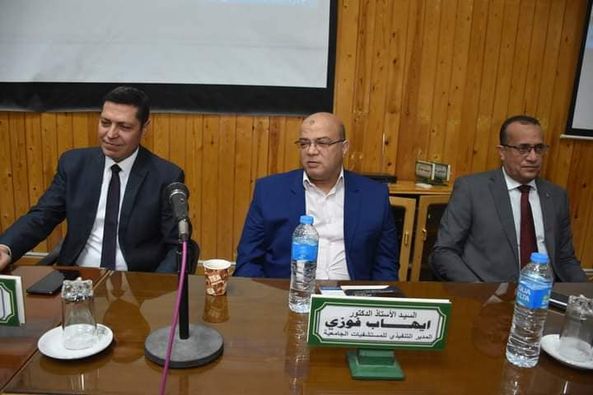
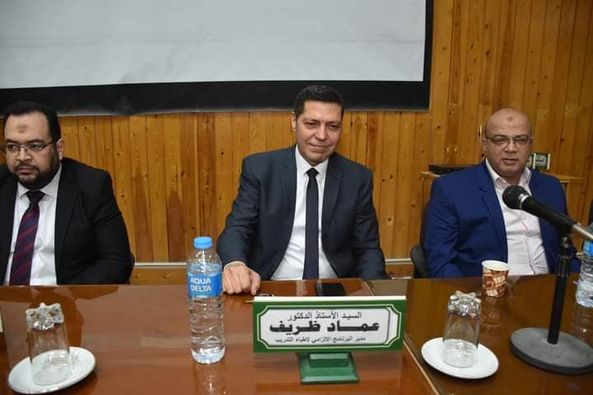
Welcome ceremony for the special training doctors of the 57th batch of Assiut Medicine

تم  الترحيب بأطباء التدريب الخاص بدفعة ٥٧ طب اسيوط

بحضور

الاستاذ الدكتور/ علاء عطية- عميد كلية الطب ورئيس مجلس إدارة المستشفيات الجامعية

الاستاذ الدكتور/ ايهاب فوزي- المدير التنفيذي للمستشفيات الجامعية

ا.د/ عماد ظريف -مدير البرنامج الإلزامي لأطباء الامتياز

ا.د/ احمد عباس- استاذ أمراض النساء والتوليد

د/ ادريس حسن- مدير مركز التوجيه المهني الطبي بمستشفيات جامعة اسيوط

وبحضور الدكتورة إحسان علي وكيل الوزارة رئيس الإدارة المركزية للشئون الطبية والعلاجية والاستاذ محمود حسين امين عام كلية الطب وبعض السادة اعضاء هيئة التدريس وطلاب امتياز دفعة ٥٧

وقام بتنظيم وتقديم الحفل الطبيب محمد جمال والطبيب عمر صلاح والطبيب بهاء علام.

وفي بداية حفل الترحيب تحدث الطبيب/ محمود عبدالواحد عن الدفعة (٥٦) عن تجربته الشخصية خلال فترة الامتياز.

وفي كلمته أشار ا.د/ علاء عطية أن فترة الامتياز هي الفترة الإلزامية التي يقضيها الطالب بعد تخرجه وتمثل مرحلة الانتقال من طالب الطب إلى طبيب مؤهل؛ العملية التي من خلالها يكتسب المتدرب ثقة أكبر في التعامل مع المريض بالفطنة المهنية، ويطبق المعرفة والمهارات في ممارسة الطب بشكل مناسب، وتعتبر هذه الفترة جزءاً مكملاً لدراسة الطب ولا يعتبر الطالب مؤهلاً لممارسة مهنة الطب إلا بعد اتمامها واجتياز امتحان مزاولة المهنة في نهاية هذه الفترة بنجاح.

وفي كلمة ا.د/ ايهاب فوزي أشار أن سنة التدريب تساعد طبيب الامتياز على الاستقلالية في العمل والقدرة على اتخاذ القرار والتعامل بكفاءة مهنية وفرصة لتعويد الطبيب على أسلوب التعامل الصحيح مع المريض وذويه، ومع الطاقم الطبي وهو وقت تنمية وتطبيق المعلومات الطبية من خلال التدريب العملي.

أضاف ا.د/ عماد ظريف أن سنة الامتياز فرصة لأهداف جديدة وخطوات جديدة وفرصة لاستكشاف واستطلاع الأقسام المختلفة تساعد الطبيب في تحديد التخصص المناسب، والإختيار الصحيح نتيجته طبيب ناجح قادر علي تحقيق رسالته الطبية وهي خدمة المرضي.

قدم د/ ادريس حسن - استشاري طب الاطفال ومدير وحدة برايت ميندز كلمة الى اطباء التدريب (الامتياز) وضح فيها اهم النقاط التي ينصح اتباعها في فترة الامتياز :

١. فترة الامتياز فترة جيدة ليكتشف الانسان شغفه .. نحن سنساعدك في وحدة برايت ميندز على ذلك

٢. تعرف على صفات شخصيتك والفرق بين نقاط القوة والضعف

٣. تعرف على بقية جوانب حياتك غير الجانب المهني الطبي

٤. تعرف واكتشف التخصص الانسب لك.

أضاف ا.د/ احمد عباس لابد من استغلال هذه الفترة لاستكشاف الأقسام المختلفة وتكوين علاقات جيدة مع الزملاء في مختلف التخصصات، حيث أن هناك تداخل وتكامل بين الأقسام والتعاون المثمر يصب في النهاية لمصلحة المريض، وضرورة الاحترام والتقدير المتبادل بين الزملاء وخاصة لمن هم أكبر منهم.

وفي ختام الحفل تم تكريم الطبيب/ اسلام أبوضيف لدوره في مساعدة زملائه في سنوات الدراسة.

111


AO Spine upper cervical injury classification system: a description and reliability study

Research Abstract

Background Context: Prior upper cervical spine injury classification systems have focused on injuries to the craniocervical junction (CCJ), atlas, and dens independently. However, no previous system has classified upper cervical spine injuries using a comprehensive system incorporating all injuries from the occiput to the C2–3 joint. Purpose: To (1) determine the accuracy of experts at correctly classifying upper cervical spine injuries based on the recently proposed AO Spine Upper Cervical Injury Classification System (2) to determine their interobserver reliability and (3) identify the intraobserver reproducibility of the experts. Study Design/Setting: International Multi-Center Survey. Patient Sample: A survey of international spine surgeons on 29 unique upper cervical spine injuries. Outcome Measures: Classification accuracy, interobserver reliability, intraobserver reproducibility. Methods: Thirteen international AO Spine Knowledge Forum Trauma members participated in two live webinar-based classifications of 29 upper cervical spine injuries presented in random order, four weeks apart. Percent agreement with the gold-standard and kappa coefficients (ƙ) were calculated to determine the interobserver reliability and intraobserver reproducibility. Results: Raters demonstrated 80.8% and 82.7% accuracy with identification of the injury classification (combined location and type) on the first and second assessment, respectively. Injury classification intraobserver reproducibility was excellent (mean, [range] ƙ=0.82 [0.58-1.00]). Excellent interobserver reliability was found for injury location (ƙ = 0.922 and ƙ=0.912) on both assessments, while injury type was substantial (ƙ=0.689 and 0.699) on both assessments. This correlated to a substantial overall interobserver reliability (ƙ=0.729 and 0.732). ConclusioNS: Early phase validation demonstrated classification of upper cervical spine injuries using the AO Spine Upper Cervical Injury Classification System to be accurate, reliable, and reproducible. Greater than 80% accuracy was detected for injury classification. The intraobserver reproducibility was excellent, while the interobserver reliability was substantial. © 2022 AO Foundation, AO Spine, AO Network Clinical Research

Research Authors
Vaccaro, Alexander R.a;Lambrechts, Mark J.a Send mail to Lambrechts M.J.;Karamian, Brian A.a;Canseco, Jose A.a;Oner, Cumhurb;Vialle, Emilianoc;Rajasekaran, Shanmuganathand;Dvorak, Marcel R.e;Benneker, Lorin M.f;Kandziora, Frankg;El-Sharkawi, Mohammadh;Tee
Research File
Research Journal
The Spine Journal
Research Publisher
Elsevier Inc.
Research Website
https://www.sciencedirect.com/science/article/pii/S1529943022008439?pes=vor
Research Year
2022

Global Validation of the AO Spine Upper Cervical Injury Classification

Research Abstract

Study Design. Global cross-sectional survey. Objective. To determine the classification accuracy, interobserver reliability, and intraobserver reproducibility of the AO Spine Upper Cervical Injury Classification System based on an international group of AO Spine members. Summary of Background Data. Previous upper cervical spine injury classifications have primarily been descriptive without incorporating a hierarchical injury progression within the classification system. Further, upper cervical spine injury classifications have focused on distinct anatomical segments within the upper cervical spine. The AO Spine Upper Cervical Injury Classification System incorporates all injuries of the upper cervical spine into a single classification system focused on a hierarchical progression from isolated bony injuries (type A) to fracture dislocations (type C). Methods. A total of 275 AO Spine members participated in a validation aimed at classifying 25 upper cervical spine injuries through computed tomography scans according to the AO Spine Upper Cervical Classification System. The validation occurred on two separate occasions, three weeks apart. Descriptive statistics for percent agreement with the gold-standard were calculated and the Pearson χ2test evaluated significance between validation groups. Kappa coefficients (κ) determined the interobserver reliability and intraobserver reproducibility. Results. The accuracy of AO Spine members to appropriately classify upper cervical spine injuries was 79.7% on assessment 1 (AS1) and 78.7% on assessment 2 (AS2). The overall intraobserver reproducibility was substantial (κ=0.70), while the overall interobserver reliability for AS1 and AS2 was substantial (κ=0.63 and κ=0.61, respectively). Injury location had higher interobserver reliability (AS1: κ=0.85 and AS2: κ=0.83) than the injury type (AS1: κ=0.59 and AS2: 0.57) on both assessments. Conclusion. The global validation of the AO Spine Upper Cervical Injury Classification System demonstrated substantial interobserver agreement and intraobserver reproducibility. These results support the universal applicability of the AO Spine Upper Cervical Injury Classification System. Level of Evidence 4. © 2022 Lippincott Williams and Wilkins. All rights reserved.

Research Authors
Vaccaro, Alexander R.a Send mail to Vaccaro A.R.;Lambrechts, Mark J.a Send mail to Lambrechts M.J.;Karamian, Brian A.a Send mail to Karamian B.A.;Canseco, Jose A.a Send mail to Canseco J.A.;Oner, Cumhurb Send mail to Oner C.;Benneker, Lorin M.c Send mail
Research Journal
SPINE
Research Publisher
Wolters Kluwer Health
Research Website
https://journals.lww.com/spinejournal/Fulltext/2022/11150/Global_Validation_of_the_AO_Spine_Upper_Cervical.1.aspx
Research Year
2022

The AO spine upper cervical injury classification system: Do work setting or trauma center affiliation affect classification accuracy or reliability?

Research Abstract

Purpose: To assess the accuracy and reliability of the AO Spine Upper Cervical Injury Classification System based on a surgeons’ work setting and trauma center affiliation. Methods: A total of 275 AO Spine members participated in a validation of 25 upper cervical spine injuries, which were evaluated by computed tomography (CT) scans. Each participant was grouped based on their work setting (academic, hospital-employed, or private practice) and their trauma center affiliation (Level I, Level II or III, and Level IV or no trauma center). The classification accuracy was calculated as percent of correct classifications, while interobserver reliability, and intraobserver reproducibility were evaluated based on Fleiss’ Kappa coefficient. Results: The overall classification accuracy for surgeons affiliated with a level I trauma center was significantly greater than participants affiliated with a level II/III center or a level IV/no trauma center on assessment one (p1<0.0001) and two (p2 = 0.0003). On both assessments, surgeons affiliated with a level I or a level II/III trauma center were significantly more accurate at identifying IIIB injury types (p1 = 0.0007; p2 = 0.0064). Academic surgeons and hospital employed surgeons were significantly more likely to correctly classify type IIIB injuries on assessment one (p1 = 0.0146) and two (p2 = 0.0015). When evaluating classification reliability, the largest differences between work settings and trauma center affiliations was identified in type IIIB injuries. Conclusion: Type B injuries are the most difficult injury type to correctly classify. They are classified with greater reliability and classification accuracy when evaluated by academic surgeons, hospital-employed surgeons, and surgeons associated with higher-level trauma centers (I or II/III). © 2022 AO Foundation

Research Authors
Lambrechts, Mark J.a Send mail to Lambrechts M.J.;Schroeder, Gregory D.a;Karamian, Brian A.a;Canseco, Jose A.a;Bransford, Richardb;Oner, Cumhurc;Benneker, Lorin M.d;Kandziora, Franke;Shanmuganathan, Rajasekaranf;Kanna, Rishif;Joaquim, Andrei F.g;Chapman,
Research File
Research Journal
Injury
Research Publisher
Elsevier Ltd
Research Website
https://reader.elsevier.com/reader/sd/pii/S0020138322005940?token=CA435AF6AC9DC5F06EC29376319728FB7C3551F2240DD621E80193588CE18906A24DFEC2C982ED5D1E2940DC9C0B0C2B&originRegion=eu-west-1&originCreation=20230309091026
Research Year
2022

specular microscopic evaluation of corneal endothelium in normal egyptian eyes and its relation to age,gender and refraction

Research Authors
AF Dalia ElSebaity,Tarek Ahmed Ali,Khaled Abdelazeem,Momen Ahmad Aly
Research Date
Research Department
Research Journal
Egyptian Journal of clinical ophthalmology
Research Member

Spine Surgery and COVID-19: The Influence of Practice Type on Preparedness, Response, and Economic Impact

Research Abstract

Study Design: Cross-sectional observational cohort study. Objective: To investigate preparation, response, and economic impact of COVID-19 on private, public, academic, and privademic spine surgeons. Methods: AO Spine COVID-19 and Spine Surgeon Global Impact Survey includes domains on surgeon demographics, location of practice, type of practice, COVID-19 perceptions, institutional preparedness and response, personal and practice impact, and future perceptions. The survey was distributed by AO Spine via email to members (n = 3805). Univariate and multivariate analyses were performed to identify differences between practice settings. Results: A total of 902 surgeons completed the survey. In all, 45.4% of respondents worked in an academic setting, 22.9% in privademics, 16.1% in private practice, and 15.6% in public hospitals. Academic practice setting was independently associated with performing elective and emergent spine surgeries at the time of survey distribution. A majority of surgeons reported a >75% decrease in case volume. Private practice and privademic surgeons reported losing income at a higher rate compared with academic or public surgeons. Practice setting was associated with personal protective equipment availability and economic issues as a source of stress. Conclusions: The current study indicates that practice setting affected both preparedness and response to COVID-19. Surgeons in private and privademic practices reported increased worry about the economic implications of the current crisis compared with surgeons in academic and public hospitals. COVID-19 decreased overall clinical productivity, revenue, and income. Government response to the current pandemic and preparation for future pandemics needs to be adaptable to surgeons in all practice settings. © The Author(s) 2020.

Research Authors
Weiner, Joseph A.a Send mail to Weiner J.A.;Swiatek, Peter R.a;Johnson, Daniel J.a;Louie, Philip K.b;Harada, Garrett K.c, d;McCarthy, Michael H.b;Germscheid, Niccolee;Cheung, Jason P. Y.f;Neva, Marko H.g;El-Sharkawi, Mohammadh;Valacco, Marceloi;Sciubba, D
Research File
Research Journal
Global Spine Journal
Research Publisher
SAGE Publications Ltd
Research Website
https://journals.sagepub.com/doi/epub/10.1177/2192568220949183
Research Year
2022

Donohue syndrome in an Egyptian infant: a case report

Research Abstract

Objectives

We aim to report a case of Donohue syndrome (DS) which is a rare genetically encoded, autosomal inherited recessive disorder linked with severe insulin-resistant diabetes.

Case presentation

We hereby report a case of a 4 month -old girl infant with DS. The patient exhibited dysmorphic facial features, severe growth retardation, fasting hypoglycemia, postprandial hyperglycemia, and hyperinsulinemia which are the hallmarks of DS. The diagnosis of DS was confirmed by genetic analysis. The patient was treated with high-dose insulin and frequent nasogastric formula milk feeding to achieve reasonable glycemic control.

Conclusions

We reported a typical case of DS in a 4-month-old female infant characterized by peculiar dysmorphic features and failure to thrive. She also fulfilled the biochemical criteria of fasting hypoglycemia, postprandial hyperglycemia, and severe hyperinsulinemia. The …

Research Authors
Kotb Abbass Metwalley, Hekma Saad Farghaly, Lamiaa Mahmood Maxi
Research Date
Research Department
Research Journal
Case Reports in Perinatal Medicine
Research Pages
20210087
Research Publisher
De Gruyter
Research Vol
12
Research Year
2022

Subclinical hyperthyroidism in children

Research Abstract

Subclinical hyperthyroidism (SH) is defined as serum thyroid-stimulating hormone (TSH) below the lower limit of the reference range in the presence of normal free T4 and free T3 levels. Depending on the degree of TSH suppression, SH could be defined as mild (TSH, 0.1–0.45 mU/L) or severe (TSH< 0.1 mU/L). Patients with SH are often asymptomatic when symptoms are present, they are similar to the symptoms in patients with overt hyperthyroidism, although they are usually milder. The management of the SH is uncertain and should be individualized. We present this review after an extensive literature search and long-standing clinical experience. This review provides the prevalence, causes, clinical presentation, investigation, and therapeutic approach of SH in children.

Research Authors
Kotb Abbass Metwalley, Hekma Saad Farghaly
Research Date
Research Department
Research Journal
De Gruyter
Research Year
2022

Urinary C-peptide creatinine ratio is a significant indicator of non-alcoholic fatty liver disease in children with obesity.

Research Abstract

Background. Nonalcoholic fatty liver disease (NAFLD) is the commonest etiology of chronic hepatic problems in children with obesity. This study aimed to assess whether urinary C-peptide creatinine ratio (UCPCR) might be a potential indicator of NAFLD in obese children.

Methods. The study included 240 children with simple obesity. Hepatic ultrasonic examination, anthropometric and laboratory measurements including fasting plasma glucose, fasting insulin, fasting C peptide, liver, renal profile, lipid profile, and UCPCR were obtained in all cases. According to the results of the hepatic ultrasonography, cases were classified into two categories, those with NAFLD (n= 98) and without NAFLD (n= 142).

Results. In cases with NAFLD, UCPCR was significantly higher than those without NAFLD (P< 0.001). A significant positive correlation between UCPCR and waist circumference (WC SDS), triglyceride, fasting C-peptide, HOMA-IR and alanine aminotransferase (ALT) was found (P< 0.001 for each). Adjusting for other variables, UCPCR was the most significant predictor of NAFLD in children with obesity with higher odds ratio (OR= 3.26) than fasting C peptide (OR= 2.87), triglyceride (OR= 1.89), ALT (OR= 2.20), WC SDS (OR= 1.32) and age (OR= 1.27). UCPCR cut-off value of 0.755 nmol/mmol was able to discriminate cases with NAFLD from those without NAFLD with a sensitivity of 95%, a specificity of 87%.

Conclusions. We concluded that UCPCR is a useful, practical and non-invasive predictor of NAFLD in children with obesity with high sensitivity and specificity.

Research Authors
Hekma Saad Farghaly, Kotb Abbass Metwalley, Yasser Gamal, Ghada Mohamed Saied, Yasser Farouk
Research Date
Research Department
Research Journal
Turkish Journal of Pediatrics
Research Vol
64
Research Year
2022
Subscribe to