 Do you have any questions?

discussion
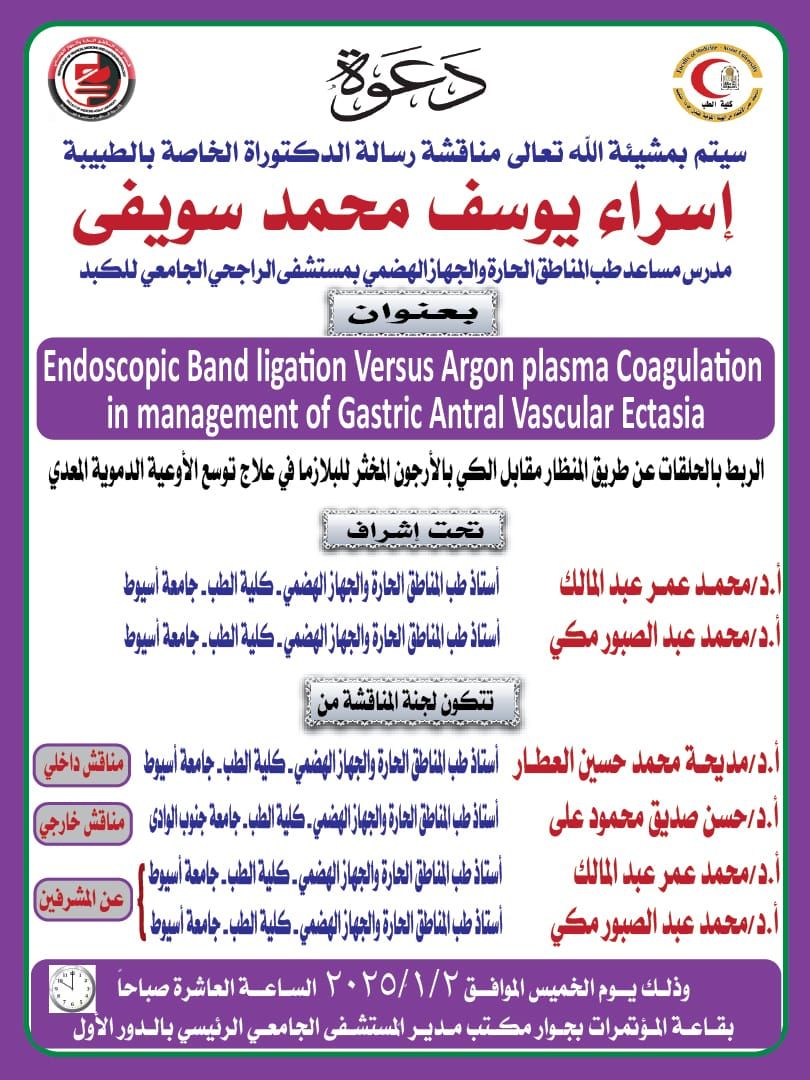
Discussing the doctoral thesis of Dr. Israa Youssef Muhammad Suwaifi - Assistant Lecturer of Tropical Medicine and Gastroenterology at Al Rajhi University Liver Hospital.
Discussing the doctoral thesis of Dr. Israa Youssef Muhammad Suwaifi - Assistant Lecturer of Tropical Medicine and Gastroenterology at Al Rajhi University Liver Hospital.
The primary etiology of pelvic venous disorder is multifactorial and challengeable in vascular surgery as it mandates multidisciplinary team cooperation for its evaluation and management.
Methods
All patients investigated for pelvic venous disorder in a high-volume, tertiary referral university hospital were identified and analyzed retrospectively during the period (March 2021 through September 2022). Demographic and medical data were scored. Agreement between the noninvasive modalities (computed tomographic venography [CTV] or magnetic resonance venography [MRV]) and diagnostic venography in detecting the refluxing pelvic veins was analyzed. Sensitivity, specificity, and diagnostic accuracy are also measured. No patients’ treatments were reported in this study as the treatment is scheduled in other sessions in some cases and is out of the scope of this article. All patients had a diagnostic …
Endovascular treatment options of aorto-iliac occlusive disease have emerged, leading to better outcomes in more complex pathology, which typically involves a reconstruction of the aortic bifurcation. The Covered Endovascular Reconstruction of Aortic Bifurcation (CERAB) configuration was introduced in 2013, in an attempt to optimize outcomes, when compared to the kissing stent configuration, which was traditionally the preferred endovascular technique for this pathology. CERAB aims to optimize geometry, and with that the arterial flow patterns that are associated with loss of patency. In CERAB, the aortic bifurcation is reconstructed using three balloon-expandable covered stents in a tight connection with each other and with an appropriate wall apposition, thereby minimizing geometrical mismatch (Fig. 1a-c). The reconstruction can be extended on both sides and could be combined with chimney, or parallel, grafts in aortic side branches that need to be preserved. In the current paper, the details of the CERAB technique are described and supported by evidence derived from pre-clinical studies that confirm the more optimal geometry and flow patterns compared to kissing stents. Also, a summary is provided of published clinical evidence, including technical and clinical outcomes of the technique. These data show promising early results, with patency rates in line with those achieved with open surgery, also in patients with extensive disease. Finally, the potential modes of failures and future developments are discussed.
The Covered Endovascular Reconstruction of the Aortic Bifurcation (CERAB) reconstruction is an endovascular technique, developed to reconstruct the aortic bifurcation in the most optimal anatomical and physiological manner. Short-term data were promising, but long-term data are still lacking. The objective was to report the long-term outcomes of CERAB for extensive aorto-iliac occlusive disease and to identify predictors for loss of primary patency.
Methods
Consecutive electively treated patients with CERAB for aorto-iliac occlusive disease in a single hospital were identified and analyzed. Baseline and procedural data and follow-up were collected at 6-weeks, 6 months, 12 months, and annually thereafter. Technical success, procedural, and 30-day complications were evaluated, as well as overall survival. Patency and freedom from target lesion revascularization rates were analyzed using Kaplan …
IntroductionCarotid atherosclerosis is one of the several etiological factors for stroke and is considered an important health problem with a high burden of disease in the western world and in developing countries.AimThis study is aimed at investigating the prevalence of asymptomatic carotid artery stenosis (ACAS) in patients with peripheral arterial disease (PAD) and identifying the predictive factors of ACAS in patients with PAD.Patients and methodsBetween September 2016 and August 2017, 750 patients with PAD (Fontaine IIb–IV) underwent percutaneous transluminal angioplasty in the Department of Vascular Surgery. Patients aged less than 50 years old and those who had a previous cerebrovascular event or carotid artery intervention were excluded ( = 105). The remaining 645 patients underwent preoperative screening for ACAS using carotid duplex ultrasonography examination. The degree of internal carotid artery (ICA) stenosis was determined by the criteria of Society of Radiologists in Ultrasound Consensus Conference.ResultsWe found that 302 (46.8%) patients had patent carotid arteries without any evidence of atherosclerotic plaque, whereas 343 (53.2%) patients had ACAS. The prevalence of significant ICA stenosis (≥70% stenosis) was 2.8%. ICA occlusion was detected in 0.6%. Univariate analysis revealed that age older than 65 years ( = 0.013), male sex ( = 0.022), hypertension ( < 0.001), and ischemic heart disease ( = 0.016) are predictive factors of critical carotid artery stenosis, which is defined as peak systolic velocity more than 230 cm/s with diameter reduction of at least 50%.Discussion and conclusionPatients with …
ABSTRACT
Pigeons (Columba livia) are closely related to humans and serve various purposes as birds. Both domestic and racing pigeon (Columba livia) populations are vulnerable to several protozoal infections that pose health challenges to the pigeons and may impact public health. Therefore, this study aimed to investigate the prevalence, biodiversity, and effects of protozoan infections in domestic and racing pigeons in Assiut Governorate, focusing on zoonotic infections. A total of 140 clinically ill pigeons, comprising 92 domestic and 48 racing pigeons of varying ages, were examined for gastrointestinal, blood, and tissue protozoal infections from February 2023 to April 2024. The birds were necropsied and examined for gastrointestinal, blood, and tissue protozoal infections. The overall protozoal infection rate was 98.6% among the examined pigeons, which was higher in racing pigeons at 100%, compared to 97.8% in domestic pigeons. Additionally, the prevalence varied slightly with climate and age, showing higher rates in colder climates and among squabs. The commonly observed protozoan was Trichomonas sp., found in 90% of the samples (126 out of 140), followed by Cryptosporidium sp. at 48.6% (68/140), Atoxoplasma at 37.1% (52/140), and Haemoproteus at 34.3% (49/140). Leucocytozoon had a prevalence of 14.3% (20/140), while both Toxoplasma and Ehrlichia had the same prevalence of 12.9% (18/140). Aegyptianella was found in 11.4% (16/140) of samples. Microsporidia had a prevalence of 7.1% (10/140), and Eimeria and Plasmodium each had a prevalence of 5.7% (8/140). The least frequently observed protozoan was Cyclospora, found in 2.9% of the samples (4/140). This research highlights the prevalence and diversity of protozoal infections in pigeons and the public health risks associated with some protozoa's zoonotic nature. This emphasizes the need for targeted control measures to reduce the impact of these parasites on pigeon health.
Keywords: Pigeon, Race, Domestic, Zoonotic protozoa, Toxoplasma, Trichomonas sp., Cryptosporidium, Atoxoplasma, and Haemoproteus, Agyptenella, Leucocytozoan sp., Plasmodium sp
ABSTRACT
While fish serve as an important source of animal protein for humans, parasitic diseases can have a detrimental effect on their production and public health. The main focus of this study was to quantify the spread of parasitic infections in some freshwater fish and to evaluate the range of zoonotic parasites present in them. In Sohag Governorate, a total of 123 freshwater fish—91 Nile tilapia (Oreochromis niloticus) and 32 catfish (Clarias gariepinus)—were randomly chosen from natural sources and markets. Fish were examined visually and microscopically. Out of 123 examined fish, 81 were infected by parasites with a prevalence of 66%. Microscopic encysted metacercariae were detected in 46.2% of the total examined fish. In tilapia, the macroscopic EMC clinostomum was 18.7%, and contarcecum 17.6% were observed, while in catfish, trematodes, Orientocreadium batrachoides 12.5% and nematode, paracamalans 3%, were detected. These findings demonstrated a wide range in the prevalence of different zoonotic parasites across two species of fish, highlighting the potential hazards to human health when consuming raw or inadequately cooked fish.
Keywords: Tilapia, Catfish, Microscopy, zoonotic parasites, prevalencevv
Empagliflozin (EMPA) is a glucose-lowering agent that is widely used for treatment of diabetes mellitus and diabetic nephropathy. This work aimed to evaluate the therapeutic and prophylactic effects of EMPA and NAC in treating nephrotoxicity caused by 5-Fluorouracil (5-FU) in male Albino Wistar rats. 48 rats were divided into 6 groups: The first group used as negative control. The second received 20 mg/kg of 5-FU intraperitoneally for 6 days. The third group received 5-FU plus 10 mg/kg EMPA orally for 10 days. The fourth group received EMPA 10 days before the injection of 5-FU. The fifth group received 5-FU plus N-acetylcysteine (NAC) 40 mg/kg. The sixth group received 5-FU, NAC plus EMPA. Biochemical evaluation for urea, creatinine, uric acid, albumin, TNF-α and IL-1β in serum and GSH and MDA in renal homogenate were done. Histopathological examination of kidneys was done with immunohistochemical analysis of caspase-3. The nephrotoxic effect of 5-FU was characterized by elevation of creatinine, urea, uric acid, MDA, TNF-α and IL-1β with reduction of albumin and GSH. EMPA caused improvement in kidney status especially when used therapeutically or with NAC. The immunohistochemical analysis showed that EMPA caused a reduction in the expression of caspase-3. EMPA is an effective drug in cases of 5-FU induced nephrotoxicity. It is more effective when used as a treatment rather than a prophylactic strategy. The effect of EMPA is enhanced when combined with NAC. EMPA nephroprotective effect is mediated via antioxidant, antiinflammatory effects and by decreasing the expression of renal caspase-3.
Postpartum family planning helps to prevent unintended pregnancies, yet utilization remains low in Upper Egypt. Women's opinions reveal preferences for traditional methods, and cultural beliefs, contributing to lower acceptance of other methods. This study aims to understand women's perspectives on postpartum IUD use after delivery.
Abstract
Background: Cryptosporidiosis is a global infection caused by Cryptosporidium, which infects various vertebrates and humans, and causes gastroenteritis with varying severity. Several Cryptosporidium spp. with different genotypes and subtypes are implicated in human cryptosporidiosis.
Objective: estimate the prevalence of Cryptosporidium species in Sohag, assess its occurrence among various patient groups, and analyze the relationship between Cryptosporidium infections and associated risk factors and assessed the genetic diversity of Cryptosporidium spp in Humans at Sohag Governorate, Egypt
Patients and Methods: A total of 245 human stool samples were collected from patients attending the outpatient clinics of Sohag hospitals. The collected samples were examined microscopically by direct smear and modified Ziehl-Neelsen stain (MZN). All positive Cryptosporidium samples detected by MZN were genotyped using nested polymerase chain reaction-restriction fragment length polymorphism (nPCR-RFLP) targeting cowp gene encoding Cryptosporidium oocyst wall protein (Cowp).
Results: Cryptosporidium was detected in 20% (49/245) of the examined samples using MZN. Only 2/45 (4%) of samples positive by microscopy were successfully amplified using cowp gene. All amplified samples were confirmed as C. hominis by nPCR-RFLP analysis of the cowp gene. Significant associations were found between cryptosporidiosis and age, residence and patient categories.
Conclusion: The identification of C. hominis indicates anthroponotic transmission. the relatively low prevalence of Cryptosporidium underscores the positive impact of public health measures implemented during and after COVID-19 pandemic on reducing parasitic infections.