 Do you have any questions? 088-2354166 complaints@aun.edu.eg

TheNationalStrategy_CombatingCorruption
Assiut University organizes a workshop to introduce the National Strategy for Combating Corruption 2023–2030.
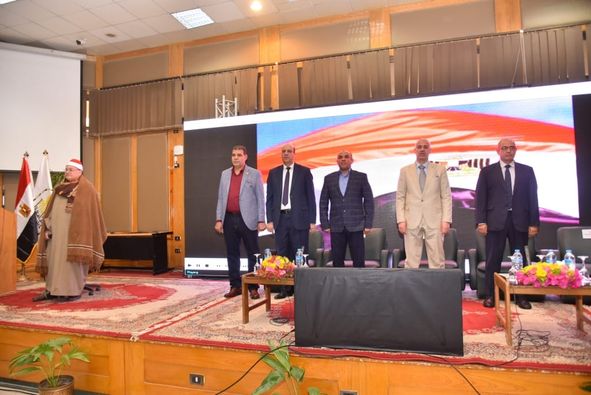
Dr. El-Menshawy: Continuous Awareness Activities and Programs to Combat Corruption and Confront All Its Forms
Under the auspices of Dr. Ahmed El-Menshawy, President of Assiut University, the General Administration for Information Systems and Digital Transformation, in cooperation with the General Administration for Public Relations and Media, organized this morning, Wednesday, December 27, an introductory workshop on: “Introducing the National Strategy for Combating Corruption 2023–2030”, with the participation of a group of deans, faculty members from various colleges, staff from administrative units, and university students.
Dr. Ahmed El-Menshawy emphasized the university administration’s continued organization of events and awareness programs that contribute to achieving national strategies aimed at combating corruption and confronting all its forms, especially in light of the efforts and policies of President Abdel Fattah El-Sisi to establish the foundations of the New Republic and achieve comprehensive and sustainable development in Egypt. He pointed out their positive impact on improving living standards, protecting state resources, and ensuring the availability of funds for developmental policies and programs, as well as promoting and activating anti-corruption cultures that reject any form or behavior of corruption.
The workshop was attended by Dr. Ahmed Abdel-Mawla, Vice President for Education and Student Affairs; Dr. Mahmoud Abdel-Alim, Vice President for Community Service and Environmental Development; Dr. Mostafa Mohamed Morsi, Director of the General Administration for Information Systems and Digital Transformation and Coordinator of the Strategy’s Implementation; and Mr. Shawkat Saber, Secretary-General of the University. The session was delivered by Dr. Mohamed Ahmed Adwy, Vice Dean of the Faculty of Commerce for Education and Student Affairs and Director of the University Future Studies Center.
Dr. Ahmed Abdel-Mawla expressed his pride in participating in the workshop activities, which reflect the university’s commitment to spreading a culture of combating corruption and raising awareness of its visible and hidden forms. This complements the Egyptian state’s efforts and success in curbing many corruption hotspots across the country, highlighting the necessity for all governmental and non-governmental institutions to unite efforts and continue working to confront this phenomenon, aiming to achieve progress, prosperity, and a better future for coming generations.
Dr. Mostafa Mohamed Morsi explained that combating corruption is a shared responsibility of all members of society, serving as a genuine motivation for everyone to uphold rights and assume responsibilities. He highlighted the Egyptian state’s strong will and sincere determination to implement the National Strategy for Combating Corruption 2023–2030, continuing previous efforts to create a transparent national environment and foster a conscious societal culture that modernizes the legislative, administrative, and institutional frameworks. This stems from the understanding that corruption undermines sustainable development efforts and weakens the mutual trust between citizens and the state.
Dr. Mohamed Ahmed Adwy delivered a lecture during the workshop titled: “Governance and Combating Corruption: Global Perspectives and Egyptian Policies”, in which he defined corruption as the misuse of power or influence in an illegal or unethical manner, often associated with favoritism, bribery, and personal gain. He explained the concept of good governance and institutional governance as a form of participation among all active forces in the state, its benefits, and objectives, aiming to achieve the aspirations of the Egyptian state. He also addressed transparency, accountability, and the political and economic effects of their implementation, reviewing the third phase of the National Strategy for Combating Corruption 2023–2030, explaining its main and sub-objectives, executive procedures, and performance indicators.
 |  |
| 
|