


Structure-based design of benzofuran library as P. aeruginosa Quorum sensing inhibitors: Synthesis, biological evaluation and Molecular docking study.

Research Abstract

Two series of benzofuran-based thiosemicarbazides 7, 8(a-l) are evaluated as P. aeruginosa quorum sensing inhibitors (QSIs). The studied compounds resulted in reduction of violacein production of C. violaceum, at ¼ MIC, up to 26.04 – 67.36%, relative to the reference drug azithromycin (54%). In vitro evaluation of QS and antivirulence activities, at the same concentration, against P. aeruginosa, showed promising inhibitory effect of biofilms formation, bacterial motility and virulence factors production (pyocyanin, and rhamnolipids). Compounds 7a, 7d, and 7k inhibit biofilm formation up to 57.31%, 67.54%, 78.38%, respectively, in addition to > 50% inhibition of hemolysin production. On the other hand, compounds 8a, 8d, 8f and 8k of the bromobenzofuran series showed, 55.66%, 50.67%, 73.34%, 79.93%, reduction in biofilm formation, respectively. Compounds 8d and 8f exhibit > 50% reduction of hemolysin

Research Authors
Shaimaa I. Nazeih Noha G. Mohamed, Wesam S. Qayed, Mahmoud M. Sheha, Farghaly A. Omar, Wael AH. Hegazy
Research Date
Research Journal
European Journal of Medicinal Chemistry
Research Year
2025

Visit of the Follow-up Team Members from the University Quality Assurance Center to the Faculty

تUnder the patronage of Prof. Dr. Ahmed Al-Manshawy, President of the University, and Prof. Dr. Gihan Nabil Hassan Fetih, Dean of the Faculty of Pharmacy, the Faculty of Pharmacy received on Monday, January 19, 2026, the esteemed members of the follow-up team from the University Quality Assurance and Accreditation Center, during a field visit to the Quality Assurance and Accreditation Unit at the Faculty.

The follow-up team included Prof. Dr. Abdel Tawab Abdallah Abdel Tawab and Dr. Amal Abdel Azim Mohamed. The team examined and documented the extent of the Faculty’s practices aimed at improving the educational process and fulfilling the requirements of institutional and program accreditation.

The team was received by Prof. Dr. Hassan Refat Hassan Ali, Vice Dean for Education and Student Affairs; Prof. Dr. Dina Fathallah Mohamed, Vice Dean for Postgraduate Studies and Research; Prof. Dr. Noha Nahedj Atia Mohamed, Vice Dean for Community Service and Environmental Development; Prof. Dr. Jelan Abd Elrazik Abd Elalim, Director of the Quality Assurance and Accreditation Unit; Dr. Marwa Ahmed Sayed, Deputy Director of the Quality Assurance Unit; and Prof. Dr. Yaser Ghallab Gouda Hussein, Coordinator of the Clinical Pharmacy Program.

news category
خبر عام

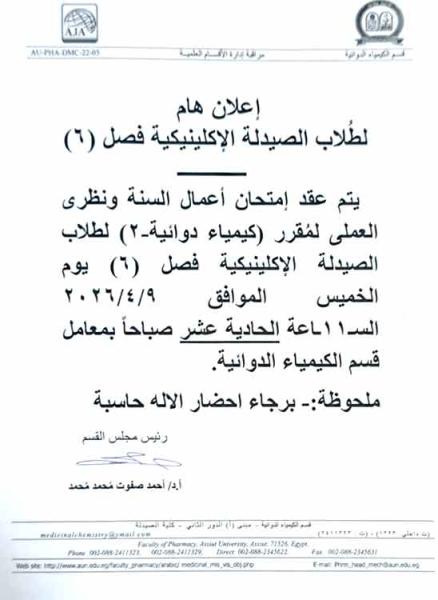
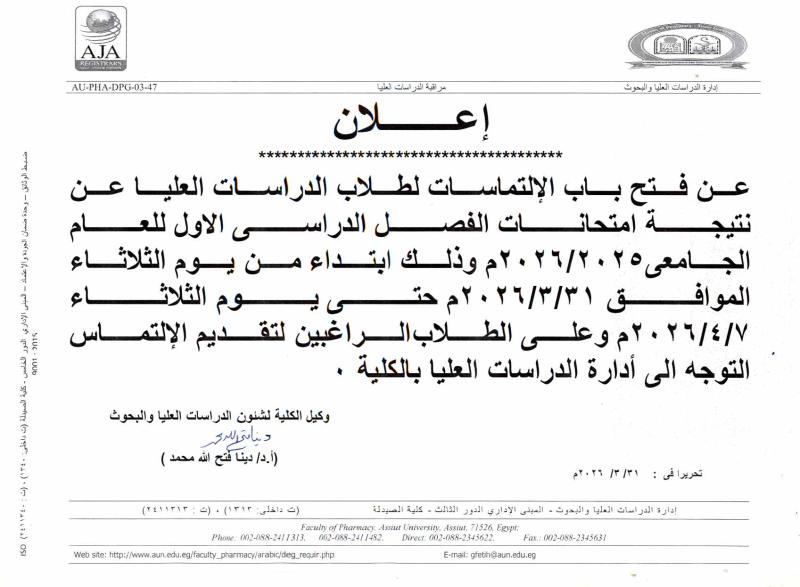
Postgraduate Examination Schedule (Diplomas – Master’s – PhD – Doctor of Pharmacy Professional Degree) and Offered Courses First Semester of the Academic Year 2025/2026

Diplomas

Doctor of Pharmacy Degree (PharmD – Professional Degree)


Master’s Degree in Pharmaceutical Sciences


Doctor of Philosophy (PhD) in Pharmaceutical Sciences

Examination Schedule for Offered PharmD Degree

Examination Schedule for Offered Diploma Programs

Examination Schedule for Offered Master’s Degree


news category
إعلانات الدراسات العليا

The Vice President of the University for Education and Student Affairs conducts an inspection tour to follow up on the progress of the first semester examinations for the academic year 2025/2026 at the Faculty of Pharmacy

Prof. Dr. Ahmed Mohamed Abd El-Mawla, Vice President of the University for Education and Student Affairs, conducted an inspection tour to review the progress of the first semester examinations for the academic year 2025/2026. He was received by Prof. Dr. Gihan Nabil Hassan Fetih, Dean of the Faculty; Prof. Dr. Hassan Refat Hassan Ali, Vice Dean for Education and Student Affairs; Mr. Tarek Sayed, Faculty Secretary; and a number of faculty members. During the tour, His Excellency was reassured about the regular and smooth conduct of the examination process.

The tour took place on Sunday, 4/1/2026.

news category
خبر عام

The Student Union of the Faculty of Pharmacy announces the organization of a distinctive recreational and cultural trip to visit the Egyptian Museum and the Pyramids area.

The Faculty of Pharmacy Student Union is organizing a special recreational and cultural trip
to visit the Egyptian Museum and the Pyramids area.

Date: Thursday, 12/2/2026
Participation fee: 150 EGP only
Reservation: First come, first served

A great opportunity to enjoy a day full of fun, culture, and great company 🤍

For registration and inquiries: Please visit the Youth Welfare Administration

news category
إعلانات الطلاب

Frequency of regulatory B cells phenotypes in breast cancer patients in Egypt

Research Abstract

Accumulating evidence has indicated that immune regulatory cells are involved in the establishment of the anti-tumor activity, however; the role of regulatory B cells (B-regs) in breast cancer (BC) remains unclear. This study intended to assess the frequency of peripheral B-regs phenotypes in patients with BC, and to determine the relation between these phenotypes and the patient's clinicopathological characters. The expressions of the immune cell populations were analyzed by four-color flow cytometry in 40 naïve BC patients and 10 age-matched apparently healthy individuals as controls attending the department of Clinical Oncology and Nuclear Medicine at Assiut University Hospitals. The percentages of B-regs phenotypes CD19+IL10+ and CD19+CD24hiCD27+IL10+ were higher in BC patients than in the controls. The percentage of CD19+IL10+ B cells phenotype was significantly associated with the HER-2 expression levels, T, and N stages of BC. In conclusion, high percentage of B-regs phenotypes CD19+IL10+ and CD19+CD24hiCD27+IL10+ in BC patients indicates a possible role in immune suppression during the development of BC.

Research Authors
Sherein G Elgendy, Ehsan MW El-Sabaa, Shabaan H Ahmed, Samir SM Eid, Mohamed A El-Feky
Research Date
Research Journal
Egyptian Journal of Immunology
Research Rank
Q3
Research Year
2021

Vitamin C effect on biofilm-forming ability of drug-resistant Acinetobacter baumannii clinical isolates

Research Abstract
Background
 
Multidrug-resistant Acinetobacter baumannii, particularly strains that produce metallo-β-lactamase (MBL) and carbapenemase, are considered emerging infection control threats. Its antimicrobial resistance and ability to form biofilm make treatment difficult. Although early research suggests that vitamin C can break down biofilms and restore antibiotic activity, its efficacy against drug-resistant A. baumannii strains is still unclear. The aim of this study was to assess the antimicrobial and biofilm inhibition properties of vitamin C against drug-resistant A. baumannii strains. 
Methods
 
Fifty clinical isolates of A. baumannii were collected from Assiut University Hospitals, Egypt. PCR detection of blaOXA-51-like gene was used for species confirmation. Antimicrobial susceptibility testing, β-lactamase phenotyping, and biofilm-forming assay were conducted. Broth microdilution was used to determine vitamin C …
Research Authors
Zainab I Rashed, Sherein G Elgendy, Amal Mohammed Hosni, Ehsan MW El-Sabaa
Research Journal
Microbes and Infectious Diseases
Research Publisher
Zagazig University, Faculty of Medicine
Research Rank
Q4
Research Year
2025

Co-occurrence of carbapenemase and ESBL encoding genes in multidrug-resistant Acinetobacter baumannii isolated from Assiut University Hospitals, Egypt

Research Abstract
 Carbapenem-resistant Acinetobacter baumannii (CRAB) is an emerging threat to healthcare systems worldwide due to its association with high morbidity, mortality, and, hard-to-treat infections. In Egypt, the prevalence of CRAB infections is rising, particularly in intensive care units (ICUs). This study aimed to investigate the prevalence, and molecular antimicrobial resistance characteristics of CRAB isolates obtained from patients at Assiut University Hospitals in Egypt. 
Methods
 
 Between July 2022 and January 2023, 50 CRAB isolates were identified and tested for antibiotic resistance through normal laboratory procedures. PCR was used to detect important resistance genes: blaOXA-51-like, blaNDM, blaVIM, and blaTEM. 
Results
 
 During the study period, all the isolates were found to be highly resistant to several antibiotics, including carbapenems. Resistance genes such as blaOXA-51-like, blaNDM …
Research Authors
Zainab I Rashed, Amal Mohammed Hosni, Ehsan MW El-Sabaa
Research Date
Research Journal
Microbes and Infectious Diseases
Research Publisher
Zagazig University, Faculty of Medicine
Research Rank
Q4
Research Year
2023

Prevalence of nosocomial Stenotrophomonas maltophilia infections in Assiut university hospitals

Research Abstract

Stenotrophomonas maltophilia is an emerging multidrug-resistant global opportunistic pathogenand isacquiring increasing importance as a nosocomial pathogen. This study aimed to determine the prevalence of nosocomial S. maltophilia infections and the important risk factors associated with such infections in Assiut University Hospitals. This study included 362 patients with nosocomial infections admitted to different wards and intensive care units (ICU) from March 2011 to March 2012. A total of 690 different clinical samples according to the site of infection were collected from them. The samples were processed and diagnosed by conventional bacteriological methods. A total of 35 strains of S. maltophilia were isolated from 362 patients (9.6%). The commonest clinical manifestations were lower respiratory tract infections (71.43%), wound infections (17.14%), bacteraemia (8.57%) and urinary tract infections (2.86%). The chest ICU showed the highest percentage of isolation (14.75%). Previous antibiotic intake was found to be a significant risk factor for nosocomial Stenotrophomonas maltophilia infections. We conclude that nosocomial Stenotrophomonas maltophilia infections are significant in Assiut University Hospitals with lower respiratory tract infections being the commonest and previous antibiotic intake an important risk factor.

Research Authors
Amany Gamal Thabit, Enas Abd-El-Meged Deaf, Nahla Mohammad Elsherbiny, Ehsan Mohammad Wageah
Research Date
Research File
Research Journal
Bulletin of Pharmaceutical Sciences Assiut University
Research Pages
27-32
Research Publisher
Assiut University, Faculty of Pharmacy
Research Rank
Q4
Research Vol
37
Research Year
2014

Phenotypic and genotypic characterization of carbapenemases in carbapenem-resistant gram-negative bacilli isolated from adult cancer patients

Research Abstract

Background: Carbapenem-resistant Gram-negative bacteria (CR-GNB) infections are prevalent in cancer patients with weakened immune systems, causing significant morbidity and mortality. The empirical use of antimicrobials has reduced mortality but led to the emergence of multidrug-resistant (MDR) bacteria. In this study, identification and susceptibility testing were carried out using standard procedures (Kirby-Bauer and broth microdilution techniques), and phenotypic and genotypic detection of carbapenemase-producing GNB isolated from adult cancer patients was performed using conventional procedures. Methods: One hundred and eight Gram negative bacteria were recovered from various specimens, with the most common isolates being, Escherichia (E.) coli (45; 41.7%), followed by Klebsiella spp. (38; 35.2%), Acromobacter spp. (9;8.3%), Acinetobacter (A.) baumannii (5; 4.6%) and others including Enterobacter aerogenes, Raoultella ornithinolytica, Serratia fonticola, Citrobacter brakii, Comamonas testosteroni, Proteus mirabilis (11; 10.2%). Concerningly, 64 of 108 Gram-negative bacterial isolates (59.3%) were MDR. Furthermore, 91 out of 108 GNB isolates (84.3%) revealed a pattern of meropenem resistance using the broth microdilution method, which is a worrying rise in the rate of carbapenem resistance. Following the modified carbapenem inactivation method (mCIM), EDTA carbapenem inactivation method (eCIM), and combined disc test as phenotypic tests for the preliminary screening of carbapenemase producers (CPs), conventional PCR was performed on the 91 extracted DNA (Using 6 common carbapenemase primers). Results: It was found that blaNDM was the most common 60(66%), then blaOXA-48, VIM 47 (51.6%), blaIMP 32(35.2%), blaKPC 20(22.2%), and blaGES 12(13.2%). Conclusion: Based on these results, rapid and precise carbapenemase detection is crucial for clinical care, epidemiological investigations, and infection control.

Research Authors
Dalia El Nobi, Sherein G Elgendy, Rania Bakry, Abeer S Hassan, Ehsan MW El-Sabaa
Research Date
Research File
paper2.pdf (1.1 MB)
Research Journal
Microbes and Infectious Diseases
Research Pages
853-870
Research Publisher
Zagazig University, Faculty of Medicine
Research Rank
Q4
Research Vol
4
Research Year
2023
Subscribe to