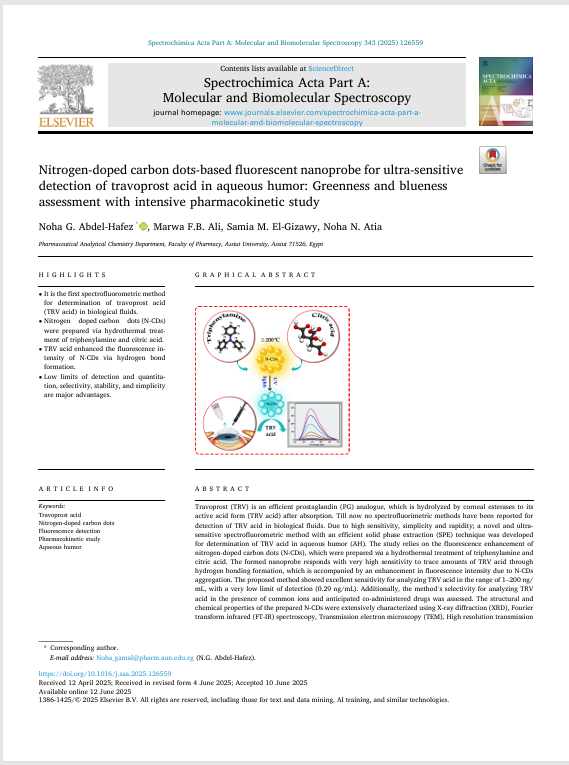



Travoprost (TRV) is an efficient prostaglandin (PG) analogue, which is hydrolyzed by corneal esterases to its active acid form (TRV acid) after absorption. Till now no spectrofluorimetric methods have been reported for detection of TRV acid in biological fluids. Due to high sensitivity, simplicity and rapidity; a novel and ultra- sensitive spectrofluorometric method with an efficient solid phase extraction (SPE) technique was developed for determination of TRV acid in aqueous humor (AH). The study relies on the fluorescence enhancement of nitrogen-doped carbon dots (N-CDs), which were prepared via a hydrothermal treatment of triphenylamine and citric acid. The formed nanoprobe responds with very high sensitivity to trace amounts of TRV acid through hydrogen bonding formation, which is accompanied by an enhancement in fluorescence intensity due to N-CDs aggregation. The proposed method showed excellent sensitivity for analyzing TRV acid in the range of 1–200 ng/ mL, with a very low limit of detection (0.29 ng/mL). Additionally, the method’s selectivity for analyzing TRV acid in the presence of common ions and anticipated co-administered drugs was assessed. The structural and chemical properties of the prepared N-CDs were extensively characterized using X-ray diffraction (XRD), Fourier transform infrared (FT-IR) spectroscopy, Transmission electron microscopy (TEM), High resolution transmission electron microscopy (HRTEM) and X-ray photoelectron spectroscopy (XPS). Furthermore, the method’s appli cability was evaluated by studying the pharmacokinetic properties of TRV acid in AH. The environmental impact of the method was evaluated using various greenness assessment tools, confirming the eco-friendly nature of the proposed method.