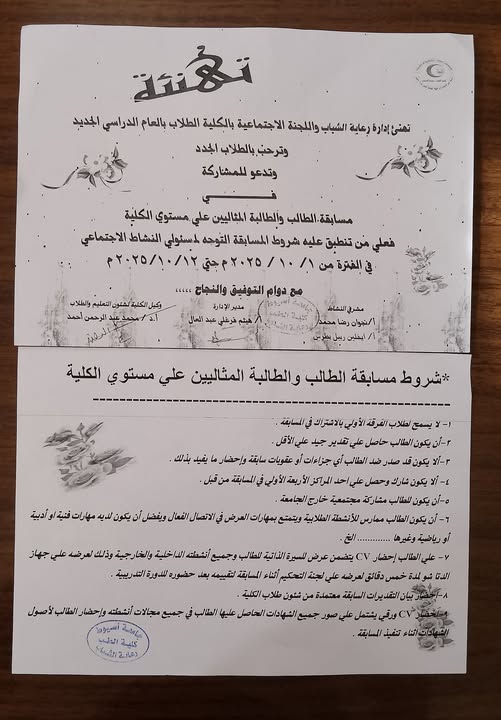
Announcement from the Student Welfare Department and the Social Committee of the College regarding the Ideal Student Competition
Doxorubicin (DOX) is a commonly used chemotherapeutic medication for treating malignancies, although its cardiotoxicity limits its use. There is growing evidence that alteration of the mitochondrial fission/fusion dynamic processes accompanied by excessive reactive oxygen species (ROS) production and alteration of calcium Ca2+ homeostasis are potential underlying mechanisms of DOX-induced cardiotoxicity (DIC). Metformin (Met) is an AMP-activated protein kinase (AMPK) activator that has antioxidant properties and cardioprotective effects. The purpose of the study is to assess Met's possible cardioprotective benefits against DOX-induced cardiotoxicity. The study included 32 adult male rats. They were randomly divided into four groups: administered saline, DOX, Met, or DOX combined with Met respectively. Heart tissues were used for biochemical assays that measured oxidative stress markers, malondialdehyde (MDA), reduced glutathione (GSH), mitochondrial dynamics markers, optic atrophy-1(OPA-1) and dynamin-1-like protein (Drp1), calcineurin and caspase-3. Serum levels of myocardial injury markers, cardiac troponin I (cTn-I), and aspartate aminotransferase (AST), were also measured. The results revealed that DOX intoxication was associated with a significant increase in the levels of serum cTn-I and AST, increased cardiac MDA level, increased cardiac Drp1, calcineurin, and caspase-3 expressions, as well as reduced cardiac GSH level and cardiac OPA-1 expression. On the other hand, Met treatment significantly reduced DIC by decreasing oxidative stress, apoptosis, and improving mitochondrial and calcium balance. Finally, this study shows that Met may be able to protect the heart from damage caused by DOX by working as an antioxidant and anti-apoptotic agent and keeping the balance of calcium and mitochondria.
A multitude of inflammatory cells and chemical mediators initiate a complex cascade that ultimately leads to hepatocyte death and a systemic inflammatory response. This research aimed to investigate the potential effects of sildenafil and neem (Azadirachta indica) extract, in both conventional and nanoparticle (NP) forms, in the treatment of moderate acute liver damage induced by orogastric carbon tetrachloride (CCL4).
To induce moderate acute hepatic damage a single oral dosage of CCL4 (2.5 mL/kg body weight) was provided 24 h before euthanasia. In liver damage-induced CCL4, sildenafil and neem extract were given in conventional and nanoparticle (PLGA or niosome) forms. To find histological anomalies and hepatic changes, behavioral, biochemical, histopathological, and immunohistochemical methods were used.
The findings indicated that sildenafil and/or neem extract, especially in NP combination, significantly mitigated CCL4-induced acute moderate liver damage. Indicators of liver function, including aspartate aminotransferase (AST), alkaline phosphatase (ALP), alanine aminotransferase (ALT), albumin, bilirubin and gamma-glutamyl transferase (GGT), shown improvement, particularly with the nanoparticulation of both therapies. Treatment, particularly in NP forms, improved the levels of malondialdehyde (MDA), superoxide dismutase (SOD), and glutathione peroxidase activity (GPx) in liver tissues. A significant reduction in NF-κB expression in hepatic tissue was shown in treatment groups. Also, medication resulted in lower levels of interleukin-1 beta (IL-1β), tumor necrosis factor alpha (TNF-α), caspase-3, and transforming growth factor-beta (TGF-β) in the liver tissue homogenates. Liver function was more significantly improved by the drug-NP combination.
This study verified the beneficial therapeutic effects of the combination of sildenafil and neem extract, particularly in NP forms, using biochemical, histological, and immunohistochemical analyses in a rat model of liver damage.
PIEZO channels are mechanical force sensors involved in various biological processes,
including somatosensation. To date, only a few PIEZO-binding
partners have been identified,
including MyoD-family
inhibitor proteins (MDFI and MDFIC). Here, we show
that MDFIC2, a third member of the MDFI protein family with an as-yet-
unknown
function, is expressed in a subset of nociceptive sensory neurons. MDFIC2 modulates
both PIEZO1 and PIEZO2 gating properties by slowing their kinetics and shifting
mechanical sensitivity to higher forces. Interestingly, Mdfic2 is downregulated in
mouse neuropathic pain models in which mechanical allodynia is a hallmark symptom.
We found that intrathecal administration of adeno-associated
virus vector encoding
MDFIC2 cDNA reduces mechanical sensitivity and attenuates mechanical allodynia in
the spared nerve injury neuropathic pain model. These findings demonstrate a mechanism
for regulating mechanosensation and highlight a potential therapeutic route for
treating mechanical allodynia.
Background Voltage-gated sodium channels
(VGSCs) are essential for generating and propagating
action potentials in excitable cells. They are considered
to be promising potential targets for analgesics
acting on nociceptive neurons. However, the translation
of animal model analgesic data to humans makes
VGSCs-targeting analgesic drug development challenging.
Starting with human experience to find
analgesics can reduce such failures. Traditional Chinese
medicine (TCM), a traditional medical system,
has rich human experience of analgesics, which means
many Traditional Chinese Medicine Herbs (TCMH)
are worth exploring for analgesic drug development.
However, studies of the analgesic mechanisms of
TCMH need to be conducted at the cellular and
molecular level for a VGSC perspective.
Purpose In this review, we provide an overview of
the TCMH analgesics and molecules from TCMH,
that act on VGSCs, especially subtype Nav1.3, Nav1.7,
and Nav1.8, along with a brief discussion on pharmaceutical
potential for pain management. We also
provide references for Chinese medicine to study pain
relief mechanisms at the molecular level of sodium ion
channels.
Methods Using Web of Science, the PubMed, and
China National Knowledge Infrastructure databases,
we conducted a comprehensive search of literature and
data on TCMH and VGSCs published before October
2024.
Conclusion While Navl.3, Navl.7, Navl.8 and Navl.9
are involved in the development and maintenance of
pain, Navl.8 can be studied as a potential drug target.
The traditional Chinese medicine herbs involved
sodium ion channels are primarily categorized into
seven types, including 30 well-defined natural ingredients
and 33 TCMH extracts. Studying the interactions
between the components of TCMH is an
important prerequisite for further exploration of how
a specific analgesic TCM or TCM formula modulates
ion channels or whether it binds to specific sites on
these channels.
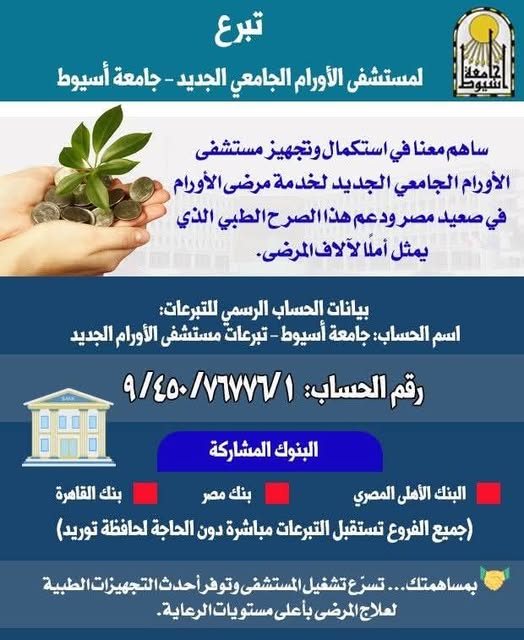
Join us in completing and equipping the cancer hospital in Upper Egypt.
For transfers from outside Egypt: IBAM Code
EG620001000100000009450767761