 Do you have any questions?

Chronic effect of aspartame versus stevioside on the cerebellar cortex of the adult albino rat: a histological and immunohistochemical study.
Research Journal
Egypt. J. Histol.
Research Year
2013
Abstract
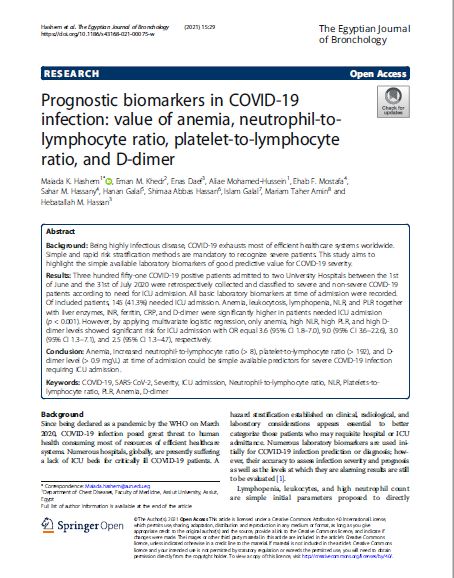
Background: Being highly infectious disease, COVID-19 exhausts most of efficient healthcare systems worldwide.
Simple and rapid risk stratification methods are mandatory to recognize severe patients. This study aims to
highlight the simple available laboratory biomarkers of good predictive value for COVID-19 severity.
Results: Three hundred fifty-one COVID-19 positive patients admitted to two University Hospitals between the 1st
of June and the 31st of July 2020 were retrospectively collected and classified to severe and non-severe COVID-19
patients according to need for ICU admission. All basic laboratory biomarkers at time of admission were recorded.
Of included patients, 145 (41.3%) needed ICU admission. Anemia, leukocytosis, lymphopenia, NLR, and PLR together
with liver enzymes, INR, ferritin, CRP, and D-dimer were significantly higher in patients needed ICU admission
(p < 0.001). However, by applying multivariate logistic regression, only anemia, high NLR, high PLR, and high Ddimer
levels showed significant risk for ICU admission with OR equal 3.6 (95% CI 1.8–7.0), 9.0 (95% CI 3.6–22.6), 3.0
(95% CI 1.3–7.1), and 2.5 (95% CI 1.3–4.7), respectively.
Conclusion: Anemia, increased neutrophil-to-lymphocyte ratio (> 8), platelet-to-lymphocyte ratio (> 192), and Ddimer
level (> 0.9 mg\L) at time of admission could be simple available predictors for severe COVID-19 infection
requiring ICU admission.
Keywords: COVID-19, SARS-CoV-2, Severity, ICU admission, Neutrophil-to-lymphocyte ratio, NLR, Platelets-tolymphocyte
ratio, PLR, Anemia, D-dimer
ABSTRACT
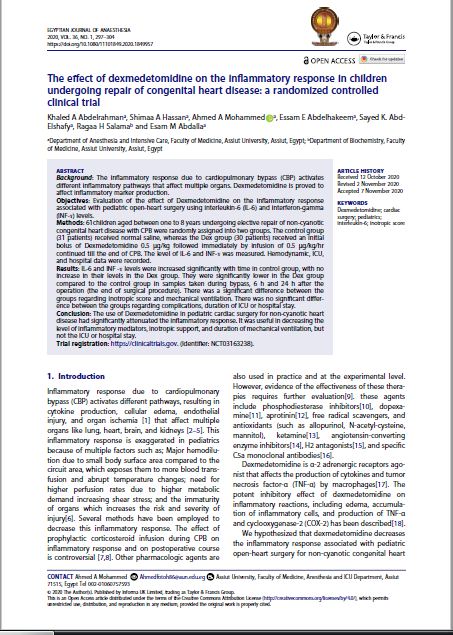
Background: The inflammatory response due to cardiopulmonary bypass (CBP) activates
different inflammatory pathways that affect multiple organs. Dexmedetomidine is proved to
affect inflammatory marker production.
Objectives: Evaluation of the effect of Dexmedetomidine on the inflammatory response
associated with pediatric open-heart surgery using interleukin-6 (IL-6) and interferon-gamma
(INF-ɤ) levels.
Methods: 61children aged between one to 8 years undergoing elective repair of non-cyanotic
congenital heart disease with CPB were randomly assigned into two groups. The control group
(31 patients) received normal saline, whereas the Dex group (30 patients) received an initial
bolus of Dexmedetomidine 0.5 μg/kg followed immediately by infusion of 0.5 μg/kg/hr
continued till the end of CPB. The level of IL-6 and INF-ɤ was measured. Hemodynamic, ICU,
and hospital data were recorded.
Results: IL-6 and INF -ɤ levels were increased significantly with time in control group, with no
increase in their levels in the Dex group. They were significantly lower in the Dex group
compared to the control group in samples taken during bypass, 6 h and 24 h after the
operation (the end of surgical procedure). There was a significant difference between the
groups regarding inotropic score and mechanical ventilation. There was no significant difference
between the groups regarding complications, duration of ICU or hospital stay.
Conclusion: The use of Dexmedetomidine in pediatric cardiac surgery for non-cyanotic heart
disease had significantly attenuated the inflammatory response. It was useful in decreasing the
level of inflammatory mediators, inotropic support, and duration of mechanical ventilation, but
not the ICU or hospital stay.
Trial registration: https://clinicaltrials.gov. (Identifier: NCT03163238).
Cases of Caesarean Scar Ectopic Pregnancy (CSEP) are becoming increasingly common at tertiary care hospitals because of increase in rate of CS. It may lead to horrible consequences, such as uncontrolled bleeding and uterine rupture (UR), which might require hysterectomy and result in subsequent loss of fertility. This report covers a case of a CSEP discovered early at 9 weeks of gestation in a 25-year-old woman coming for antenatal care. Conservative management of the uterus was performed with removal of the sac and repair of the uterine scar. The patient’s postoperative period was uneventful, and she was discharged 3 days after surgery. CSEP should be detected early to prevent its catastrophic sequences. Although it is a rare complication of cesarean section, CSEP must be kept in the minds of obstetricians facing emergency cases.
Abstract
Objective:
The objective of this paper is to create a scoring model for prediction of placenta accreta in early pregnancy by two-dimensional ultrasound and color Doppler.
Study design:
Prospective Cohort Study
Patient and Methods:
In our study we investigated 146 Patients at high risk of PAS using two dimensional and color Doppler ultrasound for findings suggestive of placenta accreta in early pregnancy. At time of delivery, diagnosis of placenta accreta was confirmed clinically.
Results:
Significant Doppler and 2D ultrasound findings for prediction for PAS in early pregnancy were; low implantation of the gestational sac, presence of placental lacunae and gestational sac or placenta overlapping uterine scar by 2D transvaginal ultrasound and Intraplacental dilated vessels by Doppler ultrasound. A scoring model for prediction of PAS in early pregnancy was created using these significant findings in addition to the number of previous CS deliveries. A cut-off point of 4.5 (out of 7.5 total score value) was used for prediction of cases at high risk of placenta accreta with sensitivity 77% and specificity 95%.
Conclusion:
A standardized risk assessment scoring model based on number of previous cesarean deliveries, 2D- ultrasound and Doppler findings can predict women at highest risk for morbidly adherent placenta in early pregnancy with relatively high specificity.