 Do you have any questions?

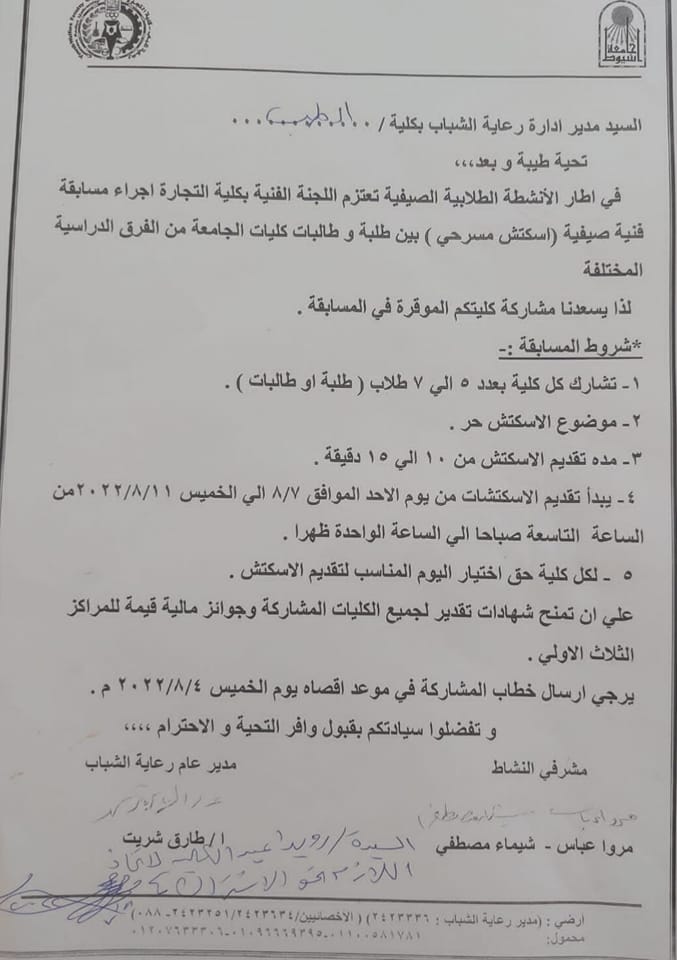
Initiation of the Catheter Aortic Valve Implantation Program - TAVI- at Assiut University Heart Hospital
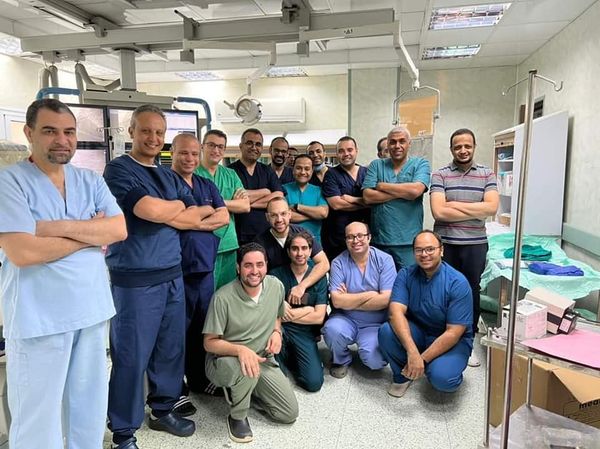
Announcement of the course of the Forensic Medicine Department - DNA topology in genomic transactions
Current iodine nutrition status and progress toward elimination of iodine deficiency disorders in Jazan, Saudi Arabia
Research Date
Research Department
Research Journal
BMC public health
Research Member
Research Year
2012
The emerging therapeutic role of some pharmacological antidotes in management of COVID-19
Research Abstract
Background A novel RNA coronavirus was identified in January 2020 as the cause of a pneumonia epidemic affecting the city of Wuhan; it rapidly spread across China. Aim of the review The aim is to discuss the potential efficacy of some pharmacologically known pharmacological antidotes (N-acetylcysteine; hyperbaric oxygen; deferoxamine; low-dose naloxone) for the management of COVID-19-associated symptoms and complications. Method An extensive search was accomplished in Medline, Embase, Scopus, Web of Science, and Central databases until the end of April, 2021. Four independent researchers completed the screening, and finally, the associated studies were involved. Conclusion The current proof hinders the experts for suggesting the proper pharmacological lines of treatment of COVID-19. Organizations, for example, WHO, should pursue more practical actions and design well-planned clinical trials so that their results may be used in the treatment of future outbreaks.
Research Date
Research Department
Research Journal
The Egyptian Journal of Bronchology volume
Research Member
Research Publisher
springeropen
Toxicological Analysis of Synthetic Cannabinoids (Strox) Seized in Assiut Governorate Using Gas Chromatography/ Mass Spectrophotometry (GC/MS)
Research Abstract
Background: In recent years many unknown synthetic cannabinoids (SCs) and other components have appeared on the market as constituents of herbal mixtures known as (Strox) which is posing a major public health and legal risk for society. Additionally, there is no adequate data on the ingredients of the illegally available ‘Strox’ and their pharmacological properties .Aim: this study was conducted to to detect active principles of some SCs products and to investigate the diversity of available synthetic cannabinoids (Strox) in Assiut governorate in 2020. Methodology: analysis of synthetic cannabinoid extract from 3 different seized samples (Strox) was conducted using Gas chromatography/ mass Spectrophotometry (GC/MS). Results: The Gas chromatography/ mass Spectrophotometry (GC/MS) analysis revealed that the different seized SCs samples were significantly different in terms of the active ingredients. Those ingredients included fatty acids, tobacco derivatives, cannabis sativa derivatives, benzodiazepines, quinazoline derivatives, piperine, indoles, analgesic agents, alkanes, melatonin derivatives, arsenic, solvents, and benzoic acid. Conclusion: The illegally available SCs samples have different ingredients which reflect the difference in the expected effects on users and making diagnosis of SCs use is challenging. Thus, leading to unpredictability of experienced symptoms and clinical presentation. Recommendations: Given the continuous emergence of variable mixtures containing new synthetic cannabinoids, a widespread cooperation system is necessary for sharing analytical information and improving drug market monitoring. This cooperation is mandatory to keep an up-to-date list of controlled substances
Research Date
Research Department
Research Journal
Zagazig Journal of forensic medicine and toxicology
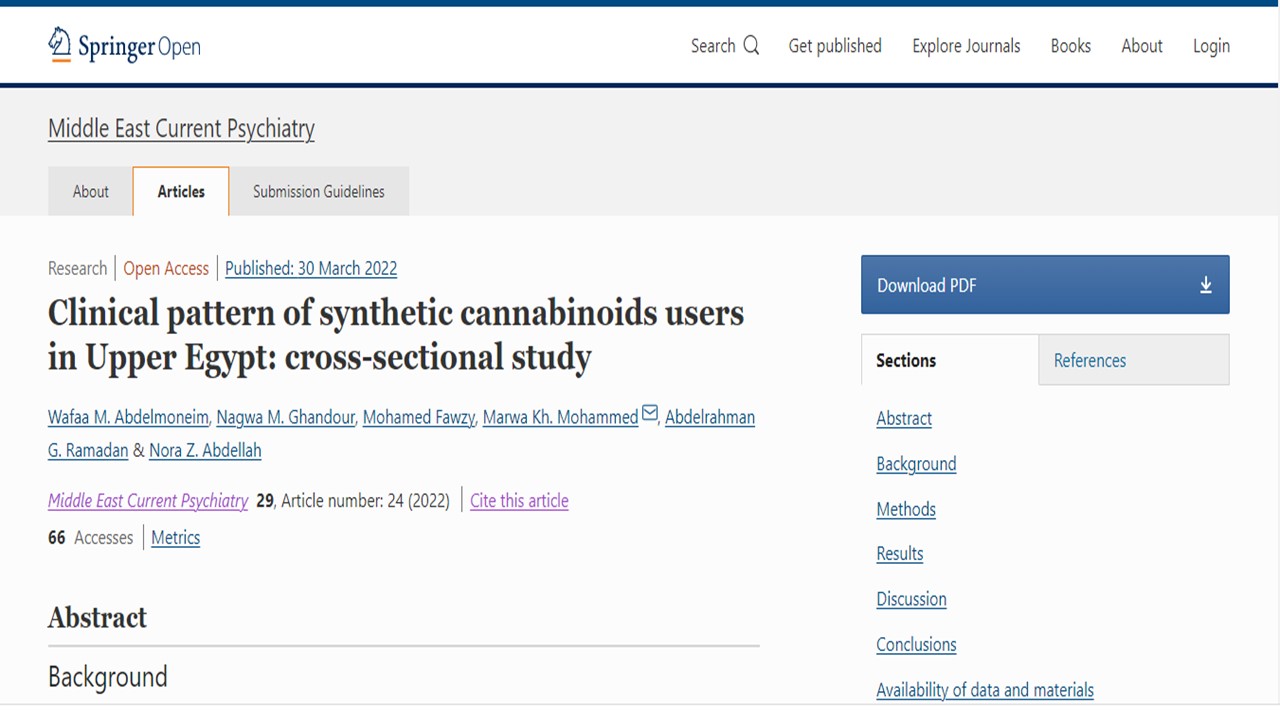
Clinical pattern of synthetic cannabinoids users in Upper Egypt: cross-sectional study
Research Abstract
Background There is an expanding use of new psychoactive substances containing synthetic cannabinoids in the last years. This study was conducted to identify the epidemiologic data of acute and chronic toxicity by synthetic cannabinoids in Upper Egypt patients. Results All cases included in the presenting study were fifty males. Most users of synthetic cannabinoids were in the adolescence and middle age group (15–< 35) representing 68%. Curiosity was the most common motivator for using synthetic cannabinoids. Alteration of perception was reported in 68% of subjects after synthetic cannabinoids use. Additionally, dizziness, loss of consciousness, convulsion, and panic attacks were also reported. Cardiovascular adverse effects experienced by users were palpitations (76%) and chest pain (12%). Half of included subjects (50%) reported financial problems and about one-third (32%) got involved in domestic violence. Abnormal routine laboratory findings that were found in included cases were in the form of 12% anemia, 10% leukocytosis, and 6% leucopenia. Also, liver and kidney functions were elevated in 8% and 4% of the cases, respectively. While 22% and 4% of cases were positive for hepatitis C and HIV respectively. Conclusions This study can be concluded that adolescence are the most common users of SCs; neuro-psychiatric and cardiovascular side effects were the most experienced by subjects. Violence in many forms, especially domestic violence, was associated with synthetic cannabinoids abuse. Trial registration Registered in clinical trial under name syntheticcannabinoidsAssiut and ID NCT03866941 and URL.
Research Date
Research Department
Research File
s43045-022-00188-y.pdf
(933.07 KB)
Research Image
Research Journal
Middle East Current Psychiatry
Research Member
Research Publisher
springeropen
The relationship between the Global Limb Anatomic Staging System (GLASS) and midterm outcomes of retrograde tibiopedal access after failure of antegrade recanalization for chronic limb threatening ischemia.
Research Abstract
Objective
To examine the relationship between the Global Limb Anatomic Staging System (GLASS) and midterm limb- and survival-related outcomes of retrograde tibiopedal access, after failed recanalization of infrainguinal chronic total occlusions (CTOs) using the antegrade approach, in patients with chronic limb threatening ischemia (CLTI).
Methods
This prospective, observational study was conducted between January 2017 and April 2019, and included 213 patients (29 GLASS I, 53 GLASS II, and 131 GLASS III lesions) with infrainguinal CTO in whom a percutaneous tibiopedal access was attempted as a consequence of failed recanalization using an antegrade approach. Multivariable Cox proportional hazard regression was performed to assess possible predictors of midterm clinical outcomes. Kaplan-Meier survival curves were used to estimate limb based patency (LBP), limb salvage, amputation free survival (AFS), and overall survival.
Results
The study reported access, crossing, and treatment success of 92.5%, 89.2%, and 89.2% of all tibiopedal access attempts, respectively. In comparison to GLASS I, GLASS stage III was associated with significantly worse midterm LBP (p= .005), overall survival (p= .037), limb salvage (p= .021), and AFS (p <.001).
Conclusion
Retrograde tibiopedal access for recanalization of infrainguinal CTOs in patients with CLTI is associated with high access, crossing, and treatment success, and low complication rates. The study suggests that GLASS stage may be a useful predictor of midterm limb- and survival-related outcomes of this approach. In comparison to GLASS I, GLASS III anatomy is associated with a significantly worse LBP, limb salvage, AFS, and overall survival.
Research Date
Research Department
Research File
ej.pdf
(616.16 KB)
Research Journal
European journal of vascular and endovascular surgery
Research Member
Research Publisher
elsevier
Research Vol
preproof
Research Website
https://www.sciencedirect.com/science/article/abs/pii/S1078588422002362
Research Year
2022
Retrograde Tibiopedal Access for Chronic Limb‑Threatening Ischemia: A Real‑World Experience Report of 178 Consecutive Patients
Research Abstract
Objective: The objective of the current study was to report single‑center data concerning the efficacy, safety, and midterm outcomes of
retrograde tibiopedal access, after failed antegrade attempts, for management of infrainguinal chronic total occlusions (CTOs) in patients
with chronic limb‑threatening ischemia (CLTI). Methods: This prospective, observational study was conducted between July 2016 and June
2019 and included 178 patients with infrainguinal CTO in whom a percutaneous tibiopedal access was attempted as a consequence of failed
recanalization using an antegrade approach due to ostial lesions or failed re‑entry. Results: The study reported access, crossing, and treatment
success of 93.8%, 89.9%, and 88.8% of all tibiopedal access attempts, respectively. Primary, assisted primary, and secondary patency rates
were 43.8% ± 3.9%, 64.2% ± 3.8%, and 71.7% ± 3.5% at 24 months, respectively. Kaplan–Meier analysis yielded an overall amputation‑free
survival of 71.1% ± 3.5% at 24 months. Conclusion: Retrograde tibiopedal access is an effective and safe approach as associated with high
access, crossing, treatment success, and low complication rates. This approach is considered as a bailout technique during endovascular
procedures in recanalization of infrainguinal CTOs, after failed antegrade attempts, in patients with CLTI.
Research Date
Research Department
Research Journal
Indian Journal of Vascular and Endovascular surgery
Research Member
Research Pages
3-10
Research Publisher
Wolters Kluwer ‑ Medknow
Research Vol
9
Research Website
https://www.indjvascsurg.org/article.asp?issn=0972-0820;year=2022;volume=9;issue=1;spage=3;epage=10;aulast=Abdelmonem
Research Year
2022
Lower Extremity Vascular Trauma Assiut University Hospital Experience
Research Abstract
Background: There is globally increase incidence in vascular trauma as a result of increase rate of civilian violence and increase rate of road
traffic accident. Vascular injury affects young males and associated with high mortality and long‑term morbidity. Here, we present our experience
as tertiary health centers in the management of this type of injury, also we present our result as regards to primary and secondary amputation
rates. The most important factors affecting these rates were ischemia time and condition of surrounding soft tissue. Aims and Objectives: Detect
rate of limb salvage after trauma injury in assuit university hospital , and risk factors for limb loss. Materials and Methods: Our study is
prospective study of all patients who vascular lower extremity trauma from January 2014 to January 2015 during the period of the study(from
January 2014 to January 2015), 135 cases of vascular injury presented to Assiut University Hospital, 87 of them had lower limb vascular
injury representing 64.4%. Results: Surgical intervention was done in 82 patients representing 94.3%, endovascular intervention was done
in 2 patients representing 2.3, 1 patient had endovascular balloon control then surgical intervention representing 1.15%, and two patients
had conservative management representing 2.3%. Conclusion: vascular trauma is prevalent health problem in our locality, which have huge
socioeconomic impact in our community as it affects mainly young men. The main controlling factor in secondary amputation rate is ischemia
time, infection which accompanies severe soft tissue damage. At the end trauma with vascular injury is considered, a complex process needs
urgent intervention with multidisciplinary team in well‑equipped facility.
Research Date
Research Department
Research File
mm.docx
(81.28 KB)
Research Journal
Indian Journal of vascular and endovascular surgery
Research Member
Research Pages
170-7
Research Publisher
Wolters Kluwer ‑ Medknow
Research Vol
9
Research Website
https://www.indjvascsurg.org/article.asp?issn=0972-0820;year=2022;volume=9;issue=2;spage=170;epage=177;aulast=Shahat;type=0
Research Year
2022