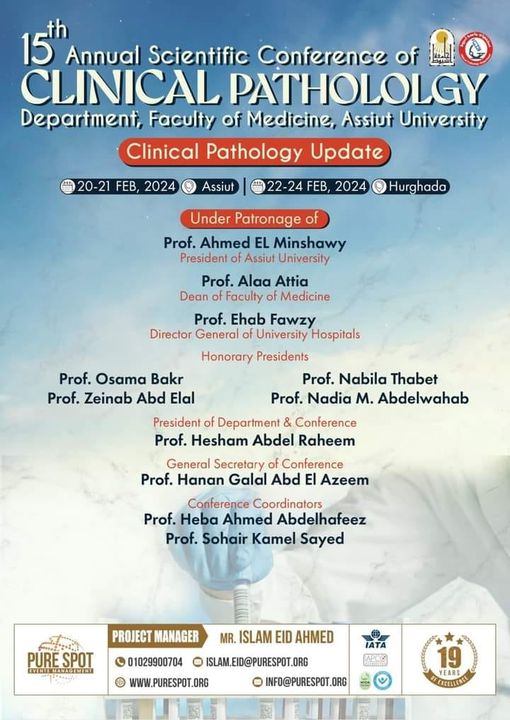
An invitation to attend the fifteenth conference of the Department of Clinical Pathology

An invitation to attend the fifteenth conference of the Department of Clinical Pathology

دعوة لحضور المؤتمر الخامس عشر لقسم الباثولوجيا الاكلينكية

تحت رعاية:

ا. د. احمد المنشاوي- رئيس جامعة أسيوط

ا. د. علاء عطية- عميد كلية الطب ورئيس مجلس إدارة المستشفيات الجامعية

ا. د. امانى عمر- وكيل الكلية لشئون الدراسات العليا والبحوث

أ.د. ايهاب فوزى- المدير التنفيذى للمستشفيات الجامعية.

أ.د.  هشام عبدالرحيم - رئيس القسم ورئيس المؤتمر

أ.د. حنان جلال عبدالعظيم- مقرر المؤتمر

وذلك في الفترة من 20–21فبراير 2024 بالمبني الإداري بجامعة أسيوط

Acetylated oligopeptide and N‐acetylcysteine protect against iron overload‐induced dentate gyrus hippocampal degeneration through upregulation of Nestin and Nrf2/HO‐1 and downregulation of MMP‐9/TIMP‐1 and GFAP

Research Abstract

Iron accumulation in the brain causes oxidative stress, blood–brain barrier (BBB) breakdown, and neurodegeneration. We examined the preventive effects of acetylated oligopeptides (AOP) from whey protein on iron‐induced hippocampal damage compared to N‐acetyl cysteine (NAC). This 5‐week study used 40 male albino rats. At the start, all rats received 150 mg/kg/day of oral NAC for a week. The 40 animals were then randomly divided into four groups: Group I (control) received a normal diet; Group II (iron overload) received 60 mg/kg/day intraperitoneal iron dextran 5 days a week for 4 weeks; Group III (NAC group) received 150 mg/kg/day NAC and iron dextran; and Group IV (AOP group) received 150 mg/kg/day AOP and iron dextran. Enzyme‐linked immunosorbent assay, spectrophotometry, and qRT‐ PCR were used to measure MMP‐9, tissue inhibitor metalloproteinase‐1 (TIMP‐1), MDA, reduced glutathione (GSH) levels, and nuclear factor erythroid 2‐related factor 2 (Nrf2) and heme oxygenase‐1 (HO‐1) gene expression. Histopathological and immunohistochemical detection of nestin, claudin, caspase, and GFAP was also done. MMP‐9, TIMP‐1, MDA, caspase, and GFAP rose in the iron overload group, while GSH, Nrf2, HO‐1, nestin, and claudin decreased. The NAC and AOP administrations improved iron overload‐induced biochemical and histological alterations. We found that AOP and NAC can protect the brain hippocampus from iron overload, improve BBB disruption, and provide neuroprotection with mostly no significant difference from healthy controls.

Research Authors
Amira A. Kamel1 | Ahmed Y. Nassar1 | Fatma Y. Meligy2,3 | Yomna A. Omar4 | Gamal A. Y. Nassar5 | Ghada M. Ezzat1
Research Journal
cell biochemistry and function
Research Member
Research Pages
e3958
Research Publisher
Wiley
Research Vol
42
Research Website
https://doi.org/10.1002/cbf.3958
Research Year
2024

Results of treating Patients with Chronic Migraine with OnabotulinumtoxinA alone Versus Its Combination with Other Prophylactic Drugs

Research Abstract

ABSTRACT

Background: Chronic migraine [CM] is a severe neurological disorder characterized by pulsating unilateral or bilateral headache episodes. In people with chronic migraine, onabotulinumtoxinA could reduce the frequency and severity of migraines. Patients report that the treatment is well tolerated.


The Aim of The Work: The aim of this study was to evaluate the efficacy of onabotulinumtoxinA injection compared with the efficacy of onabotulinumtoxinA injection in combination with other oral prophylactics.


Materials and Methods: This observational study included one hundred five patients with chronic migraine attending the neurology clinic at Almoosa Specialized Hospital in Saudi Arabia, and was conducted from November 2019 to January 2021. Forty-five patients [42.9%] received an injection of onabotulinumtoxinA alone [group A], and 60 patients [57.1%] received a combined injection of onabotulinum- toxinA plus oral prophylaxis [group B].


Results: The study included 105 patients. The mean age of participants was 41.2 ± 5.7 years and ranged from 35 to 55 years. Seventy women [66.7%] and 35 men [33.3%] were affected. The mean frequency of migraine days showed a significant reduction from 17.6±10.3 days per month to 7.2±4.3 days after treatment in patients receiving onabotulinum toxin-A in combination with oral prophylactic medication, whereas it showed a less significant reduction from 16.4 ± 10.4 days per month to 9.1 ± 2.4 days in patients receiving onabotulinum toxin-A alone. Mean treatment frequency per month and mean duration of migraine attacks per hour were also significantly reduced after treatment in both groups.


Conclusion: Onabotulinum toxin-A toxin injection is highly effective in treating patients with chronic daily migraine, reducing the number and severity of migraine attacks per month and improving the quality of life of migraine patients. However, it is even more effective when combined with other prophylactic medications depending on the patients' concomitant diseases.

Research Authors
Saber Aboelhassan Abdelrohman 1*, Sherif Saad Osman 2
Research Date
Research File
Paper 7.pdf (1.76 MB)
Research Journal
International Journal of Medical Arts
Research Member
Research Pages
2271-2278
Research Publisher
International Journal of Medical Arts
Research Vol
4
Research Website
https://ijma.journals.ekb.eg/
Research Year
2022

PROGNOSTIC VALUE OF LATE RESPONSE (F WAVE AND H REFLEX) IN SURGICAL MANAGEMENT OF LUMBER DISC HERNIATION (L5-S1)

Research Abstract

ABSTRACT

Background: The diagnosis of lumbar disc herniation is based on clinical history and examination, imaging studies, and electrophysiologic studies. Many factors have been reported as affecting recovery following surgical decompression. Electrophysiological studies has role in the diagnosis and predicting the prognosis of lumbar disc herniation.

Aims and Objectives: To study the prognostic value of the late response (F wave and H reflex) in lumbar disc herniation (L5-S1) treated surgically.

Materials and Methods: The study was conducted from January 2014 to April 2015 on fifty patients presented with lumbar disc herniation (L5-S1) and admitted in the department of spine surgery for surgical decompression. Both preoperative and 3 months postoperative electrophysiological studies were done.

Results: Preoperative F wave were abnormal in 74% of patients while H reflex were abnormal in all patients. 3 months follow up postoperative, 82% of patients had good outcome and improved neurological symptoms and 18% of patients still complaining of low back pain and sciatica. Postoperative F wave results showed 56% of patients had abnormal F wave response while H reflex results showed 52% of patients had abnormal H reflex. There were significant difference between both groups regarding to age, BMI, duration of disease, preoperative F wave and H reflex.

Conclusion: Old age patients with high BMI, long duration of neurological symptoms, absent F wave and H reflex response had unfavorable outcome postoperative.

Research Authors
Yasser H. Mustafaa, Saber Aboelhassanb and Ahmed I. Abdelsalamc
Research Date
Research File
Paper 3.pdf (572.6 KB)
Research Journal
AL-AZHAR ASSIUT MEDICAL JOURNAL
Research Member
Research Pages
6
Research Publisher
AL-AZHAR ASSIUT MEDICAL JOURNAL
Research Vol
AAMJ ,VOL 13 , NO 3
Research Year
2015

Modified Mallampati Score as a Predictor for the Presence and the Severity of Obstructive Sleep Apnea in Snoring Patients

Research Abstract

Abstract

Aim of the study: To assess if the modified Mallampati score (MMS) can predict the presence and the severity of obstructive sleep apnea syndrome (OSA) in a group
of patients who had snoring and witnessed apnea from Al-Azhar university hospitals, Cairo, Egypt and Almoosa Hospital, Alhasa, Saudi Arabia.


Methods: A retrospective study was done for patients who had snoring and witnessed apnea referred to a sleep lab for the diagnosis of OSA by overnight full polysomnogram from January 2017 to November 2020. Apnea-hypopnea index (AHI) was used to categorize the severity of sleep apnea. Age, sex, MMS, body mass
index (BMI), comorbidities, sleep and laboratory parameters were recorded. Also, full Otorhinolaryngological, Neurological and Internal medicine examinations were recorded.

Results: The study was carried out on 350 patients fulfilling the inclusion criteria with a mean age 51.3 ± 14.3 years ranging from 14 to 81 years. More than half of them (58.6%) were males, the mean BMI was 35.1 ± 8.8 kg/m2 and the mean MMS was 4.7 ± 1.6 with about 65% of patients grouped in classes III and IV. OSA
(AHI>5) was diagnosed in 278 (79.4%) patients. Significantly, OSA was more detected among males, those with increased age, BMI, MMS, and those with type 2 diabetes mellitus (T2DM). Further evaluation showed a significant positive correlation between both BMI and MMS with the severity of OSA (ρ =0.23, P<0.001 and
ρ =0.36, P<0.001) respectively.

Conclusion: MMS is a useful tool to predict the presence as well as the severity of OSA in snoring patients. BMI and male gender are independent predictors.

Keywords: Snoring; Modified Mallampati Score; Body Mass Index; Obstructive Sleep Apnea

Research Authors
Eldaboosy SAM1,2, Eldesoky I3*, Nour SO2, Abdelsalam E4, Mohammed RAF4, Awad A5 and Abolhassan S6
Research Date
Research File
Paper 2.pdf (697.74 KB)
Research Journal
La Prensa Medica Argentina
Research Member
Research Pages
5
Research Publisher
La Prensa Medica Argentina
Research Vol
Volume 107 Issue 3
Research Website
DOI: https://doi.org/10.47275/0032-745X-332
Research Year
2021

Autonomic function assessment in Egyptian patients with Behçet’s disease: a case–control study

Research Abstract

Background
Behçet’s disease (BD) is considered a chronic multisystem disorder, where
neurological manifestations are common. There is scarcity of investigations that
have assessed the autonomic nervous system dysfunction in BD, with conflicting
results.

Objectives
The current study aimed to identify presence of autonomic nervous system
dysfunction using neurophysiological assessment in BD and to investigate the
relationship between the indicators of autonomic function and the disease activity
parameters.

Patients and methods
The study involved 30 patients with BD in accordance with the Universal Criteria for
Behçet’s Diseases and 25 controls, who were subjected to clinical evaluation and
Palmar sympathetic skin response (SSR).

Results
Patients with BD had a significant difference in SSR (P<0.001) compared with
controls. Moreover, a significant positive association was found among neuropathic
pain and disease activity parameters.

Conclusion
The study confirms the presence of sympathetic autonomic dysfunction in BD,
which related to disease activity using a simple noninvasive test such as SSR.

Research Authors
Anwar M. Alia, Esraa A. Talaatb, Saber A.E.H. El Nazera, Manal M. Hasaneinb
Research Date
Research Journal
Al-Azhar Assiut Medical Journal 2021, 19:216–221
Research Member
Research Pages
216–221
Research Publisher
Al-Azhar Assiut Medical Journal 2021, 19:216–221
Research Website
http://www.azmj.eg.net on Monday, May 3, 2021, IP: 196.158.8.5]
Research Year
2021

A rare association: Obesity hypoventilation syndrome with myasthenia gravis and systemic lupus erythematosus, case report

Research Abstract

Background: Shrinking lung syndrome (SLS) is an uncommon complication of systemic lupus
erythematosus (SLE) that has also been seen in other autoimmune diseases and is linked with a
high risk of acute or chronic respiratory failure. Alveolar hypoventilation in the presence of
obesity-hypoventilation syndrome, systemic lupus erythematosus (SLE), and myasthenia gravis
(MG) is uncommon and poses a diagnostic and therapeutic challenge.


Case report: We reported a 33-year-old female patient from Saudi Arabia who suffered from obesity,
bronchial asthma, newly diagnosed essential hypertension, type 2 diabetes mellitus, with
recurrent acute alveolar hypoventilation, secondary to obesity hypoventilation syndrome and
mixed autoimmune disease (systemic lupus erythematosus and myasthenia gravis), based on the
correct constellation of clinical findings and laboratory evidence.

Conclusion: The interesting aspect of this case report: is the presentation of the overlap of obesity
hypoventilation syndrome and shrinking lung syndrome due to systemic lupus erythematosus
with generalized and respiratory muscle dysfunction due to myasthenia gravis with good outcomes
after therapy.

Research Authors
Safwat Eldaabossia, b, *, Man Alrashdanb, Ghada Aljanobic, Noha Warshac, Saber Abo Elhassand, Waheed Mahdie, Abdullah Faroukf, Ahmad Tahaa, Ahmad Qabila, Sameh Maklada, Usama Nabwaya, Hatem Kenanyg, Yasser Jaberh, Boshra Zaghlouli
Research Date
Research Journal
Respiratory Medicine Case Reports 44 (2023) 101848
Research Member
Research Pages
6
Research Publisher
Respiratory Medicine Case Reports journal
Research Vol
44 (2023) 101848
Research Website
homepage: www.elsevier.com/locate/rmcr
Research Year
2023

Neurovascular Findings and Associated Risk Factors in Stroke in Young and Middle-Aged Patients: A Single Center Experience

Research Abstract

Background: The increasing incidence of stroke in younger people underscores the urgent need for research to elucidate the underlying risk factors and causes. To date, the vast majority of studies of stroke in young people have been conducted in European and North American regions.

Aim of the work: To characterize the neurovascular findings and associated risk factors for stroke in young and middle-aged patients at Almoosa Hospital in Saudi Arabia.
Methods: We retrospectively analyzed data from consecutive patients with ischemic stroke and transient ischemic attack aged 25 to 60 years who underwent detailed cardiocerebrovascular examination.

Results: The study included 182 patients, most of whom [89%] presented with stroke and 11% with transient ischemic attack. The mean age was 51.2±8.4 years [25-60 years], 62.6% were men, mean BMI was 30.7±5.4, 41.2% were smokers, 52.7% were diabetic, 60.4% had hypertension, and 38.5% had dyslipidemia. Cardiac risk factors were valvular heart disease [34.1%], ischemic heart disease [16.5%], cardiac thrombi [8.8%], and septal defects [4.4%]. Magnetic resonance imaging revealed anterior circulation infarction in 47.3% and posterior circulation infarction in 14.3%, whereas both anterior and posterior circulation infarction were found in 27.5%. Neurovascular imaging of the neck was performed in 102 patients, with 16.5% having mild stenosis, 7.7% moderate stenosis, 9.9% severe stenosis 8.8%, and 5.5% complete stenosis. Carotid arteries duplex examination revealed insignificant stenosis in 15.4% and significant stenosis in 6.6%. Type 2 diabetes, hypertension, and dyslipidemia had a major impact on the extent of stenosis, whereas DM 2 and dyslipidemia were significantly more common in patients with increasing degrees of stenosis.

Conclusion: In this study young patients with ischemic stroke had different cerebro-vascular risk factors and etiologies compared with previous cohorts, indicating the need for tailored prevention interventions that take into account regional epidemiological data on cerebrovascular health.
Received:

Research Authors
Saber Aboelhassan Abdelrohman 1*, Abdallah Farouk Elatrash 2, 3, Hatem Kenany 4, Yasser G. Abish 5, 6, Shimaa Hassan 7, Mohamed Sabry Attia 7, Mahmoud Farouk Elmeniesy 8
Research Date
Research Journal
Available online at Journal Website https://ijma.journals.ekb.eg/ Main Subject [Neurology]
Research Member
Research Pages
2641-2649
Research Vol
Volume 4, Issue 9, September 2022
Research Website
https://ijma.journals.ekb.eg/
Research Year
September 2022
Subscribe to