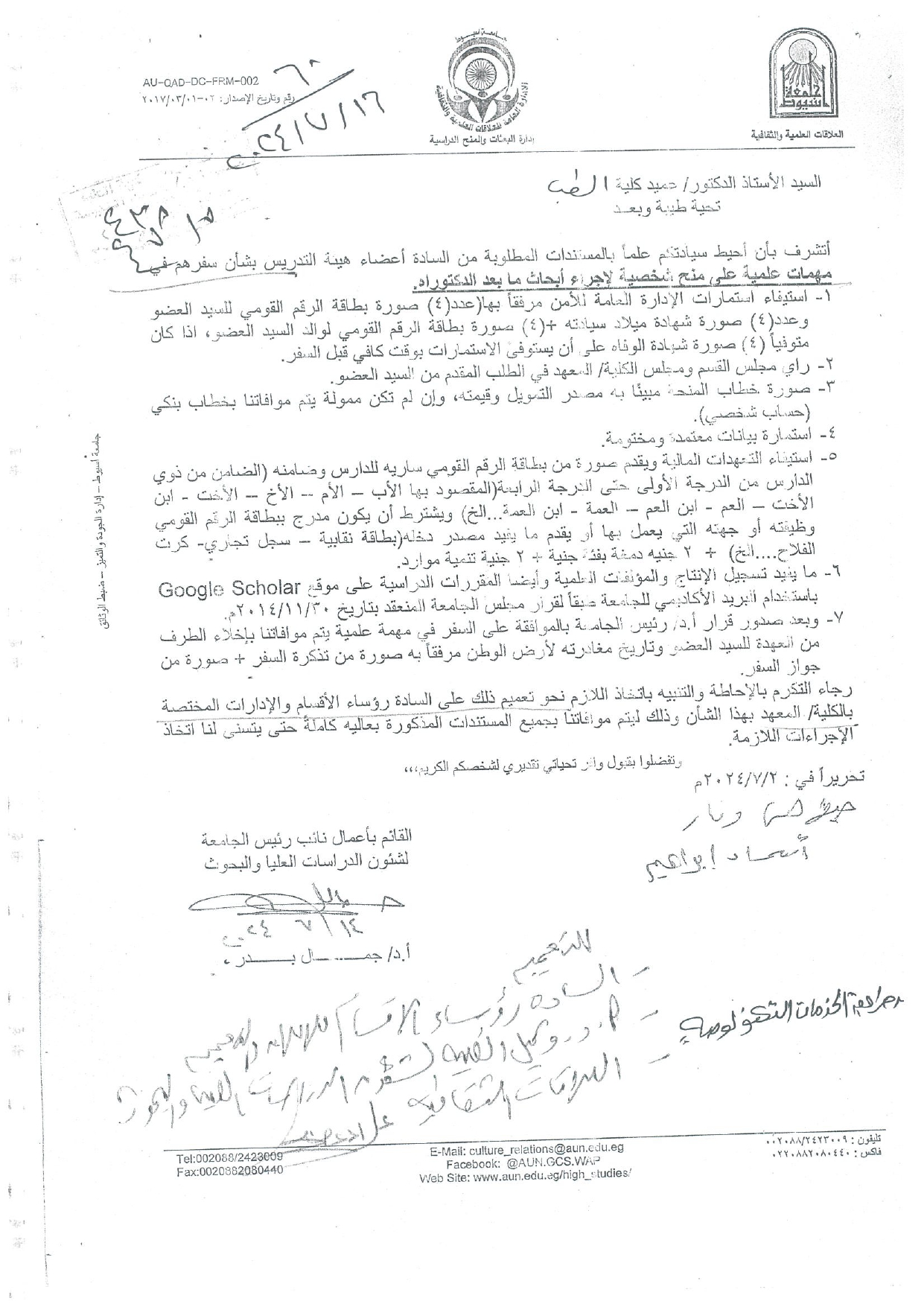
Regarding the documents required from faculty assistants regarding their travel on study leaves on personal scholarships to obtain a master’s or doctoral degree.

Regarding the documents required from faculty assistants regarding their travel on study leaves on personal scholarships to obtain a master’s or doctoral degree.

Regarding the documents required from faculty assistants regarding their travel on study leaves on personal scholarships to obtain a master’s or doctoral degree.

Alleviation of doxorubicin-induced cardiotoxicity in rat by mesenchymal stem cells and olive leaf extract via MAPK/ TNF-α pathway: Preclinical, experimental and bioinformatics enrichment study

Research Abstract

Background

Toxic cardiomyopathies were a potentially fatal adverse effect of anthracycline therapy.

Aim

This study was conducted to demonstrate the pathogenetic, morphologic, and toxicologic effects of doxorubicin on the heart and to investigate how the MAPK /TNF-α pathway can be modulated to improve doxorubicin-Induced cardiac lesions using bone marrow-derived mesenchymal stem cells (BM-MSCs) and olive leaf extract (OLE).

Methods

During the study, 40 adult male rats were used. Ten were used to donate MSCs, and the other 30 were split into 5 equal groups: Group I was the negative control, Group II obtained oral OLE, Group III obtained an intraperitoneal cumulative dose of DOX (12 mg/kg) in 6 equal doses of 2 mg/kg every 48 h for 12 days, Group IV obtained intraperitoneal DOX and oral OLE at the same time, and Group V obtained intraperitoneal DOX and BM-MSCs through the tail vein at the same time for 12 days. Four weeks after their last dose of DOX, the rats were euthanized. By checking the bioinformatic databases, a molecularly targeted path was selected. Then the histological, immunohistochemistry, and gene expression of ERK, JNK, NF-κB, IL-6, and TNF-α were done.

Results

Myocardial immunohistochemistry revealed severe fibrosis, cell degeneration, increased vimentin, and decreased CD-31 expression in the DOX-treated group, along with a marked shift in morphometric measurements, a disordered ultrastructure, and overexpression of inflammatory genes (ERK, NF-κB, IL-6, and TNF-α), oxidative stress markers, and cardiac biomarkers. Both groups IV and V displayed reduced cardiac fibrosis or inflammation, restoration of the microstructure and ultrastructure of the myocardium, downregulation of inflammatory genes, markers of oxidative stress, and cardiac biomarkers, a notable decline in vimentin, and an uptick in CD-31 expression. In contrast to group IV, group V showed a considerable beneficial effect.

Conclusion

Both OLE and BM-MSCs showed an ameliorating effect in rat models of DOX-induced cardiotoxicity, with BM-MSCs showing a greater influence than OLE.

Research Authors
Mahrous A. Ibrahim a , Athar M. Khalifa b , Noha M. Abd El-Fadeal c d e , Rehab I. Abdel-Karim f , Ayman F. Elsharawy g h , Alia Ellawindy i , Heba M. Galal j k , Eman H. Nadwa l m , Mohamed A. Abdel-Shafee n , Rania A. Galhom d o p
Research Date
Research Department
Research Journal
Tissue and Cell
Research Member
Research Year
2023

GC/MS Analysis, Cytotoxicity, and Antiviral Activities of Annona glabra Hexane Extract Supported by In Silico Study

Research Authors
Dalia M Soleman, Omayma A Eldahshan, Mona H Ibrahim, Hanan A Ogaly, Heba M Galal, Gaber El-Saber Batiha, Rawah H Elkousy
Research Date
Research Department
Research Journal
Molecules
Research Member
Research Publisher
MDPI
Research Year
2023

Use of mesenchymal stem cells in Experimental Ovarian Damage

Research Abstract

Background

Bisphenol-A (BPA) has a well-proven deleterious effect on the hypothalamicpituitary- gonadal axis.

Objectives

The current study investigated the therapeutic potentials of mesenchymal stem cells (MSCs) in a murine model of BPA-induced ovarian damage.

Methods

Fifty adult female rats were divided into: Group 1; control group, Group IIa, IIb: rats were given oral gavage of BPA (25 and 50 mg/Kg body weight respectively) on a daily basis for 15 days, and Group IIIa, IIIb; rats were intravenously treated with of MSCs (106 cells) after receiving the last dose of BPA as in group II. Plasma and ovarian tissue levels of Malondialdehyde (MDA) and gonadal axis hormones were assessed. Apoptosis was evaluated by TUNNEL assay and by apoptosis markers (FAS, FASL, Caspase 3, SLTM). A histological examination of ovarian tissue was also conducted.

Results

BPA resulted in a significant elevation in plasma …

Research Authors
Hanan Fouad, Ibrahim A Albahlol, Hazim A Wahab, Eman H Nadwa, Heba M Galal, Mohamed Abouelkheir, Ahmed E Taha, Abdelkarim G Kamel, Hassan A Abdelmawlla
Research Date
Research Department
Research Journal
Current Stem Cell Research & Therapy
Research Member
Research Pages
Pages 725-734
Research Publisher
Bentham Science Publishers
Research Vol
Volume 19, Issue 5
Research Website
https://scholar.google.com/scholar?oi=bibs&cluster=1539492433798837275&btnI=1&hl=en
Research Year
2024

Surveillance of antibiotic resistance among uropathogens in Aljouf region northern Saudi Arabia

Research Abstract

Background and Objectives:

Urinary tract infections are common health problem affecting millions worldwide. Antibiotic resistance among uropathogens (Ups) is prevalent in many countries. In the absence of any available data in the region, this hospital-based study investigated the pattern, frequency and susceptibility of Ups at Prince Mutaib Bin Abdulaziz Hospital, Aljouf Region, Saudi Arabia.

Materials and Methods:

A retrospective assessment of UPs and their antibiotics susceptibility was conducted from January 2017 to December 2017 using the fully automated Vitek2 system (BioMérieux, France).

Results:

Among the 415 uropathogens isolates, the most prevalent bacteria were Gram-negatives comprising 137 (51%) E. coli; 46 (17.2%) Klebsiella spp.; 30 (11.2%) Pseudomonas spp.; 25 (9.3%) Proteus spp.; 14 (5.2%) Acinetobacter baumanii and 16 (5.9%) others. On the other hand, Enterococcus spp. were predominant among Gram-positive isolates representing 54 (36.7%), 47 (32.0%) Staphylococcus spp., 22 (15.1%) Streptococcus spp., and 13 (8.8%) S. aureus, and 11 (7.5%) others. Gram-negative Ups showed multidrug resistance towards the majority of the tested antimicrobials (ampicillins, cephalosporins, fluoroquinolones, trimethoprim-sulfamethoxazole, fosfomycin, aztreonam, and nitrofurantoin). While high resistance patterns by Gram-positives was also seen against cephalosporins, penicillins, amoxicillin-clavulanic acid, trimethoprim-sulfamethoxazole, clindamycin, erythromycin and tetracycline.

Conclusion:

The observed widespread multidrug resistance clearly warrant implementing stricter control measures, local guidelines of antimicrobials usage, and continuous epidemiological surveys at hospitals and communities.

Research Authors
Ibrahim Taher, Abdulrahman Almaeen, Hassan Aljourfi, Eyad Bohassan, Ahmed Helmy, Eman El-Masry, Baraka Saleh, Nawaf Aljaber
Research Journal
Iranian journal of microbiology
Research Member
Research Year
2019
Subscribe to