The Faculty of Engineering at Assiut University showcases its students' graduation projects for the 2025/2026 academic year, supporting innovation and aligning education with labor market needs.
As part of Assiut University's commitment to fostering innovation and enhancing the practical application of the educational process, the Faculty of Engineering showcased its graduation projects for the 2025/2026 academic year. These projects reflected the outstanding level of the faculty's students and their ability to develop applied engineering solutions that meet the demands of the Fourth Industrial Revolution, contribute to sustainable development and digital transformation, and align educational outcomes with labor market needs.
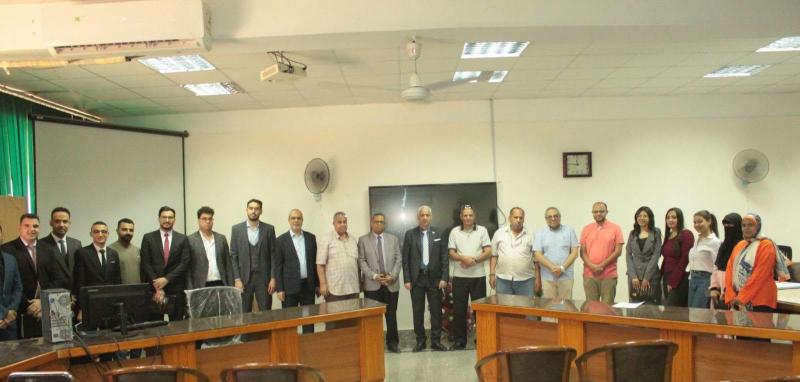
The event was held under the patronage of Dr. Ahmed El-Menshawy, President of Assiut University, and under the supervision and in the presence of Dr. Ahmed Abdel-Mawla, Vice President for Education and Student Affairs. Also in attendance were Dr. Khaled Salah, Dean of the Faculty of Engineering, Dr. Mohamed Safwat, Vice Dean for Education and Student Affairs, department heads, special program coordinators, and faculty members.
Dr. Ahmed El-Menshawy affirmed that the graduation projects at the Faculty of Engineering reflect the outstanding level of the university's students and their creative abilities and applied skills, which qualify them to provide innovative engineering solutions that meet the demands of the modern era. He pointed out that the university is keen to support innovation and link academic education with the needs of the labor market, especially in the fields of artificial intelligence, digital transformation, robotics, energy, and sustainability.
The academic supervision of the projects included; Dr. Khaled Ali Youssef, Head of the Department of Architectural Engineering; Dr. Mohamed Abdel-Basset Abdo, Head of the Department of Civil Engineering; Dr. Atef El-Sayed El-Naqeeb, Head of the Department of Mining and Metallurgical Engineering; Dr. Mohamed Abbas Abdel-Radi, Head of the Department of Electrical Engineering; Dr. Mahmoud El-Sherif, Head of the Department of Mechanical Design and Production Engineering; Dr. Othman Omran Othman, Head of the Department of Mechanical Power Engineering; and Dr. Omar Salah El-Din, Head of the Department of Mechatronics Engineering, along with the coordinators of the special programs: Dr. Walid Abu El-Wafa, Coordinator of the Construction Engineering and Project Management program; Dr. Essam Salah Saeed, Coordinator of the Interior Architecture program; Dr. Gamal Abdel-Nasser, Coordinator of the Mechatronics and Robotics Engineering program; and Dr. Abdel-Rahman Morsi, Coordinator of the Biomedical Engineering program.
Dr. Ahmed Abdel-Mawla emphasized that graduation projects represent a model for integrating academic knowledge with practical applications. They contribute to transforming students from passive recipients of knowledge into innovators capable of designing engineering solutions that serve society and strengthen the link between the university and the job market, particularly in the fields of artificial intelligence, the Internet of Things, robotics, and modern technologies.
Dr. Khaled Salah explained that this year's projects reflect the Faculty of Engineering's commitment to supporting student creativity and aligning academic programs with future needs. He noted that students presented outstanding engineering models in various fields, including energy, artificial intelligence, infrastructure, and environmental sustainability, contributing to the development of competitive graduates.
In the Mechatronics Engineering Department, students presented several distinguished projects, including the Smart Aquaculture System, which integrates Internet of Things (IoT) technologies and smart sensors to enhance fish farming systems; the Smart Assembly Line, which utilizes artificial intelligence and IoT to achieve maximum production efficiency and minimize breakdowns and waste; a self-driving delivery robot equipped with a robotic arm; and the ACLR (Autonomous Construction Layout Robot) project, which uses autonomous robots to plan construction sites and bridges.
The Mechanical Power Engineering Department's projects included several engineering applications, such as a design analysis of various types of air conditioning systems/performance evaluation of units installed in an office and lecture hall, a project to upgrade and operate a low-speed wind tunnel unit for turbine blade testing, and a project to design an oil pipeline.
The Mining and Metallurgy Engineering Department's projects included an evaluation of limestone reserves in cement quarries and their impact on industry sustainability, a project on processing Egyptian phosphate ores and their industrial applications, and a project studying the recycling of electric arc furnace dust in certain engineering applications.
In the Electrical Engineering Department – Computer and Systems Division, students discussed several specialized projects, including the design and control of an autonomous waste collection vehicle, a framework for error injection in automotive software compliant with the ISO-26262 safety standard, traffic signal control using artificial intelligence, and research and development in machine learning using the C++ language.
The Communications Division of the Electrical Engineering Department also discussed a project to adapt and optimize the Vortex processor to be compatible with ASIC design, in collaboration with Silicon Arts. This project provides students with practical experience in custom integrated circuit design and converting open-source designs into manufacturable designs.
In the Civil Engineering Department, projects spanned various construction and infrastructure fields, including: Foundations on Problematic Soils (Regulation 2021), Foundations on Problematic Soils (Regulation 2004), Project Management (Regulation 2021), Project Management (Regulation 2004), Design of Reinforced Concrete Structures (Regulation 2021), Design of Reinforced Concrete Structures (Regulation 2004), Soil Engineering and Foundations (Regulation 2021), Sanitary and Environmental Engineering (Regulation 2004), and Roads and Traffic (Regulation 2004).
The Mechanical Design and Production Engineering Department also presented several applied projects, including the design and fabrication of a compression mold for producing sealants, and a Smart Recycling Lab project: developing a scalable university-level model for converting plastic waste into practical products using 3D printing and injection molding.The college's specialized programs showcased several high-quality projects. The Mechatronics and Robotics Engineering program presented projects such as the Automatic Production Line for Manufacturing and Packaging Foam Plates, which utilizes industrial control, computer vision, and delta robotics to develop smart production lines; the Automated Vision-Guided Sorting, Grading, and Packaging Line for Pears (SAAT), a smart, solar-powered system for sorting and packaging pears using artificial intelligence; Trajectory Planning for KUKA Robot Arm, developing industrial robotics applications; and SAPRS (Smart Automated Plastic Recycling System) for recycling plastic waste.
The Biomedical Engineering program also presented innovative projects, including a smart baby incubator with advanced IoT features; a smart car accident avoidance system based on drivers' biometric data; a smart alert vest to prevent child sexual abuse; a below-elbow prosthetic arm controlled by deep learning-based surface electrical muscle signals; and the design and implementation of AI-powered visual aid glasses for the blind.
In the Construction Engineering and Project Management program, students discussed several projects, including the construction of a 36-km link between El Badari and the Hurghada road (structural planning and design), the design of reinforced concrete structures, and integrated project planning and construction management (preparing scope, time, and cost management plans).
Through these projects, the Faculty of Engineering affirms its commitment to preparing graduates who possess scientific knowledge and practical skills, enabling them to contribute to the development process, in line with the state's vision for digital transformation and building a knowledge-based and innovation-driven economy.