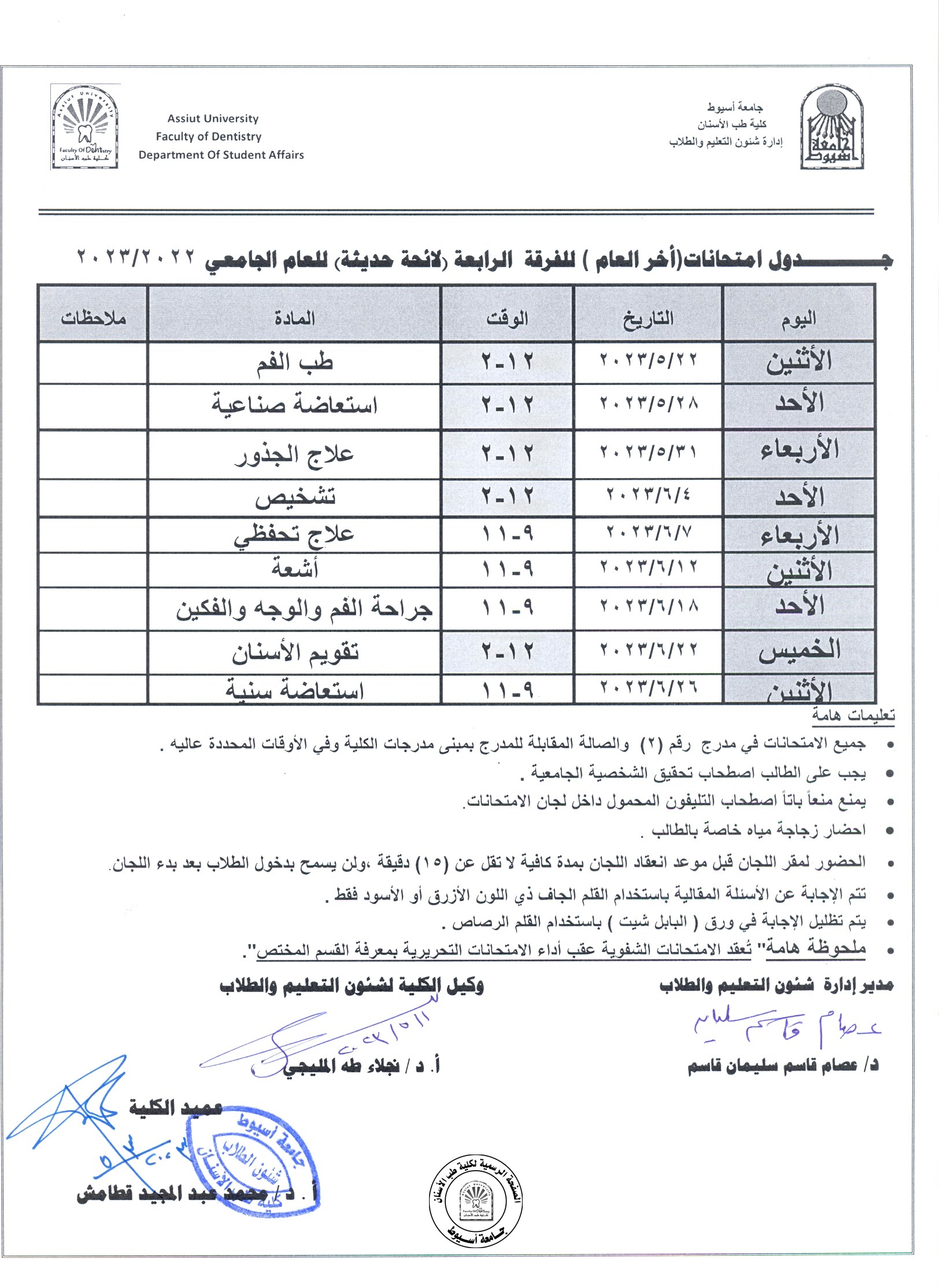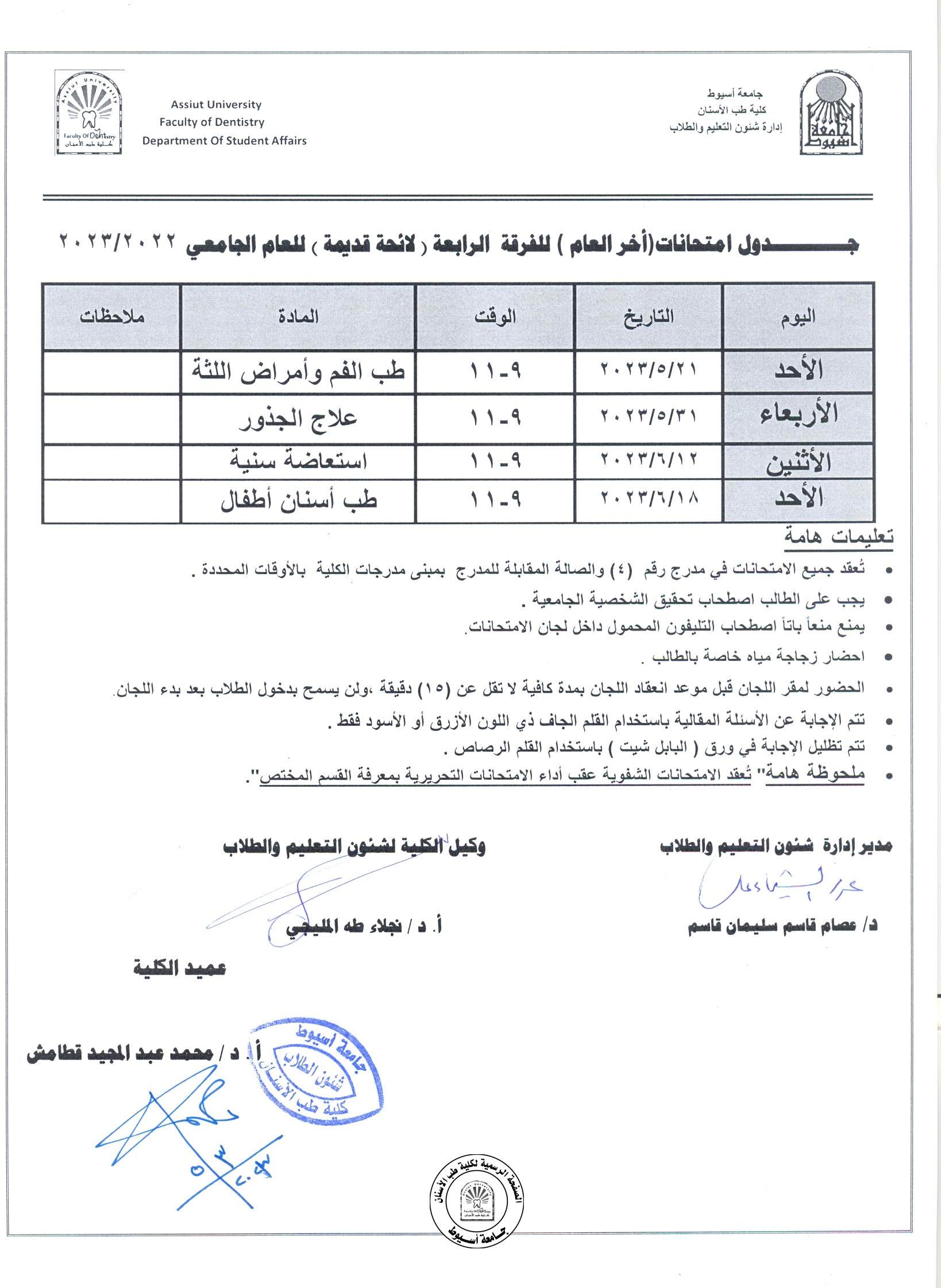

Second Term Schedule for 3rd Year Students
Second Term schedule for 2nd year students.

Second Term schedule for 2nd year students.

Second Term schedule for 3rd year students.

Second Term schedule for 4th year students.

Second term schedule for 5th year students.

The Faculty of Dentistry would like to congratulate Dr. Mayada Muhammad Ahmad on her promotion to lecturer in the Pediatric Dentistry and Oral Hygiene department, wishing her all the best in her life.

The Students Union in the Youth Welfare office decided that student group registration for Assiut University and Assiut National University 2022-2023 is available until 30-1-2023 through which students can practice different kinds of activities. For registration, kindly visit the coordinator in the Youth Welfare Office in the faculty.

The faculty of dentistry set its 10th committee on Wednesday 18-1-2023. The attendees were Prof/ Mohamed Abdul Maged Katamish ,Dean of the Faculty of Dentistry, Prof/ Naglaa El-Meligy, the Vice Dean for Education and Student Affairs and heads of departments to discuss faculty meeting agenda.
Abstract
Background: Oral squamous cell carcinoma (OSCC) is the pathological type of oral cancer. Chemotherapy has become increasingly effective in OSCC therapy. Of these agents, Doxorubicin (Dox) is the most efficient cytotoxic agent but is prevented by cardiac toxicity. Several experimental results demonstrated the use of a combination of low-toxic secondary metabolites, such as polyphenols, to reduce the required dose of cytotoxic agents in cancer treatment.
Objective: The study aims to analyze the influence of Dox alone and its combination with pyrogallol (PG), a phenolic extract on the tongue SCC-25-cell, and to evaluate possible apoptotic pathways in the SCC-25 cells.
Methods: Image morphometric analysis for the estimation of nuclear area factor (NAF) and Evaluation of caspase-3 fold change by Real-Time PCR.
Results: The data recorded showed a significant decrease in the mean values of NAF of SCC-25 cells treated with different concentrations of Dox and its combination with PG. While, the combination revealed the least in the mean values of NAF when compared to control cells. Also, the combination induced apoptosis by simultaneous up-regulation of caspase-3.
Conclusions: The combined use of Dox and PG may increase the effectiveness of treatment and reduce negative side effects.
ABSTRACT
To analyze whether the S-phase fraction (SPF) may contribute to prognosis of similarly staged tongue squamous cell carcinoma, DNA flow cytometric data from 30 cases of tongue squamous cell carcinoma were analyzed. The SPF values ranged between 2.30% and 34.32% (mean 10.92%). SPF was calculated and correlated with the disease free survival rate and the overall survival of the patients. By multivariate survival analysis, SPF was significantly associated with the disease free survival rate and the overall survival of patients (P < 0.05). The results indicate that SPF has a relevant prognostic power for tongue squamous cell carcinoma.
Abstract
Background: Despite improvements in diagnosis and therapy of oral and oro-pharyngeal carcinomas during the past 30 years the 5-year disease-free survival is still poor. Patient’s prognosis is affected by cervical lymph node metastasis rather than primary tumors. The DNA ploidy and S-phase fraction (SPF) are associated with tumor aggressiveness and patient outcome in many solid tumors.
Purpose: Analysis of DNA ploidy and SPF in primary oral squamous cell carcinoma (OSCC) and corresponding node metastasis as prognostic markers in relation to conventional prognostic factors and disease-free survival (DFS).
Methods: Ploidy status and SPF (mean value) of 37 formalin-fixed paraffin embedded (FFPE) primary OSCC tumors and their corresponding lymph node metastasis were assessed by flow cytometry (FCM) and correlated with clinicopathologic prognostic parameters and DFS.
Results: Most of OSCC tumors (86.5%) were Grade II. Among primary OSCC the incidence of aneuploidy was 19%, 51.4% showed high SPF (>10.62%) and 48.6% had low SPF (<10.62%). Border line significance (P = 0.10) was detected between ploidy status and SPF in primary tumors. In lymph node metastases all tumors were diploid, 78.4% of metastatic tumors revealed low SPF and only 21.6% showed high SPF. There was a statistically significant correlation (p = 0.02) between site of tumors and DFS and a highly statistically significant correlation (p = 0.01) between SPF of primary tumors and DFS.
Conclusions: High SPF of primary OSCC tumors assessed by FCM was significantly associated with decreased disease free survival rates. DNA ploidy showed no relationship to bad prognostic indicators in either primary OSCC or their metastatic tumors.