

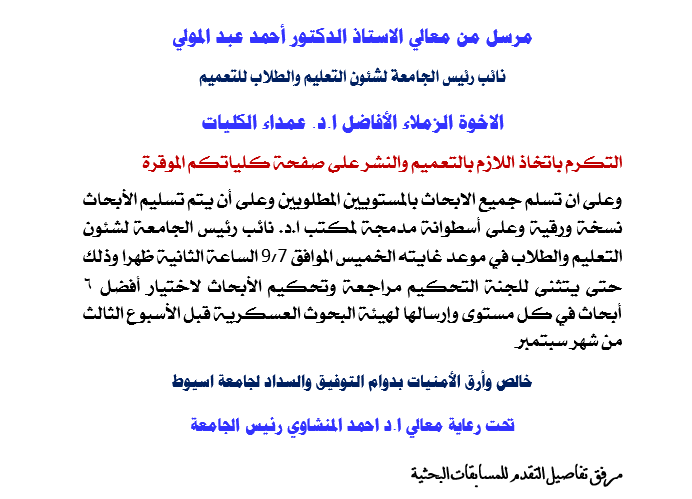
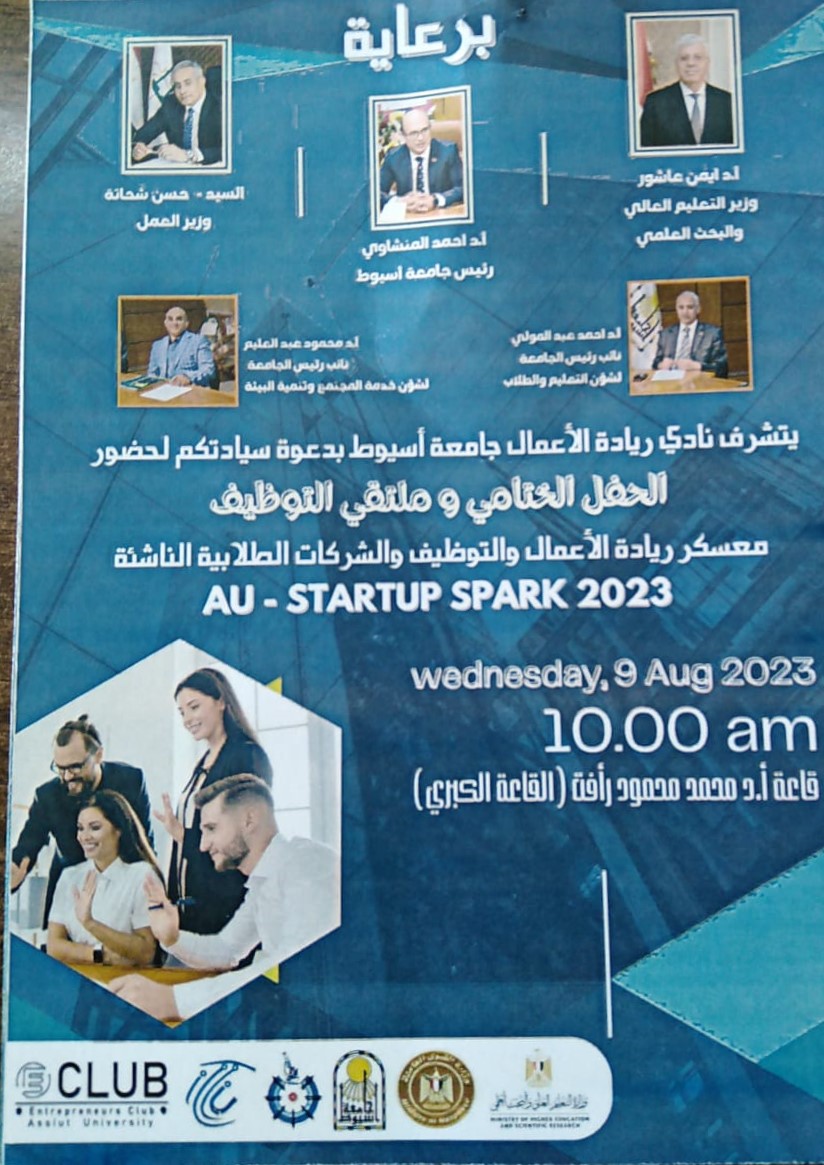
Invitation: the closing ceremony and the recruitment process
Congratulations: Appointing Prof. Dr. Mahmoud Mustafa Mahmoud, Professor of Aquatic Animals Medicine and Management, and sponsoring hem, as Director of the Veterinary Teaching Hospital

Important announcement

Dietary supplementation with different nano and organic selenium doses improves ovarian activity, fertility rate, and progesterone level in Ossimi ewes
Research Abstract
This study aimed to investigate the effects of nano and organic selenium on ovarian activity,
fertility rate, and progesterone hormone levels in Ossimi ewes. Thirty ewes were treated with
intra-vaginal sponges impregnated with medroxyprogesterone acetate (40mg) for 14 d and
simultaneously assigned randomly to three groups. The 1st group ewe served as control (CG).
Ewes in the 2nd and 3rd groups were treated orally with organic selenium 3 mg/ewe and Nanoselenium
0.2mg/ewes during intra-vaginal sponges (IVS) treatment SeG and N-SeG, respectively.
The ovarian activity was monitored using an ultrasonic device, and serum samples were harvested
for progesterone measurement. The results revealed that ewes in SeG and N-SeG groups
had a significantly (p<.05) higher number of small and large follicles after 48 h of IVS withdrawal
than in the CG, respectively, on the left ovary. Also, the N-SeG group had a larger diameter
of the Corpus luteum on both ovaries’ sides than CG, respectively, at the same time.
However, the diameter of large follicles on both ovaries was significantly (p<.05) larger in the
N-SeG after 72 h of IVS withdrawal than in SeG and CG. The ewes in N-SeG and SeG came in
oestrus earlier (p<.05) than those in CG, and the oestrus durations were longer (p<.05) than
that recorded in ewes of CG. The oestrus response and fertility rate were higher (p<.01) in
N-SeG and SeG than in CG. Moreover, the progesterone concentrations were significantly higher
(p<.05) in the N-SeG and SeG after 48 and 72 h of IVS withdrawal than in the CG. Also, the
recorded serum progesterone concentrations in the included ewes non-significantly differed
between groups during the first four months of pregnancy. It could be concluded that using
nano and organic selenium can improve the quality of ovarian follicles and CL function and
enhance the fertility rate in Ossimi ewes.
Research Date
Research Department
Research Journal
ITALIAN JOURNAL OF ANIMAL SCIENCE
Research Member
Research Pages
651–659
Research Publisher
Taylor and Francis Ltd.
Research Rank
Q1, Impact Factor: 2.63
Research Vol
VOL. 22, NO. 1
Research Website
https://doi.org/10.1080/1828051X.2023.2231946
Research Year
2023
Comparative study between efficacy of dexamethasone-prostaglandin-receptal combination and mechanical correction in uterine torsion cases in Egyptian buffalocows (Bubalus bubalis)
Research Abstract
Background According to reports, the majority of domesticated species exhibited uterine torsion. It was occasionally
noted as a cause of dystocia in buffaloes. The uterus might twist more frequently late in pregnancy because of certainanimal traits. The current research monitored the clinical findings and laboratory assays associated with uterine torsion cases in pregnant buffalo-cows through comparing between normal labored buffalo-cows (Norm-Labgr; n = 20), mechanically corrected uterine torsed animals without medicament interference (UtrTorsgr; n = 160), and mechanically corrected uterine torsed animals with medicament interference (UtrTors-Medgr; n = 40) through focusing on placental characterization, calves body weight, milk constituents and milk somatic cell count (SCC) in normal labored buffaloes and uterine torsed ones. Through clinical and laboratory investigations of these buffaloes (N = 220) had been conducted 3 times; 7 h pre-calving and post calving (Post uterine correction) i.e. 48 and 96 h. Uterine torsion prevalence parameters, placental characterization, calves body weight, milk constituents and milk somatic cell counts were evaluated in normal labored buffaloes and uterine torsed ones.
Results and Conclusions The study concluded pre-calving remarkable variations in clinical findings, leukogram
picture, calf birth weight and some placental characterization parameters between Norm-Labgr and each of UtrTorsion and UtrTors-Medgr whereas these variations disappeared post-partum as a result to either only mechanical correction or mechanical correction plus medicaments interference. No pre-or post-calving significant changes between UtrTorsgr and UtrTors-Medgr except for the abnormal clinical findings were more representative in UtrTors-Medgr than those in UtrTorsgr particularly pre-calving. The applied pre-calving therapeutic regimen including dexamethasoneprostaglandin-receptal combination had a powerful potential efficacy that induced vaginal delivery of calves in UtrTors-Medgr as well as prepartum mechanical correction of torsed uterus approved higher efficacy in UtrTorsgr. The applied prepartum mechanical correction of torsed uterus and/or pre-calving therapeutic regimen as well
Research Date
Research Department
Research Journal
BMC Veterinary Research
Research Member
Research Pages
14
Research Publisher
Springer Nature
Research Rank
Q1, Impact Factor 2.62
Research Vol
19
Research Website
https://doi.org/10.1186/s12917-023-03651-y
Research Year
2023
Comparative study between efficacy of dexamethasone-prostaglandin-receptal combination and mechanical correction in uterine torsion cases in Egyptian buffalocows (Bubalus bubalis)
Research Abstract
Background According to reports, the majority of domesticated species exhibited uterine torsion. It was occasionally
noted as a cause of dystocia in buffaloes. The uterus might twist more frequently late in pregnancy because of certainanimal traits. The current research monitored the clinical findings and laboratory assays associated with uterine torsion cases in pregnant buffalo-cows through comparing between normal labored buffalo-cows (Norm-Labgr; n = 20), mechanically corrected uterine torsed animals without medicament interference (UtrTorsgr; n = 160), and mechanically corrected uterine torsed animals with medicament interference (UtrTors-Medgr; n = 40) through focusing on placental characterization, calves body weight, milk constituents and milk somatic cell count (SCC) in normal labored buffaloes and uterine torsed ones. Through clinical and laboratory investigations of these buffaloes (N = 220) had been conducted 3 times; 7 h pre-calving and post calving (Post uterine correction) i.e. 48 and 96 h. Uterine torsion prevalence parameters, placental characterization, calves body weight, milk constituents and milk somatic cell counts were evaluated in normal labored buffaloes and uterine torsed ones.
Results and Conclusions The study concluded pre-calving remarkable variations in clinical findings, leukogram
picture, calf birth weight and some placental characterization parameters between Norm-Labgr and each of UtrTorsion and UtrTors-Medgr whereas these variations disappeared post-partum as a result to either only mechanical correction or mechanical correction plus medicaments interference. No pre-or post-calving significant changes between UtrTorsgr and UtrTors-Medgr except for the abnormal clinical findings were more representative in UtrTors-Medgr than those in UtrTorsgr particularly pre-calving. The applied pre-calving therapeutic regimen including dexamethasoneprostaglandin-receptal combination had a powerful potential efficacy that induced vaginal delivery of calves in UtrTors-Medgr as well as prepartum mechanical correction of torsed uterus approved higher efficacy in UtrTorsgr. The applied prepartum mechanical correction of torsed uterus and/or pre-calving therapeutic regimen as well
Research Date
Research Department
Research Journal
BMC Veterinary Research
Research Member
Research Pages
14
Research Publisher
Springer Nature
Research Vol
19
Research Website
https://doi.org/10.1186/s12917-023-03651-y
Research Year
2023
Comparative study between efficacy of dexamethasone-prostaglandin-receptal combination and mechanical correction in uterine torsion cases in Egyptian buffalo-cows (Bubalus bubalis)
Research Abstract
According to reports, the majority of domesticated species exhibited uterine torsion. It was occasionally noted as a cause of dystocia in buffaloes. The uterus might twist more frequently late in pregnancy because of certain animal traits. The current research monitored the clinical findings and laboratory assays associated with uterine torsion cases in pregnant buffalo-cows through comparing between normal labored buffalo-cows (Norm-Labgr; n = 20), mechanically corrected uterine torsed animals without medicament interference (UtrTorsgr; n = 160), and mechanically corrected uterine torsed animals with medicament interference (UtrTors-Medgr; n = 40) through focusing on placental characterization, calves body weight, milk constituents and milk somatic cell count (SCC) in normal labored buffaloes and uterine torsed ones. Through clinical and laboratory investigations of these buffaloes (N = 220) had been conducted 3 times; 7 h pre-calving and post calving (Post uterine correction) i.e. 48 and 96 h. Uterine torsion prevalence parameters, placental characterization, calves body weight, milk constituents and milk somatic cell counts were evaluated in normal labored buffaloes and uterine torsed ones.
Results and Conclusions
The study concluded pre-calving remarkable variations in clinical findings, leukogram picture, calf birth weight and some placental characterization parameters between Norm-Labgr and each of UtrTorsgr and UtrTors-Medgr whereas these variations disappeared post-partum as a result to either only mechanical correction or mechanical correction plus medicaments interference. No pre-or post-calving significant changes between UtrTorsgr and UtrTors-Medgr except for the abnormal clinical findings were more representative in UtrTors-Medgr than those in UtrTorsgr particularly pre-calving. The applied pre-calving therapeutic regimen including dexamethasone-prostaglandin-receptal combination had a powerful potential efficacy that induced vaginal delivery of calves in UtrTors-Medgr as well as prepartum mechanical correction of torsed uterus approved higher efficacy in UtrTorsgr. The applied prepartum mechanical correction of torsed uterus and/or pre-calving therapeutic regimen as well as subsequent post-calving, post uterine correction applied medicament treatment accelerated rapid recovery of affected buffalo-cows through achieving rapid restoring of their physiological parameters. Buffalo-cow’s milk composition, milk pH and milk SCC were not affected whereas no significant variations were reported between Norm-Labgr, UtrTorsgr and UtrTors-Medgr.
Research Date
Research Department
Research File
Research Journal
BMC Veterinary Research
Research Member
Research Pages
1-14
Research Publisher
Springer nature
Research Rank
Q1
Research Vol
19
Research Website
https://link.springer.com/article/10.1186/s12917-023-03651-y#Abs1
Research Year
2023
Obligatory condolence

Important Announcement: The Central Laboratory of the Faculty of Veterinary Medicine, Assiut University announces the holding of a training course entitled: "Principles and Applications of Gas Chromatography-(GC) MS"

Schedule for the third day of the Panel during the visit to renew accreditation for the College