Announcement for grievance for graduate students
The applications will be starts for postgraduate students
)PhD - Master - Doctor of Pharmacy - Diplomas)
Starting from March 20, 2024 until March 28, 2024
Do you have any questions? (088) 2080369 - 2345622 Pharmacy_QAAU@pharm.aun.edu.eg
The applications will be starts for postgraduate students
)PhD - Master - Doctor of Pharmacy - Diplomas)
Starting from March 20, 2024 until March 28, 2024
The periodic and theoretical practical exam for the course Pharmaceutical Medicinal Chemistry - 2 for clinical pharmacy students, semester (6),
will be held on Thursday, March 21, 2024, at 10:30 a.m. in the department’s auditorium and laboratories.
the periodic and practical sheet exams for the Pharmaceutical Chemistry 2 course for third-year Pharm-D students
will be held on Thursday, March 21, 2024, from twelve to one-thirty in the afternoon in Hall (2).
The mid-term exam for first-year students (Pharmacognosy1 course) will be held on Thursday, April 18, 2024, in Hall (1) from two to three p.m.
The practical and mid-term exams will be held on Thursday, March 28, 2024, from 9 to 10:20 a.m. in the C and D laboratories, third floor.
Trichinella spiralis infection is a food-borne zoonotic disease caused by nematodes
that dwell in the tissues, presenting a significant public health concern. This study
aimed to evaluate the effectiveness of different treatments including silver nanoparticles (AgNPs), myrrh biosynthesized AgNPs “AgNPs synthesized using plant-based
green technologies”, myrrh extract, and myrrh essential oil, as alternative treatments
against T. spiralis infection. Parasitological, histopathological, and cytotoxicity assessments were conducted to investigate the effects of various concentrations of these
treatments in reducing the populations of adult worms and larvae during both the
intestinal and muscular phases of T. spiralis-infected mice. The results showed that
the highest antihelminthic efficacy against the intestinal phase of T. spiralis was
achieved by myrrh extract (86.66%), followed closely by AgNPs (84.96%) and myrrh
AgNPs (82.51%) at higher concentrations (800 mg/kg for myrrh extract, 40 μg/mL
for AgNPs, and 40 μg/mL for myrrh AgNPs). While the group treated with myrrh
essential oil showed the lowest percentage of adult reduction (78.14%). However, all
treatments demonstrated comparable effects in reducing the larvae population in the
muscle phase. Histopathological examination of the tissues revealed compelling evidence of the effectiveness of AgNPs, particularly when prepared with myrrh. Additionally, a comprehensive assessment of the cytotoxicity of AgNPs indicated low
toxicity levels. This study supports that AgNPs synthesized using plant-based green
technologies hold therapeutic potential for the treatment of T. spiralis infection.
These findings present a promising avenue for the development of novel antiparasitic
drugs that are both effective and safe.
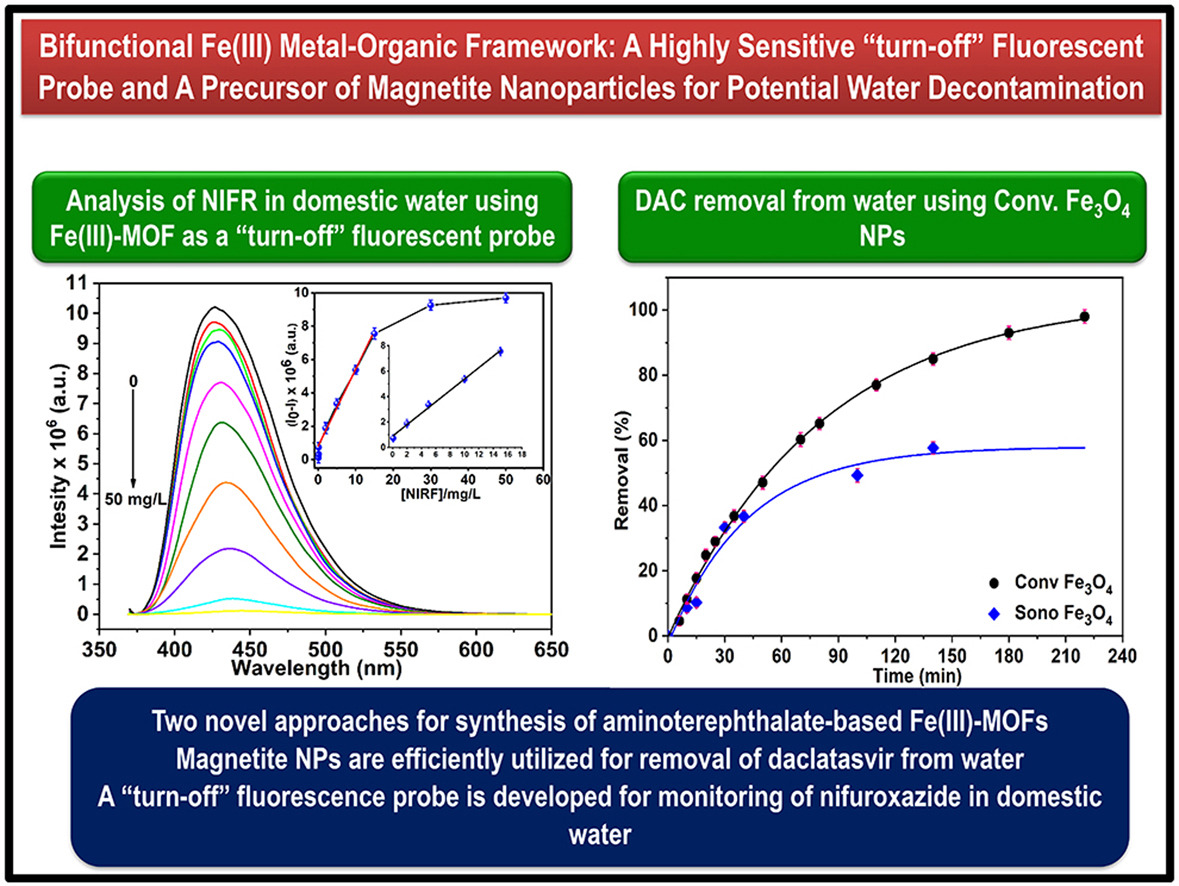
Nowadays growing concerns are rising toward water contamination caused by pharmaceuticals. Consequently, the design of optical sensors for their detection and analysis is extremely essential. In the current work, iron (III) aminoterephthalate-based metal-organic framework (Fe(III)-MOF) was synthesized by two approaches i.e. conventional and ultrasonication without the use of any organic solvents. Calcination of the synthesized Fe(III)-MOFs resulted in formation of different iron oxide phases i.e. magnetite and hematite depending on the calcination conditions. Magnetite NPs obtained from calcination of conventionally prepared MOF were efficiently utilized in the removal of daclatasvir (DAC), a hepatitis C antiviral drug, from water. Adsorption mechanism was investigated, and it was found that electrostatic interaction is the main force governing the adsorption of DAC on the magnetite NPs surface. Moreover, adsorption kinetics was studied, and it was established that adsorption of DAC on magnetite NPs surface follows pseudo-second order kinetics with R2 = 0.9970. The removal efficiency reached 99.9% after 220 min while using 5.0 mg/L of DAC. Furthermore, conventionally prepared Fe(III)-MOF showed higher fluorescence signal than ultrasonically-prepared MOF (∼3.0 times). This finding was exploited for utilization of conventionally prepared Fe(III)-MOF as a highly sensitive “turn-off” fluorescent probe for the analysis of nifuroxazide (NIFR) in domestic water. Parameters affecting sensing properties such as pH, solvent type and concentration of Fe(III)-MOF were optimized. The highest fluorescence quenching efficiency of NIFR was achieved while using 50 mg/L of Fe(III)-MOF in pH 9.0. Inner-filter effect was verified experimentally and mathematically to be the principal mechanism of the fluorescence quenching. The developed strategy showed high selectivity and sensitivity towards the analysis of NIFR with limit of detection and quantitation of 8.0 and 25.0 μg/L, respectively. Moreover, the designed sensor was successfully applied for determination of NIFR in domestic water without any interference from other tested antiviral, antidiabetic or antimicrobial drugs.
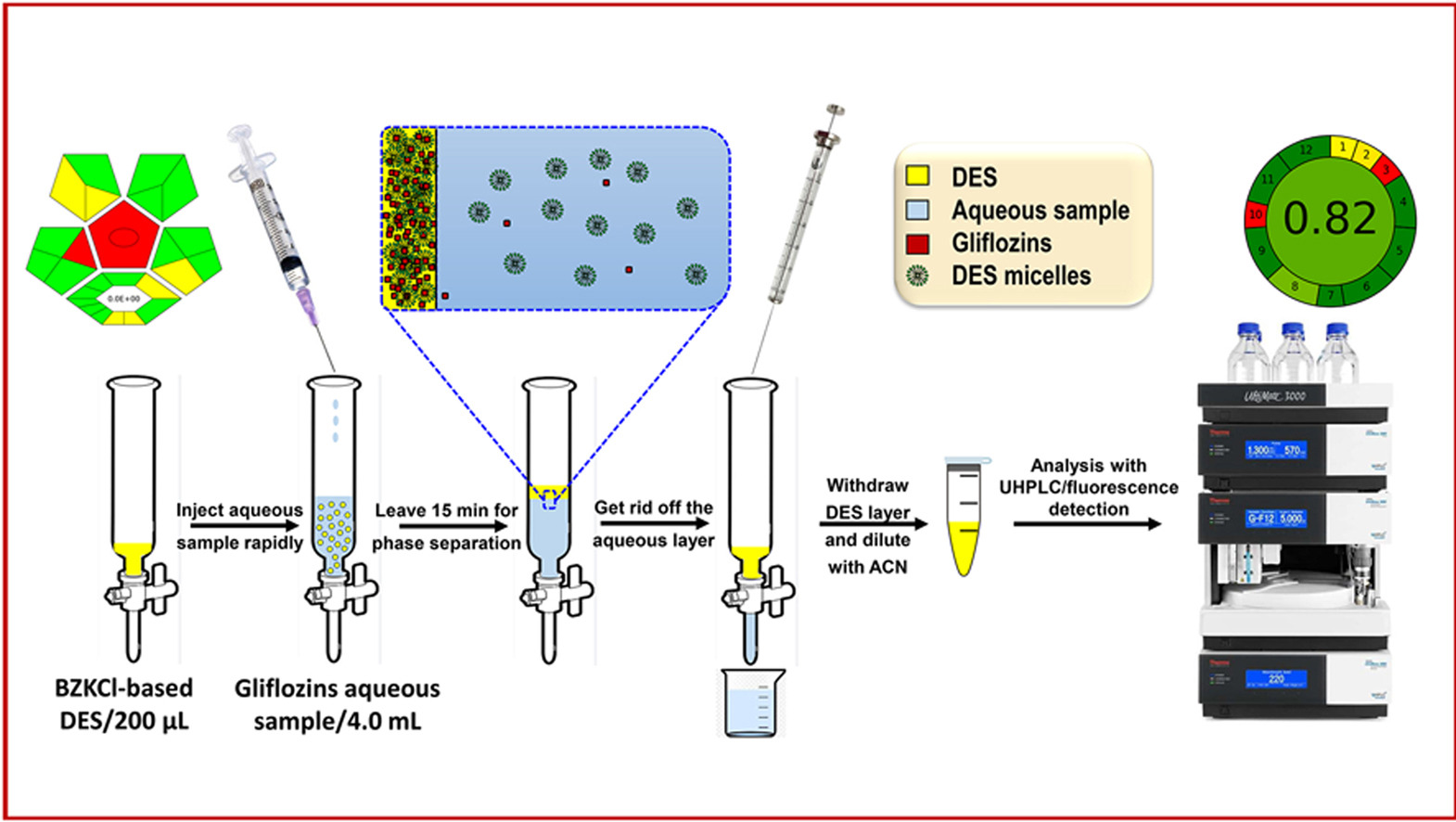
Despite the anticipated exceptional properties of deep eutectic solvents (DES) in microextraction techniques, their self-aggregation behaviour has only been sporadically studied in the previous literature. In the presented study, a novel surfactant-based quasi-hydrophobic deep eutectic solvent (DES) is synthesized and utilized in dispersive liquid-liquid microextraction (DLLME) of three gliflozins in environmental water samples as a proof-of-concept examples. The synthesized DES is composed of benzalkonium chloride (BZKCl) as a hydrogen bond acceptor and octanol (Oct) as a hydrogen bond donor. A full optimization of the extraction conditions was carried out including molar ratio and composition of DES, volume of DES, volume of water samples, extraction time and type of diluting solvent. Moreover, the extraction mechanism was thoroughly investigated, and it was established that the extraction of the target analytes is attributed to the analytes' incorporation into the micelles’ cores that facilitates mass transfer from the aqueous layer into DES layer. Furthermore, micelles formed by surfactant-based DES will provide adequate dispersion of extractant phase within water samples, which consequently improves the extraction efficiency. Micelles formation was confirmed by transmission electron microscopy (TEM). Furthermore, 1H NMR spectra verifies that the synthesized DES keeps its integrity even after extraction, which excludes any decomposition of DES after DLLME procedure. The extraction recovery is in an excellent agreement with the hydrophobicity of the investigated drugs, being the highest for the most hydrophobic one. The extracted analytes were separated by UHPLC coupled with fluorescence detection. Under the optimized experimental conditions, the method exhibits excellent linearity and a high detection sensitivity with a limit of detection of 0.5, 2.0 and 0.1 ng mL−1 for EMP (empagliflozin), DAP (dapagliflozin) and CAN (canagliflozin), respectively. The greenness of the developed microextraction approach was assessed by different greenness metrics such as Complex GAPI and AGREE tools. The developed method shows excellent greenness of synthetic procedure for preparation of DES, the environmentally benign nature of DLLME procedure as well as the greenness of the developed UHPLC approach.
Nitric oxide (NO) is one of the reactive nitrogen species (RNS) that has been proposed to be a key signaling molecule in migraine. Migraine is a neurological disorder that is linked to irregular NO levels, which necessitates precise NO quantification for effective diagnosis and treatment. This work introduces a novel fluorescent probe, 2,3-diaminonaphthelene-1,4-dione (DAND), which was designed and synthesized to selectively detect NO in-vitro and in-vivo as a migraine biomarker. DAND boasts high aqueous solubility, biocompatibility, and facile synthesis, which enable highly selective and sensitive detection of NO under physiological conditions. NO reacts with diamine moieties (recognition sites) of DAND, results in the formation of a highly fluorescent product (DAND-NO) known as 1H-naphtho[2,3-d][1,2,3]triazole-4,9-dione at λem 450 nm. The fluorescence turn-on sensing mechanism operates through an intramolecular charge transfer (ICT) mechanism. To maximize fluorescence signal intensity, parameters including DAND concentration, reaction temperature, reaction time and pH were systematically optimized for sensitive and precise NO determination. The enhanced detection capability (LOD = 0.08 μmol L−1) and high selectivity of the probe make it a promising tool for NO detection in brain tissue homogenates. This demonstrates the potential diagnostic value of the probe for individuals suffering from migraine. Furthermore, this study sheds light on the potential role of zolmitriptan (ZOLM), an antimigraine medication, in modulating NO levels in the brain of rats with nitroglycerin-induced migraine, emphasizing its significant impact on reducing NO levels. The obtained results could have significant implications for understanding how ZOLM affects NO levels and may aid in the development of more targeted and effective migraine treatment strategies.
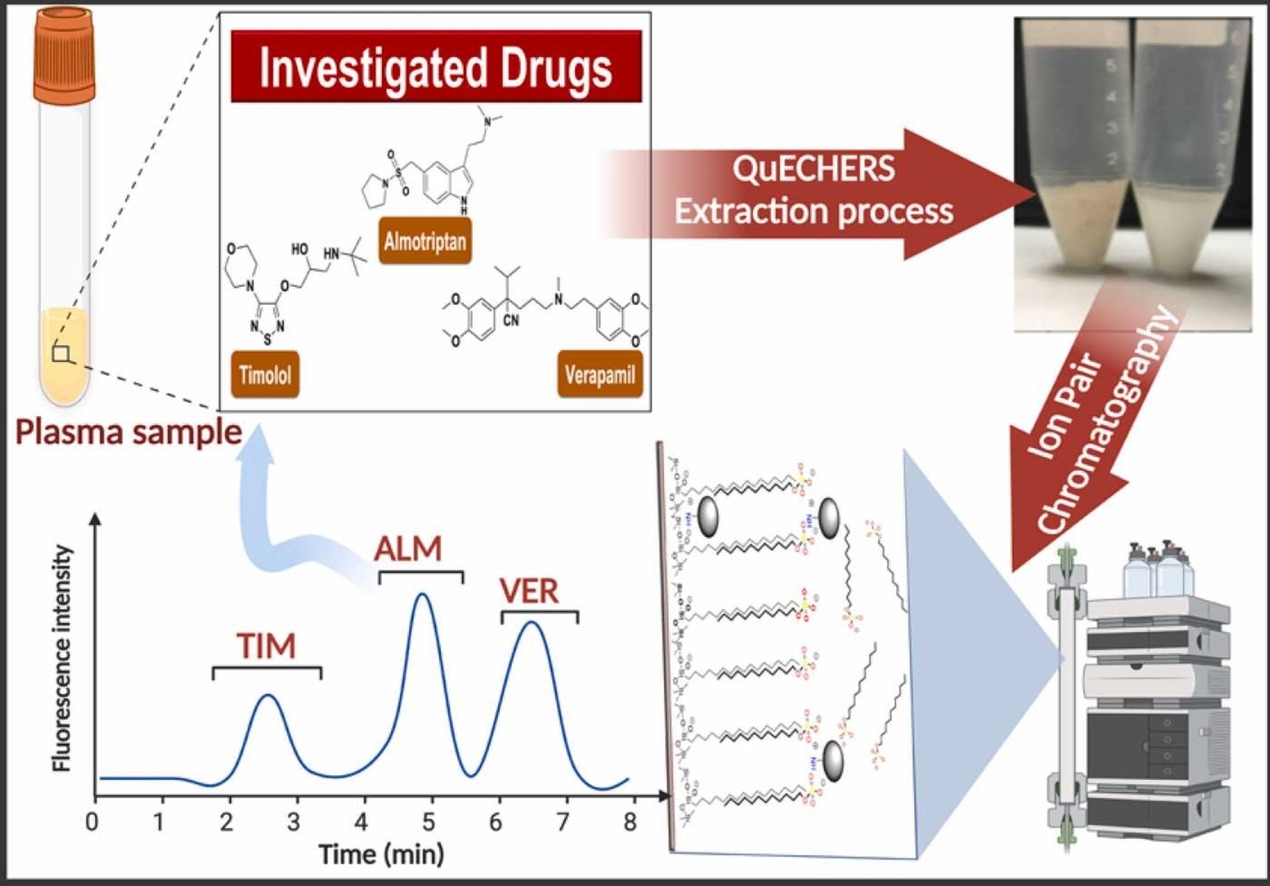
Antimigraine combination therapy has shown significant effectiveness in relieving pain, as well as reducing the frequency, duration, and severity of migraine attacks if compared to a single migraine medication. This work represents the first analytical investigation for emphasizing the synergistic effect of combining ophthalmic beta blockers with triptans in migraine treatment. The presented study was conducted to investigate the pharmacokinetic profile of almotriptan (ALM), a serotonin (5-HT1B/1D) receptor agonist used to treat migraine, when coadministered with timolol (TIM) or verapamil (VER) which are considered as an adjuvant therapy in migraine prevention. Ion pair chromatography (IPC) with online fluorescence detection was applied to simultaneously detect and quantify the binary mixtures of ALM/TIM and ALM/VER in rabbit plasma samples. The separation was achieved using a Platinum C18 analytical column with a mobile phase composed of methanol: 35 mmol L-1 phosphate buffer solution containing 10 mmol L-1 SDS at pH = 6.8 (60:40 v/v). Several parameters were evaluated during the optimization of separation conditions including mobile phase composition, buffer concentration, buffer pH and concentration of ion pair reagent. A thorough investigation of the retention mechanism was performed, and the results showed that Coulomb forces were the main contributors to the overall retention mechanism, which may be hydrophobically assisted. QuEChERS extraction technique was utilized to extract the investigated drugs from plasma samples and a detailed study was carried out to optimize partition/extraction solvents, pH, extraction salts, sample volume and clean-up step. The method had a limit of detection and quantitation of 5.6 and 16.9 ng mL-1 for ALM in ALM/TIM mixture and 2.5 and 7.6 ng mL-1 for ALM in ALM/VER mixture, with an overall recovery not less than 95.22%. This newly proposed method offers a faster alternative to existing chromatographic methods for extraction and determination of ALM in binary mixtures with TIM or VER in rabbit plasma and provides a platform for studying pharmacokinetic parameters. The coadministration of either TIM or VER with ALM resulted in a notable rise in Cmax (maximum plasma concentration) and AUC (area under the plasma concentration-time curve) of ALM, implying possible alterations in the absorption and overall exposure of ALM.