
Research Abstract
Background: Post-Critical Illness Dysphagia (PCID) is a common complication among Intensive Care Unit (ICU) patients. Early detection and appropriate sensory-based rehabilitation are essential to prevent aspiration, improve swallowing safety, and optimize functional recovery. Purpose: This study aimed to compare the effects of single-modality (thermal, tactile, gustatory) versus combined multimodal sensory stimulations on swallowing function in patients with PCID. Design: A quasi-experimental comparative design was used. Sample: A purposive sample of 120 adult ICU patients with PCID was divided systematically into four groups (n =30 each): tactile stimulation, thermal stimulation, gustatory stimulation, and combined multimodal sensory stimulation. Setting: Stroke and Trauma Intensive Care Units at Menoufia University Hospital, Egypt. Instruments: Data were collected using: (1) Demographic and Clinical Data Sheet; (2) Dysphagia Severity Rating Scale (DSRS); ( 3)The Fiberoptic Endoscopic Evaluation of Swallowing with the Penetration-Aspiration Scale (FEES-PAS); (4) Gugging Swallowing Screen (GUSS); (5) Functional Oral Intake Scale (FOIS); (6) Charlson Comorbidity Index (CCI); and (7) Simplified Acute Physiology Score II (SAPS II). Results: After the intervention, patients receiving combined multimodal sensory stimulation demonstrated significantly greater improvement across all swallowing outcomes compared with those receiving single-modality stimulation. Dysphagia severity was significantly reduced in the multimodal group compared to the tactile, thermal, and gustatory groups. Swallowing function improved significantly more in the multimodal stimulation group compared with all single-modality groups, indicating enhanced swallowing safety. Similarly, aspiration risk decreased significantly in the combined multimodal group compared with all single-modality groups. Additionally, patients receiving multimodal sensory stimulation had a significantly shorter ICU length of stay than those receiving tactile, thermal, or gustatory stimulation alone .Conclusion: Combined multimodal sensory stimulation is more effective than single-modality stimulation in improving swallowing function, reducing dysphagia severity and aspiration risk, enhancing oral intake, and shortening ICU stay among patients with PCID. Recommendations: Multimodal sensory stimulation should be incorporated into routine ICU dysphagia management protocols to enhance patient outcomes and reduce complications associated with PCID.
Research Date
Research Department
Research File
EJHC_Volume 16_Issue 3_Pages 1202-1221 (1).pdf
(355.85 KB)
Research Image
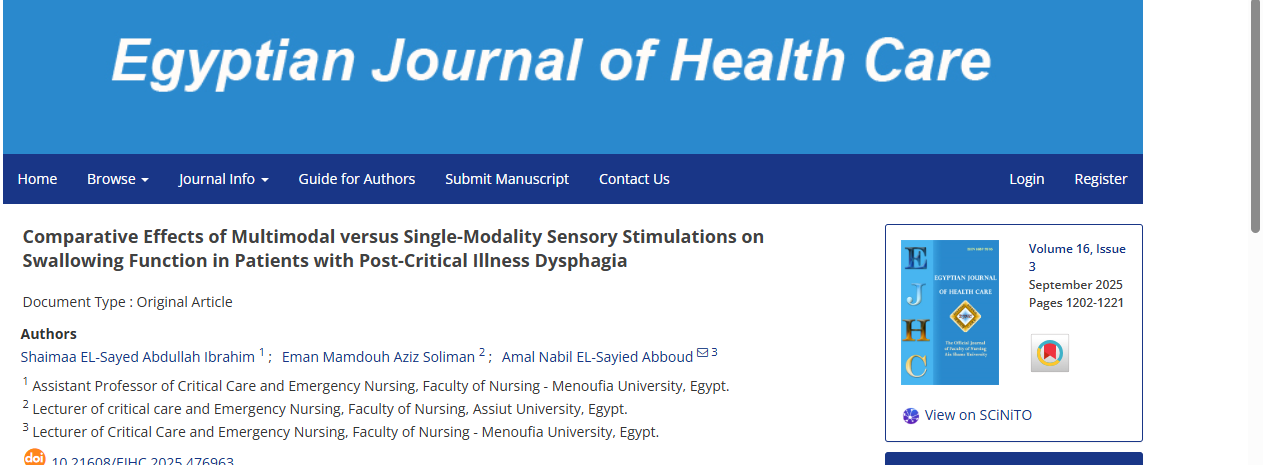
Research Journal
Egyptian journal of health care
Research Member
Research Pages
1202-1221
Research Publisher
Egyptian journal of health care, EKB
Research Rank
local
Research Vol
16
Research Website
https://ejhc.journals.ekb.eg/article_476963.html
Research Year
2025