Positive effects of systemic sodium benzoate and olanzapine treatment on activities of daily life, spatial learning and working memory in ketamine-induced rat model of …

Research Authors
GS Mahmoud, SA Sayed, SN Abdelmawla, MA Amer
Research Date
Research Department
Research Journal
International journal of physiology, pathophysiology and pharmacology 11 (2), 21
Research Member

International accredited courses and certificates for doctors at Assiut University Hospitals

International accredited courses and certificates for doctors at Assiut University Hospitals


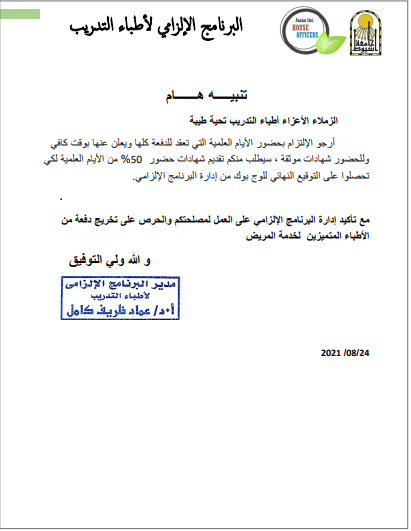
تحت رعايه الاستاذ الدكتور طارق الجمال رئيس جامعه اسيوط والاستاذ الدكتور علاء عطيه عميد كليه الطب ورئيس مجلس اداره المستشفيات والاستاذ الدكتور إيهاب فوزي المدير التنفيذي للمستشفيات الجامعيه والاستاذ الدكتور هاني المربع رئيس قسم التخدير و الدكتور عماد ظريف كامل مدير البرنامج الالزامي لأطباء التدريب.

تم تخصيص برنامج خاص باطباء التدريب واخر للأطباء المقيمين بقسم التخدير والعنايه المركزه. وذلك لزياده الوعي الطبي والبحثي لدي الاطباء الجدد وتوفير بعض الدورات العلميه العالميه المتميزة والمعتمدة و دون تكلفه على الطبيب . من خلال الالتحاق بموقع Incision academy  علي الإنترنت  والمتعاقد معها المجلس الأعلى للجامعات عن طريق بنك المعرفة المصري. يختار الطبيب من بين مئات الدورات المتاحه اون لاين ما يود  ليتدرب عليها ثم يجتاز  امتحان MCQ  فيحصل على  شهاده موثقه معتمده دولية  من  The Royal College of Surgeons.

Investigation of the levels of circulating miR-29a, miR-122, sestrin 2 and inflammatory markers in obese children with/without type 2 diabetes: a case control study

Research Abstract

Aim

The present work investigated serum levels of miR-29a, miR-122 and sestrin2 in obese children with/without type-2-diabetes mellitus (T2DM), and their correlations with inflammatory, metabolic and anthropometric parameters.

Methods

The study included 298 children, divided into: G1 (control, n = 136), G2 (obese without diabetes, n = 90) and G3 (obese with T2DM, n = 72). Metabolic and anthropometric parameters, miR-29a, miR-122 relative expressions, and sestrin2, high sensitivity C-reactive protein (hsCRP), interleukin-6 (IL-6), and tumor necrosis factor-α (TNF-α) levels were measured by their specific methods. The data was processed and analyzed by SPSS V.26 using the corresponding tests. After testing the variables’ normality, Kruskal–Wallis one-way-ANOVA, Spearman correlations coefficient were used.

Results

Significant higher serum miR-29a, miR-122, IL-6, hsCRP and TNF-α and lower sestrin2 levels were found in G2 and G3 than G1 and in G3 than G2 (p= > 0.001 for all). Especially in G3, miR-29a and miR-122 levels correlated positively while sestrin2 levels correlated negatively with waist circumference and BMI percentiles, serum levels of LDL-cholesterol, triacylglycerol, total cholesterol, HbA1c%, glucose, insulin, c-peptide, homeostatic model assessment-insulin resistance (HOMA-IR), IL-6, hsCRP and TNF-α.

Conclusion

The change in the serum miR-29a, miR-122 and sestrin2 levels in obese children with/without T2DM may suggest a possible role of these biomarkers in the pathogenesis of childhood obesity and their accompanied complications e.g. inflammations and T2DM. Also, further studies are required to test drugs that antagonize the action miR-29a and miR-122 or upregulate sestrin2 in the management of these cases.

Research Authors
Khalid M. Mohany, Osamah Al Rugaie, Osama Al-Wutayd & Abdullah Al-Nafeesah
Research Date
Research Department
Research Journal
BMC endocrine disorders
Research Pages
152
Research Publisher
BMC
Research Vol
21
Research Year
2022

Mechanics of guided growth of the distal femur for correction of fixed knee flexion deformities: an extra-articular technique

Research Abstract

Introduction

Anterior distal femoral hemiepiphysiodesis using intra-articular plates for correction of pediatric fixed knee flexion deformities (FKFD) has two documented complications: postoperative knee pain and implant loosening. The aim of this study is to investigate the mechanical properties of a novel extra-articular technique for anterior distal femoral hemiepiphysiodesis in patients with FKFD and to compare them to the conventional technique.

Materials and methods

Sixteen femoral sawbones were osteotomized at the level of the distal femoral physis and fixed by rail frames to allow linear distraction simulating longitudinal growth. Each sawbone was tested twice: first using the conventional technique with eight plates placed anteriorly just medial and lateral to the femoral sulcus (group A) and then with plates inserted in the proposed novel location at the most anterior part of the medial and lateral surfaces of the femoral condyles with screws in the coronal plane (group B). Gradual linear distraction was performed, and the resulting angular correction was measured. Strain gauges were attached to the plates, and the amount of strain (and equivalent stress) over the plates in response to linear distraction was recorded. The two groups were compared using the Wilcoxon signed-rank test.

Results

The amount of angular correction was statistically higher in group B (extra-articular plates) at 5, 10-, and 15-mm of distraction (p < 0.001). As regards stress over the plates, the maximum stress and the area under the curve (sum of all stresses measured throughout the distraction process) were significantly higher when the plates were inserted at the conventional position (group A) (p < 0.001).

Conclusions

During anterior distal femoral hemiepiphysiodesis, the fixation of the eight plates in the coronal plane at the anterior part of the femoral condyles may produce a greater amount of correction and a lower degree of stress over the implants as compared to the conventional technique.

Research Authors
Mohamed Y. Hassanein, Ahmed Hassanein, Mahmoud Y. Hassanein, Mohamed Khaled & Nariman Abol Oyoun
Research Date
Research Journal
Archives of Orthopaedic and Trauma Surgery
Research Publisher
Springer
Research Rank
Q2
Research Website
https://link.springer.com/article/10.1007/s00402-021-03911-2
Research Year
2021

SARS-CoV-2 infection and venous thromboembolism after surgery: an international prospective cohort study

Research Abstract

SARS-CoV-2 has been associated with an increased rate of venous thromboembolism in critically ill patients. Since surgical patients are already at higher risk of venous thromboembolism than general populations, this study aimed to determine if patients with peri-operative or prior SARS-CoV-2 were at further increased risk of venous thromboembolism. We conducted a planned sub-study and analysis from an international, multicentre, prospective cohort study of elective and emergency patients undergoing surgery during October 2020. Patients from all surgical specialties were included. The primary outcome measure was venous thromboembolism (pulmonary embolism or deep vein thrombosis) within 30 days of surgery. SARS-CoV-2 diagnosis was defined as peri-operative (7 days before to 30 days after surgery); recent (1–6 weeks before surgery); previous (≥7 weeks before surgery); or none. Information on prophylaxis regimens or pre-operative anti-coagulation for baseline comorbidities was not available. Postoperative venous thromboembolism rate was 0.5% (666/123,591) in patients without SARS-CoV-2; 2.2% (50/2317) in patients with peri-operative SARS-CoV-2; 1.6% (15/953) in patients with recent SARS-CoV-2; and 1.0% (11/1148) in patients with previous SARS-CoV-2. After adjustment for confounding factors, patients with peri-operative (adjusted odds ratio 1.5 (95%CI 1.1–2.0)) and recent SARS-CoV-2 (1.9 (95%CI 1.2–3.3)) remained at higher risk of venous thromboembolism, with a borderline finding in previous SARS-CoV-2 (1.7 (95%CI 0.9–3.0)). Overall, venous thromboembolism was independently associated with 30-day mortality (5.4 (95%CI 4.3–6.7)). In patients with SARS-CoV-2, mortality without venous thromboembolism was 7.4% (319/4342) and with venous thromboembolism was 40.8% (31/76). Patients undergoing surgery with peri-operative or recent SARS-CoV-2 appear to be at increased risk of postoperative venous thromboembolism compared with patients with no history of SARS-CoV-2 infection. Optimal venous thromboembolism prophylaxis and treatment are unknown in this cohort of patients, and these data should be interpreted accordingly.

Research Authors
COVIDSurg Collaborative, GlobalSurg Collaborative
Research Date
Research Journal
Anaesthesia
Research Website
https://associationofanaesthetists-publications.onlinelibrary.wiley.com/doi/10.1111/anae.15563
Research Year
2021

Free entry to the historical archive of Al-Ahram newspaper

The information tochnology Unit - Faculty of Medicine - Assiut University, in cooperation with the university’s digital library and East View

From getting a free one-month subscription to Al-Ahram newspaper archive..


- The archive is accessed via the university internet only (only inside the university campus), through the link

 https://gpa.eastview.com/alahram/

From within the archive, it is possible to search by keywords or search by date for the entire number of the newspaper.


Do we need doctors ... Al-Ahram Archive,     

link :

https://gpa.eastview.com/alahram/newspapers/aar19600810-01.1.6


Ledipasvir/Sofosbuvir in Adolescents With Chronic Hepatitis C Genotype 4 With and Without Hematological Disorders: Virological Efficacy and Impact on Liver Stiffness

Research Abstract

Abstract

Background

Egypt has the highest prevalence of hepatitis C virus (HCV) infection. Anti-HCV antibodies were detectable in 3% of children in Upper Egypt. Our aim was to evaluate the efficacy of ledipasvir/sofosbuvir for chronic HCV genotype 4 in adolescents with/without hematological disorders and to determine the effect of sustained virological response (SVR) on liver stiffness.

Methods

Sixty-five adolescents were recruited. There were 3 patient groups: group 1, 44 treatment-naive without hematological disorders; group 2, 6 previously treated; and group 3, 15 treatment-naive with hematological disorders. All patients received sofosbuvir 400 mg/ledipasvir 90 mg per day for 12 weeks. Serum HCV RNA levels were measured before treatment, at week 12, and at 12 weeks after the end of treatment (SVR12). Liver stiffness and the aspartate aminotransferase–platelet ratio index (APRI) score were estimated at baseline and at SVR12.

Results

SVR12 was 100%. At SVR12, there was a significant improvement in liver stiffness in all groups. The APRI score showed significant improvements in groups 1 and 3 (P < .001 and P = .004, respectively). The treatment was well tolerated, with minimal and self-limited side effects.

Conclusions

Treatment of chronic HCV in adolescents using ledipasvir/sofosbuvir was effective, with a cure rate (at SVR12) of 100%. Significant improvement in liver stiffness was found in all groups.

Research Authors
Nahed A Makhlouf, Mohamed O Abdelmalek, Mohamed Eltaher Ibrahim, Nagla H Abu-Faddan, Abeer E Kheila, Amal A Mahmoud
Research Date
Research Journal
Journal of the Pediatric Infectious Diseases Society
Subscribe to