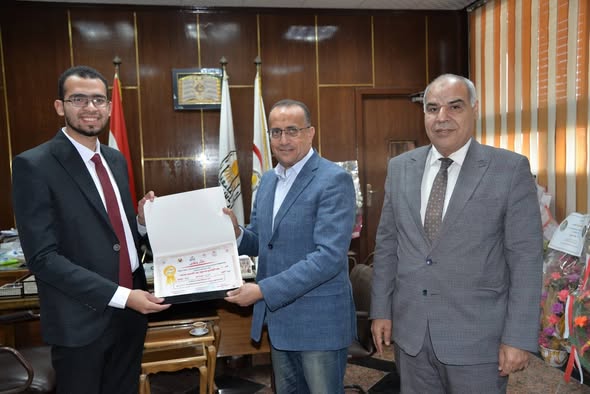
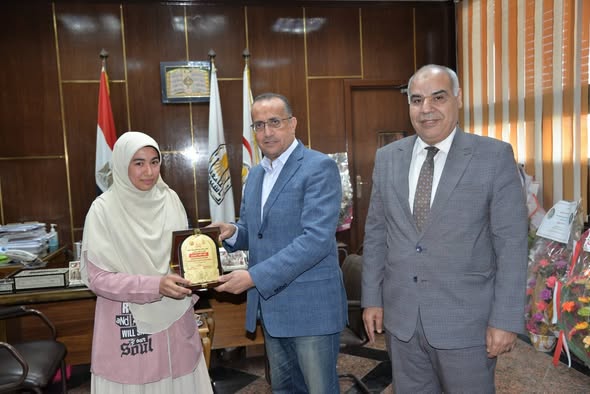
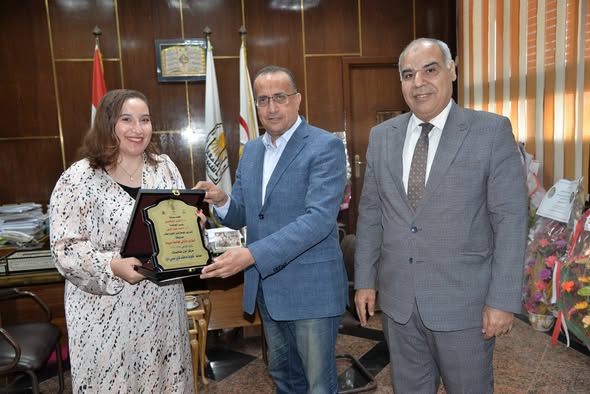
Invitation to discuss the doctoral dissertation submitted by Dr. Mohamed Kamal Mohamed Mustafa, Specialist in the Department of Chest Diseases, Faculty of Medicine, Assiut University.

Invitation to discuss the doctoral dissertation submitted by Dr. Mohamed Kamal Mohamed Mustafa, Specialist in the Department of Chest Diseases, Faculty of Medicine, Assiut University.

Invitation to discuss the doctoral dissertation submitted by Dr. Mohamed Kamal Mohamed Mustafa, Specialist in the Department of Chest Diseases, Faculty of Medicine, Assiut University.


V‑Y flap vs occlusive dressing for treating fingertip injuries with exposed bone

Research Authors
Mohamed M. Kotb Mohammed A.A. Farghalya, Tarek A. El-Gammalb, Amr E. Alic
Research Date
Research Journal
Journal of Current Medical Research and Practice
Research Year
2021

Value of tumor necrosis factor-alpha and high-sensitive cardiac troponin-I as early predictors of subclinical atherosclerosis and their relation to disease activity in patients with rheumatoid arthritis: A case-control study

Research Abstract

Patients with rheumatoid arthritis (RA) have a higher risk of cardiovascular disease (CVD) compared to the general population, which leads to increased morbidity and mortality. Inflammation is the key in RA and CVD. Our study aimed to refine cardiovascular (CV) risk assessment in RA patients by using carotid intima-media thickness (cIMT) as a marker of subclinical atherosclerosis. We also explored whether proinflammatory cytokines represented by tumor necrosis factor-alpha (TNF-α) and high-sensitivity cardiac troponin I (hs-cTnI), a biomarker of myocardial injury, could be correlated in RA patients. The study included 80 RA patients and 80 control subjects. TNF-α and hs-cTnI levels were measured. Subclinical atherosclerosis was evaluated by cIMT by means of carotid ultrasound. Disease activity score 28 (DAS28) was used to evaluate disease activity. hs-cTnI and TNF-α serum levels were higher in RA patients compared to controls (p=0.001). There was a significant difference in the median of cIMT between cases and controls (median (IQR) 0.9 (0.2) for cases, 0.7 (0.1) for controls, (p=0.001). A significant correlation was found between the level of TNF-α and hs-cTnI (p=0.002). Also, there was a significant correlation between the cIMT level and TNF-α and hs-cTnI (p=0.003 and p=0.002, respectively). Significant correlation was found between cIMT, TNF-α, and hs-cTnI in relation to the DAS28 score (p < 0.001, p < 0.001, and p=0.001, respectively). In conclusion, patients with RA are more likely to develop subclinical atherosclerosis, as reflected in increased cIMT. Higher levels of hs-cTnI in RA patients may correlate with the presence of occult cardiovascular disease. TNF-α and hs-cTnI correlations can reveal the interplay between disease activity and CVD. Thus, inflammation must be the primary target of various therapeutic approaches.

Research Authors
Eman M Ibrahem 1, Nabawia M Tawfik 1, Refaat F Abdel-Aal 1, Ehab M Moussa 2, Azza M Ezz-Eldin 3, Sabrin R Mahmoud 1
Research Date
Research Department

Outcome of Second Line Chemotherapy (Gemcitabine, Dexamethasone, and Cisplatin) in Relapsed and Refractory Non Hodgkin Lymphoma

Research Abstract

Background: The treatment of patients with relapsed or refractory non-Hodgkin lymphoma remains challenging. The strategy for management of relapsed or refractory disease is to deliver salvage chemotherapy, followed by autologous stem-cell transplantation in responding patient. Such salvage therapies typically consist of cytotoxic agents that have not been used in first line therapy.
Aim of Study: In this study we are trying to study one of the salvage chemotherapy lines which is GDP regarding response rate, quality of life and toxicity.
Patients and Methods: Seventy patients diagnosed as refractory or relapsed NHL were included in the study; all patients received GDP for 4 to 6 cycles. Primary end point was to evaluate overall response to treatment; secondary end point was to evaluate quality of life and toxicity. An informed written consent was obtained from all the patients and approval of Research Ethics Committee of Assiut, Faculty of Medicine was obtained prior to the study.
Results: The overall response was 65% with complete response 25% and partial response 40%. Regarding quality of life it was noticed that 32.9% patients using GDP were improved, 40% were stable patients while significant deteri-oration occurred in 27.1%. Regarding toxicity profile, occur-rence of neutropenia was 50% with grade III-IV 15%, throm-bocytopenia 40% with grade IV-V 5%, anemia 60% with grade II-III 7%. Nausea 50% with grade III-IV 3%, vomiting 40% with grade III-IV 10%, diarrhea 34.3% with grade II-III 5%. Renal toxicity 31.4% with grade I-II 15%, neurological toxicity 40% grade I-II 10%. Hepatic toxicity 25.7% with grade I-II 20%.
Conclusion: GDP is effective as second line chemotherapy with good response rate, quality of life and a manageable range of toxicity

Research Authors
YOUSRYEIA A. AHMAD, M.D.; RANIA HAFEZ, M.D. SABRIN REFAAT, M.Sc.; MARWA ISMAIL, M.D.
Research Date
Research Department
Research Journal
MEDICAL JOURNAL OF CAIRO UNIVERSITY

Vitamin D3 Ameliorates BDL-Induced Hepatocardiac Abnormalities. Possible Role of IGF-1

Research Authors
Ramadan A Saad, Mai Tarek, Howaida S Ali, Wael M Elayat, Abd El-Hamid A Mohamed
Research Date
Research Department
Research Journal
Journal of Evolutionary Biochemistry and Physiology
Research Member
Research Pages
327-342
Research Publisher
Pleiades Publishing
Research Year
2025

Chemotherapeutic potential of betanin/capecitabine combination targeting colon cancer: experimental and bioinformatic studies exploring NFκB and cyclin D1 interplay

Research Authors
Rehab Ahmed, Sawsan A Zaitone, Asmaa KK Abdelmaogood, Huda M Atef, Mona FM Soliman, Alaa M Badawy, Howaida S Ali, AbdelNaser Zaid, Hatem I Mokhtar, Lamiaa M Elabbasy, Emad Kandil, Asmaa Mokhtar Yosef, Rama I Mahran
Research Date
Research Department
Research Journal
Frontiers in Pharmacology
Research Pages
1362739
Research Publisher
Frontiers Media SA
Research Year
2024
Subscribe to