 Do you have any questions?

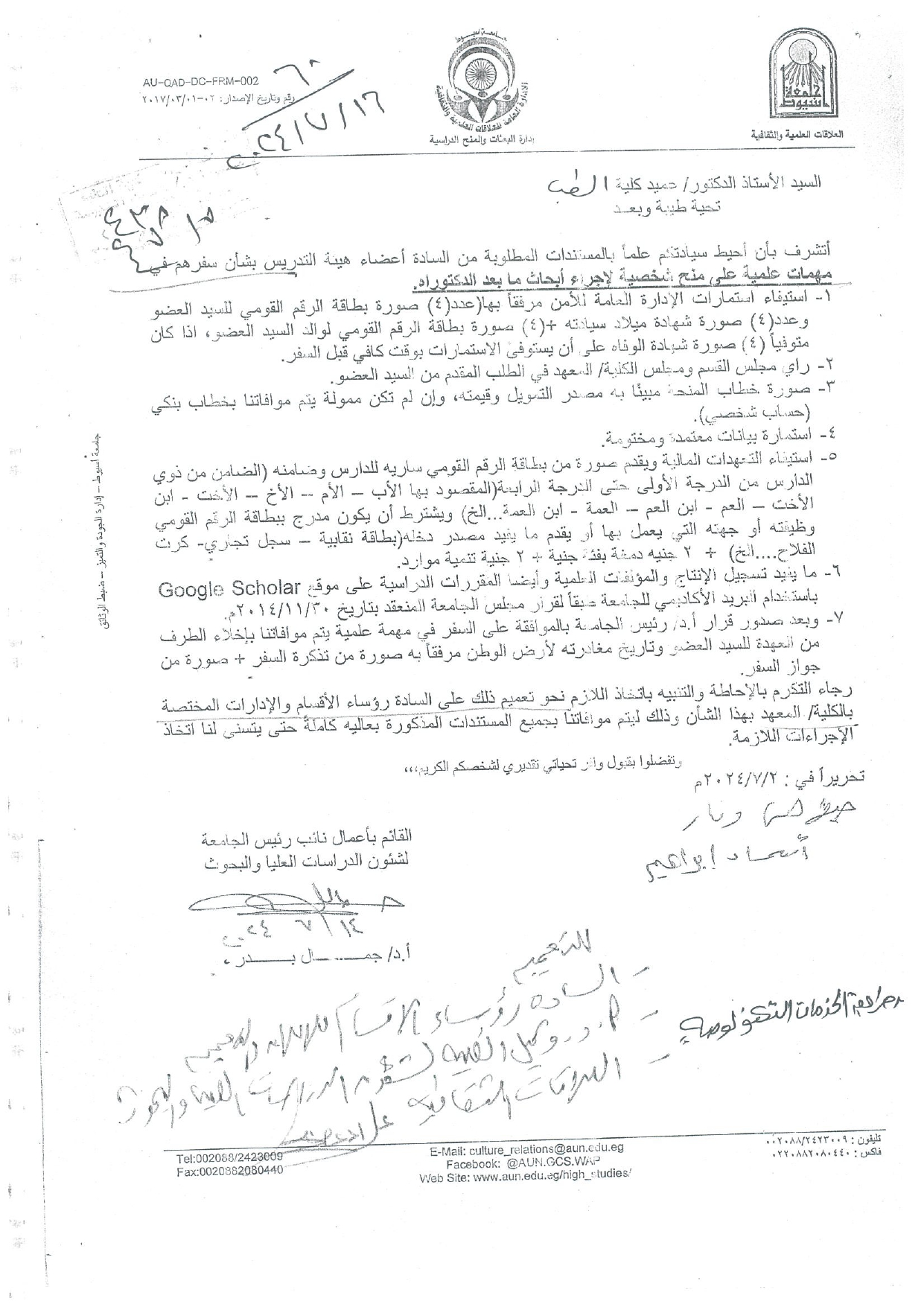
Regarding the documents required from faculty members regarding their loan to work abroad


Toxic cardiomyopathies were a potentially fatal adverse effect of anthracycline therapy.
This study was conducted to demonstrate the pathogenetic, morphologic, and toxicologic effects of doxorubicin on the heart and to investigate how the MAPK /TNF-α pathway can be modulated to improve doxorubicin-Induced cardiac lesions using bone marrow-derived mesenchymal stem cells (BM-MSCs) and olive leaf extract (OLE).
During the study, 40 adult male rats were used. Ten were used to donate MSCs, and the other 30 were split into 5 equal groups: Group I was the negative control, Group II obtained oral OLE, Group III obtained an intraperitoneal cumulative dose of DOX (12 mg/kg) in 6 equal doses of 2 mg/kg every 48 h for 12 days, Group IV obtained intraperitoneal DOX and oral OLE at the same time, and Group V obtained intraperitoneal DOX and BM-MSCs through the tail vein at the same time for 12 days. Four weeks after their last dose of DOX, the rats were euthanized. By checking the bioinformatic databases, a molecularly targeted path was selected. Then the histological, immunohistochemistry, and gene expression of ERK, JNK, NF-κB, IL-6, and TNF-α were done.
Myocardial immunohistochemistry revealed severe fibrosis, cell degeneration, increased vimentin, and decreased CD-31 expression in the DOX-treated group, along with a marked shift in morphometric measurements, a disordered ultrastructure, and overexpression of inflammatory genes (ERK, NF-κB, IL-6, and TNF-α), oxidative stress markers, and cardiac biomarkers. Both groups IV and V displayed reduced cardiac fibrosis or inflammation, restoration of the microstructure and ultrastructure of the myocardium, downregulation of inflammatory genes, markers of oxidative stress, and cardiac biomarkers, a notable decline in vimentin, and an uptick in CD-31 expression. In contrast to group IV, group V showed a considerable beneficial effect.
Both OLE and BM-MSCs showed an ameliorating effect in rat models of DOX-induced cardiotoxicity, with BM-MSCs showing a greater influence than OLE.
Background
Bisphenol-A (BPA) has a well-proven deleterious effect on the hypothalamicpituitary- gonadal axis.
Objectives
The current study investigated the therapeutic potentials of mesenchymal stem cells (MSCs) in a murine model of BPA-induced ovarian damage.
Methods
Fifty adult female rats were divided into: Group 1; control group, Group IIa, IIb: rats were given oral gavage of BPA (25 and 50 mg/Kg body weight respectively) on a daily basis for 15 days, and Group IIIa, IIIb; rats were intravenously treated with of MSCs (106 cells) after receiving the last dose of BPA as in group II. Plasma and ovarian tissue levels of Malondialdehyde (MDA) and gonadal axis hormones were assessed. Apoptosis was evaluated by TUNNEL assay and by apoptosis markers (FAS, FASL, Caspase 3, SLTM). A histological examination of ovarian tissue was also conducted.
Results
BPA resulted in a significant elevation in plasma …
Urinary tract infections are common health problem affecting millions worldwide. Antibiotic resistance among uropathogens (Ups) is prevalent in many countries. In the absence of any available data in the region, this hospital-based study investigated the pattern, frequency and susceptibility of Ups at Prince Mutaib Bin Abdulaziz Hospital, Aljouf Region, Saudi Arabia.
A retrospective assessment of UPs and their antibiotics susceptibility was conducted from January 2017 to December 2017 using the fully automated Vitek2 system (BioMérieux, France).
Among the 415 uropathogens isolates, the most prevalent bacteria were Gram-negatives comprising 137 (51%) E. coli; 46 (17.2%) Klebsiella spp.; 30 (11.2%) Pseudomonas spp.; 25 (9.3%) Proteus spp.; 14 (5.2%) Acinetobacter baumanii and 16 (5.9%) others. On the other hand, Enterococcus spp. were predominant among Gram-positive isolates representing 54 (36.7%), 47 (32.0%) Staphylococcus spp., 22 (15.1%) Streptococcus spp., and 13 (8.8%) S. aureus, and 11 (7.5%) others. Gram-negative Ups showed multidrug resistance towards the majority of the tested antimicrobials (ampicillins, cephalosporins, fluoroquinolones, trimethoprim-sulfamethoxazole, fosfomycin, aztreonam, and nitrofurantoin). While high resistance patterns by Gram-positives was also seen against cephalosporins, penicillins, amoxicillin-clavulanic acid, trimethoprim-sulfamethoxazole, clindamycin, erythromycin and tetracycline.
The observed widespread multidrug resistance clearly warrant implementing stricter control measures, local guidelines of antimicrobials usage, and continuous epidemiological surveys at hospitals and communities.
Methods: A case–control study involving 100 patients with cirrhosis and PHT with (n = 50) or without (n = 50) PSCVs detected by using MSCT. Direct transjugular HVPG was measured in 10 patients with (n = 5) or without (n = 5) PSCVs using Swan-Ganz catheters.
Results: A total of 47(94%) of the patients with PSVCs had SCVs, which were classified according to their site (hilum, upper pole, lower pole), and shape (grape-like, serpiginous, worm-like). Compared to patients without PSVCs, those with PSVCs has significantly less endoscopically-detectable gastroesophageal varices (58% vs. 92%; P < 0.001), more hemorrhoids (48% vs. 20%; P < 0.001), higher rate of HCC (88.2% vs. 11.8%; P < 0.001), more HE recurrence (4.9 ± 2.4 vs. 2.8 ± 1.62% attacks in 6 months; P < 0.001), lower HVPG (2.2 ± 1.6 vs. 12.8 ± 1.6 mmHg; P < 0.001), but similar splenic size (14.7 ± 2.8 vs.14.8 ± 0.9 cm; P = 0.788), respectively.
Conclusions: MSCT accurately delineates PSVCs, and SCVs are the most common. Clinical significance of SCVs classification needs further investigated. Patients with PSVCs may require less variceal endoscopic surveillance, more HCC screening, and prolonged HE prophylaxis.
Background & Aim
Skin cancer is the most common cancer around the world. Regional differences have been reported affecting the demographics and the prevalence of non-melanoma skin cancers; furthermore, non-melanoma skin cancers are believed to be underreported. In this study, we aim to identify and highlight any possible significant characteristics of skin cancer in our rural center in Scotland's Highlands.
Methods
This is a retrospective study analyzing and reporting cancerous skin lesions excision rates among all skin lesions excised and their characteristics in our rural center for one year. Clinical and histopathological data for patients attending our services for suspicious skin lesions excision were collected. Data included the patient’s age, gender, lesion’s diagnosis, site, size, color, borders, resection edges, recurrence, and complications. A database was created creating two cohorts: cancer and non-cancerous lesions groups, both cohorts' data was compared using student T-tests and Z-tests. P-values were considered statistically significant if < 0.5, Overall data was analyzed revealing trends and end results.
Results
From December 2019 to December 2020, 96 patients underwent skin lesions excision, 30% were cancerous. Basal cell carcinoma was the most common malignant growth standing for 76.7% of all malignant lesions excised. Squamous cell carcinoma and melanoma were found in 20% and 3.3% of patients with malignant lesions, respectively. Out of the total, 76% of cancerous lesions were in males. The most common site was head and neck (58.8%). High-risk lesions were the ones on the head and neck (P= 0.00988), in the elderly over 74.5 years (P= 0.000037), and males (P= 0.001).
Conclusion
Basal cell carcinoma was the most common malignant lesion. Elderly men with lesions on the head and neck had higher risks for cancer. Further clarification may be required with larger multi-center studies involving general practitioners, which might help identify regional variations.