 Do you have any questions?

Pharmaceutical Seminar - Nada Helmy Abdel Tawab
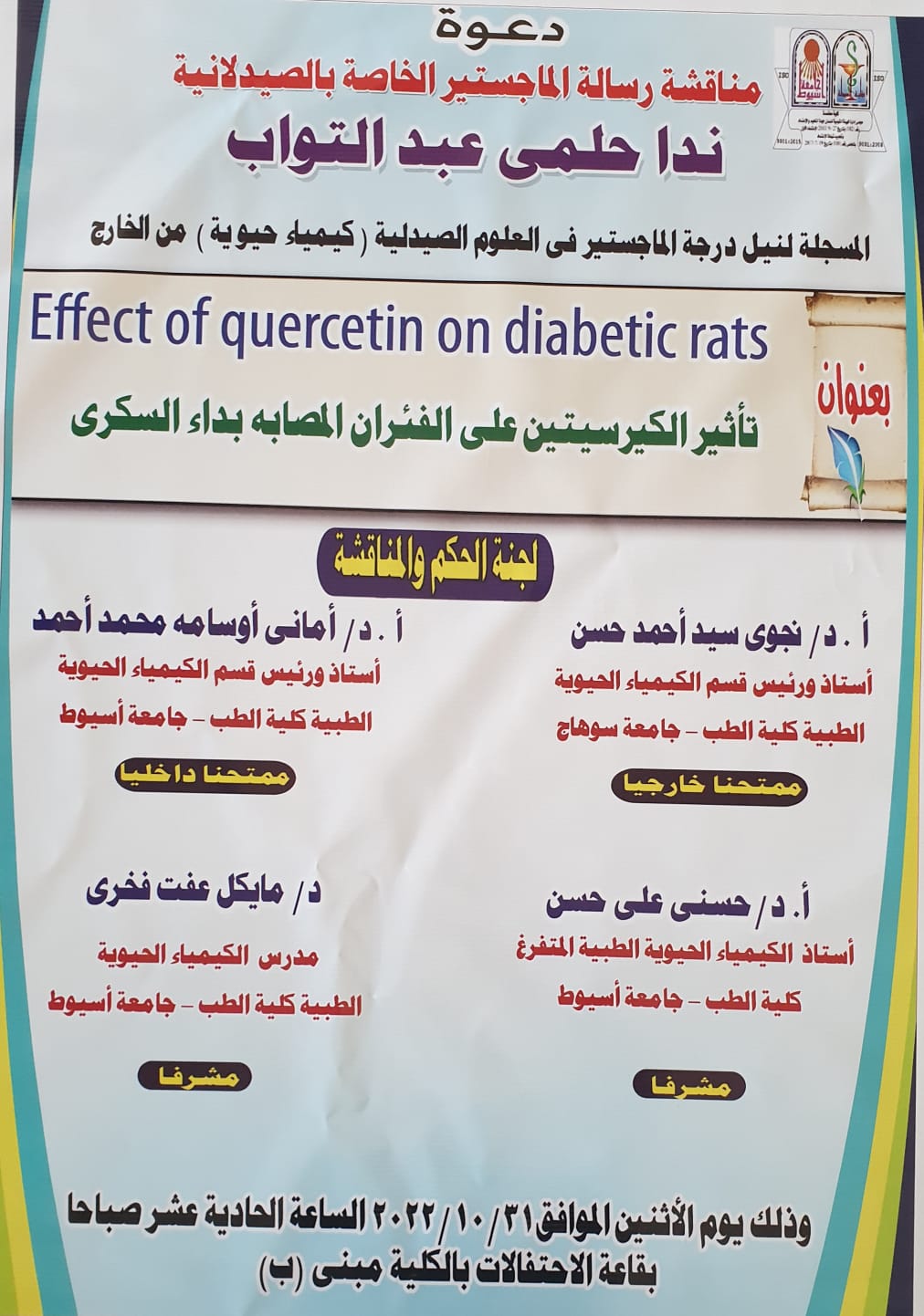
Role of Copper-Albumin Complex in Treatment of Gastric Ulcer in Rats
Research Abstract
The main goal of this submitted work was to investigate the effect of copper-albumin complex on serum and mucosal oxidative stress for gastric ulcer treatment. Forty seven 8-week-old rats were classified into five groups as follow: G1 (control, n=7), G2 (Experimental control, n=10) was left without treatment, G3 (Mucogel group, n=10), G4 (Mucogel-plus group, n=10) and G5 (Omeprazole group, n=10). Treatment has been started six hour after Induction of Ulcers and continued till the 6th day. Ulcer index were reduced more than 30% in G3 and about 90% in G4 more than that of G5 in comparison to G2. The immunostained fundic tissue showed a marked reduction of iNOS activity in G4 more than in G3 and G5. Nitric oxide (NO) was slightly reduced in serum of G3 but it was somewhat at the level of reference control by treatment in G4 and G5 which recorded the strongest reduction of mucosal NO level followed by G4 then G3 compared to G1. Moreover, serum and mucosal total peroxide and oxidative stress index (OSI) were highly elevated in G2 while G4 recorded the strongest reduction followed by G5 then G3 compared to G1. On the other hand, Serum and mucosal superoxide dismutase (SOD) activity showed a significant reduction in G2 and G3 from that of G1 but significantly increased in G4 followed by G5. We also noted that total antioxidant activity (TAO) levels in both Serum and mucosa was almost normalized in G4 followed by G5 then the serum TAO in G3 but mucosal TAO level was non-significantly different comparing G2 and G3. Thus, co treatment of copper-albumin complex seems to be useful for gastric ulcer treatment by decreasing oxidative stress.
Research Date
Research Department
Research Journal
Journal of Applied Sciences Research
Research Member
Research Pages
5789-5798
Research Vol
8 (12)
Research Year
2012
Copper one (I)-Nicotinate Promotes Gene Expression of CYPs that Produce M1 and Q1 in Aflatoxicosed Rats
Research Abstract
Abstract: Aflatoxin-contaminated food poses a serious risk to both human
and animal health. Copper (1)-nicotinate (Cu+-nicotinate) complex
potentiated the prophylactic effect against chronic aflatoxicosis in the
experimental animals through the synthesis of less toxic metabolites M1
and Q1 which are easily excreted in urine. To investigate the action of the
safety Cu+-nicotinate complex on gene expression of Cytochrome 450
(CYP450) system, the liver tissue samples of orally administered rats for 3
weeks with aflatoxin B1 (AFB1; 30 μg/kg body weight), with and without
association of the copper complex (400 μg/kg body weight) were assayed
for their gene expression of CYP450 families including 1A2, 3A2 and
2C11 as well as histopathological examination of the hepatic tissue samples
was performed. The obtained data denoted that the Cu+-nicotinate complex
significantly reduced gene expression of CYP2C11 and CYP3A2 that
enhancing the most toxic epoxide metabolite. On the contrary, this complex
enhanced the expression of CYP1A2 that synthesize the less toxic
metabolite M1 and Q1. The histopathological examination mostly
confirmed such observation as the signs of aflatoxicosis were absent in
Cu+-nicotinate-treated group. Consequently, it could be predicted that the
Cu+-nicotinate complex may be medically used as an inhibitory food
additive agent against exposure of aflatoxicosis in the intact animals since
the complex contains the copper and nicotinic acid, the two daily required
biochemical elements for sustaining live in healthy conditions.
Research Date
Research Department
Research Journal
American Journal of Biochemistry and Biotechnology
Research Member
Research Pages
40-50
Research Publisher
Science Publications
Research Vol
16 (1)
Research Year
2020
IRON-KINETICS IN ALBINO RATS
Research Abstract
A mathematical model of iron kinetics derived by POLLYCOVE and MORTIMER (1961) was successfully used on normal adult rats. R.B.C. iron turnover number, mean delay of iron in red marrow for haemoglobinization, and the R.B.C. life span were determined. Comp < /strong>lete iron exchange between the main plasma iron pool, and the storage compart ments was detected. The findings elucidated the comp < /strong>lex equilibrium between the plasma iron and the various iron pools, namely the erythrocytic pool, itself com prising almost equal labile and fixed compartments and the storage pool. The equil ibrium shows that the iron actually deposited in the storage pool is little (97 Pg Fe/day) comp aired to the erythrocytic iron turnover (410 Pg Fe/day).
Research Date
Research Department
Research Journal
Assiut Veterinary Medical Journal
Research Member
Research Pages
45-50
Research Vol
8 (15)
Research Year
1981
Binding of aflatoxin B1, G1 and M to plasma albumin
Research Abstract
The aflatoxins B1, G1 and their metabolites exist in the systemic blood as protein conjugate. This conjugation is specific to plasma albumin and proceeds enzymatically by liver and kidney cells. The aflatoxin-albumin conjugate is permanent and the conjugation is an irreversible one. This may interpret the acute liver damage of animal ingested a single dose of aflatoxin (3,4). The existence of bound aflatoxin-albumin in the systematic blood could be considered as one factor of low excretions of aflatoxins and their metabolites in urine (5,6,7).
Research Date
Research Department
Research Journal
Mycopathologia
Research Member
Research Pages
35-38
Research Publisher
Pubmed
Research Vol
79 (1)
Research Year
1982
Aflatoxin and aflatoxicosis: V. The kinetic behaviour of dietary aflatoxins in colostrum drawn from cows postpartum.
Research Abstract
This work was conducted in order to study the kinetic behaviour of dietary aflatoxins in the colostrum of a pregnant cow exposed to contaminated feeds for a short period. In this study, two pregnant cows received a single dose of dietary aflatoxins in the form of rice powder contained 31.20 ppm aflatoxin B and 19.68 ppm aflatoxin G during the last stage of pregnancy, at about two weeks before parturition. Samples of colostrum were collected from dams and assayed for the presence of toxic metabolites as well as its conjugations by electrophoretic analysis. The results revealed that the intake of aflatoxins appeared in the colostrum postpartum as AFM1 and also AFB2a which is a non toxic metabolite. Moreover, it was found that the excreted metabolites including AFB2a were conjugated to the immunoglobulin protein fraction of the colostrum. The significance of the obtained results to the newborn calf are discussed.
Research Date
Research Department
Research Journal
Mycopathologia
Research Member
Research Pages
161-164
Research Publisher
Springer
Research Vol
89 (3)
Research Year
1985
The role of copper(I)-nicotinic acid complex on kojic acid biosynthesis by Aspergillus flavus
Research Abstract
Abstract
Addition of copper-monovalent-nicotinic acid complex to a synthetic medium specific for kojie acid production by Aspergillus flavus enhanced the production by about 47%. The substance is proposed to act via a biochemical utilization of the copper(I)-B3 complex in a manner similar to that of the naturally utilized nicotinic acid. NAD and NADP like carriers with higher reactivity have been predicted. According to this prediction the biosynthetic route of kojic acid has been interpreted on the basis of a model proposed by BAJPAI et al. (1981). In this model the enzymes participating are dependent on NAD and NADP (glucose dehydrogenase and gluconate dehydrogenase) as well as on other reduction processes.
Research Date
Research Department
Research Journal
Journal of basic microbiology
Research Member
Research Pages
29-33
Research Publisher
Wiley‐VCH
Research Vol
24 (1)
Research Year
1987
Copper (I)-nicotinic acid complex: an immunopotentiator in chickens vaccinated against newcastle disease
Research Abstract
Copper-nicotinic acid complex was fed as a food additive to baby chicks and their immune status estimated after vaccination with Hitchner B1 and inactivated ND vaccines. This work was done in order to determine the immunostimulant effect of copper(I)-nicotinic acid complex in chickens. Immunity was estimated by haemagglutination inhibition, agar-gel precipitation, and challenge tests. Results showed much higher immunity status and post vaccination protection in birds supplemented with the complex. These data can be used in developing and realizing veterinary preventive programs or passive immunity in childhood.
Research Date
Research Department
Research Journal
Biology of Copper Complexes
Research Member
Research Pages
343-350
Research Publisher
Humana Press
Research Year
1987
Effect of prostaglandins B1, F1a and F2a on thyroxine, triiodothyronine and calcium levels in albino rat serum
Research Abstract
Effect of prostaglandins B1, F1a and F2a on thyroxine, triiodothyronine and calcium levels in albino rat serum FAO_logo AGRIS home-icon English Español Français العربية 中文 Русский Journal Article Journal Article Effect of prostaglandins B1, F1a and F2a on thyroxine, triiodothyronine and calcium levels in albino rat serum [1988] Nassar, AY (Assiut Univ. (Egypt). Faculty of Medicine); Hassan, KA; Omar, HM; Access the full text NOT AVAILABLE Lookup at Google Scholar google-logo From the journal Assiut Journal of Agricultural Science (Egypt) Bibliographic information Language: English Type: Summary In AGRIS since: 1990 Volume: 19 Issue: 2 Start Page: 43 End Page: 56 All titles: "Effect of prostaglandins B1, F1a and F2a on thyroxine, triiodothyronine and calcium levels in albino rat serum"@eng Other: "2 ill. 1 fig. 2 tables; 18 ref. Summaries (Ar, En)" Loading... Translate with Google Access the full text NOT …
Research Date
Research Department
Research Journal
Assiut Journal of Agricultural Science (Egypt)
Research Member
Research Pages
43-56
Research Vol
19 (2)
Research Year
1988