



Schedule of public and private students in the college for the academic year 2022 / 2023

Happy New Year

Schedule
Arabic aspect based sentiment analysis using bidirectional GRU based models
Research Abstract
Aspect-based Sentiment analysis (ABSA) accomplishes a fine-grained analysis that defines the aspects of a given document or sentence and the sentiments conveyed regarding each aspect. This level of analysis is the most detailed version that is capable of exploring the nuanced viewpoints of the reviews. The bulk of study in ABSA focuses on English with very little work available in Arabic. Most previous work in Arabic has been based on regular methods of machine learning that mainly depends on a group of rare resources and tools for analyzing and processing Arabic content such as lexicons, but the lack of those resources presents another challenge. In order to address these challenges, Deep Learning (DL)-based methods are proposed using two models based on Gated Recurrent Units (GRU) neural networks for ABSA. The first is a DL model that takes advantage of word and character representations by combining bidirectional GRU, Convolutional Neural Network (CNN), and Conditional Random Field (CRF) making up the (BGRU-CNN-CRF) model to extract the main opinionated aspects (OTE). The second is an interactive attention network based on bidirectional GRU (IAN-BGRU) to identify sentiment polarity toward extracted aspects. We evaluated our models using the benchmarked Arabic hotel reviews dataset. The results indicate that the proposed methods are better than baseline research on both tasks having 39.7% enhancement in F1-score for opinion target extraction (T2) and 7.58% in accuracy for aspect-based sentiment polarity classification (T3). Achieving F1 score of 70.67% for T2, and accuracy of 83.98% for T3.
Research Date
Research Department
Research File
article_1.pdf
(1.08 MB)
Research Journal
Journal of King Saud University - Computer and Information Sciences
Research Member
Mohammed Fawzi Seddik Farghally
Research Pages
6652-6662
Research Publisher
Elsevier
Research Rank
Q1
Research Vol
34
Research Website
https://doi.org/10.1016/j.jksuci.2021.08.030
Research Year
2021
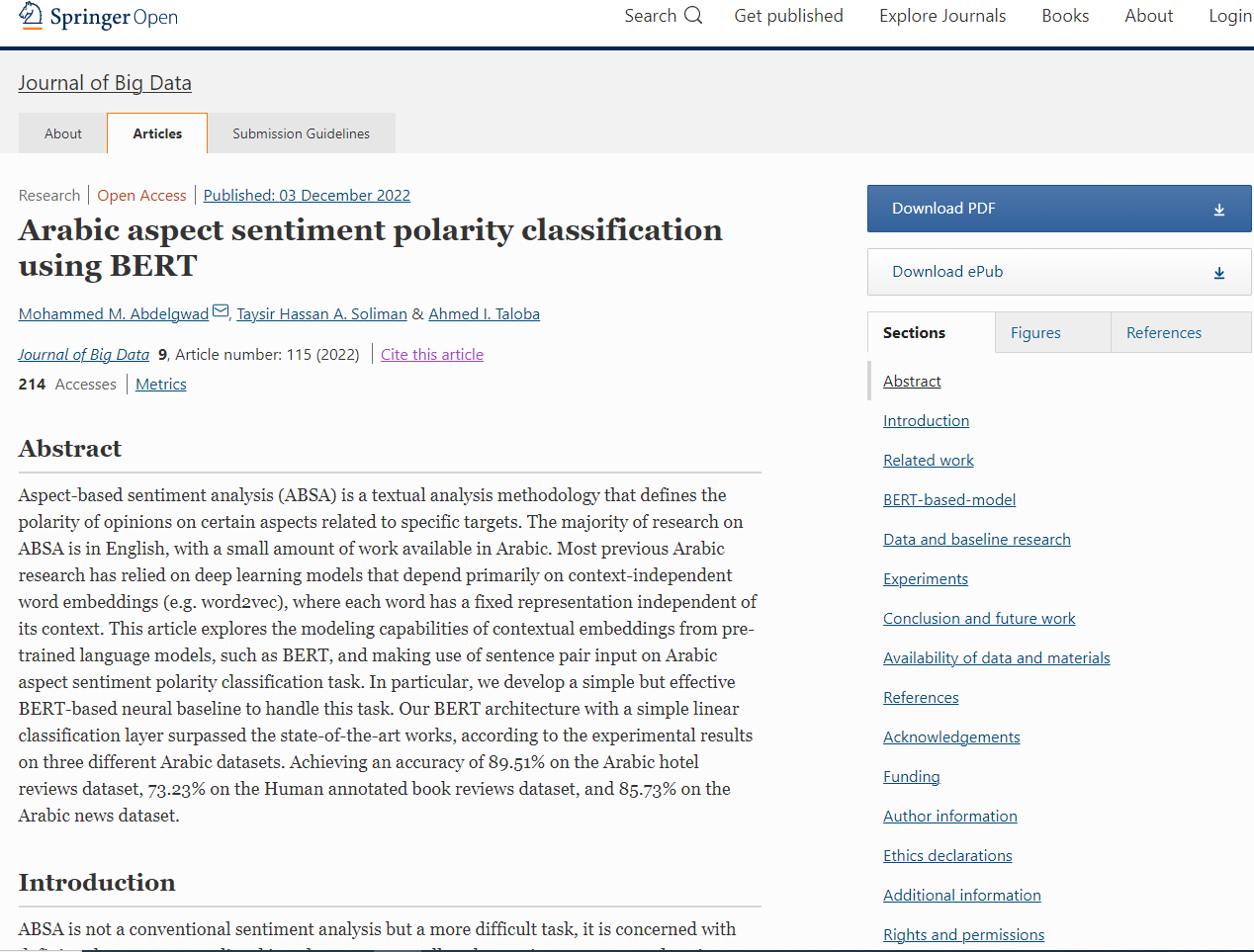
Arabic aspect sentiment polarity classification using BERT
Research Abstract
Aspect-based sentiment analysis (ABSA) is a textual analysis methodology that defines the polarity of opinions on certain aspects related to specific targets. The majority of research on ABSA is in English, with a small amount of work available in Arabic. Most previous Arabic research has relied on deep learning models that depend primarily on context-independent word embeddings (e.g. word2vec), where each word has a fixed representation independent of its context. This article explores the modeling capabilities of contextual embeddings from pre-trained language models, such as BERT, and making use of sentence pair input on Arabic aspect sentiment polarity classification task. In particular, we develop a simple but effective BERT-based neural baseline to handle this task. Our BERT architecture with a simple linear classification layer surpassed the state-of-the-art works, according to the experimental results on three different Arabic datasets. Achieving an accuracy of 89.51% on the Arabic hotel reviews dataset, 73.23% on the Human annotated book reviews dataset, and 85.73% on the Arabic news dataset.
Research Date
Research Department
Research File
article_0.pdf
(1.45 MB)
Research Image
Research Journal
Journal of Big Data
Research Member
Research Pages
15
Research Publisher
SpringerOpen
Research Rank
Q1
Research Vol
9
Research Website
https://doi.org/10.1186/s40537-022-00656-6
Research Year
2022
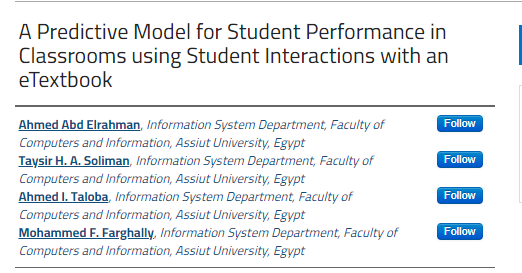
A Predictive Model for Student Performance in Classrooms using Student Interactions with an eTextbook
Research Abstract
With the rise of online eTextbooks and Massive Open Online Courses (MOOCs), a huge amount of data has been collected related to students’ learning. With the careful analysis of this data, educators can gain useful insights into their students’ performance and their behavior in learning a particular topic. This paper proposes a new model for predicting student performance based on an analysis of how students interact with an interactive online eTextbook. By being able to predict students’ performance early in the course, educators can easily identify students at risk and provide a suitable intervention. We considered two main issues: the prediction of good/bad performance and the prediction of the final exam grade. To build the proposed model, we evaluated the most popular classification and regression algorithms. Random Forest Regression and Multiple Linear Regression have been applied in Regression. While Logistic Regression, decision tree, Random Forest Classifier, K Nearest Neighbors, and Support Vector Machine have been applied in classification. Based on the findings of the experiments, the algorithm with the best result overall in classification was Random Forest Classifier with an accuracy equal to 91.7%, while in the regression it was Random Forest Regression with an R2 equal to 0.977.
Research Date
Research Department
Research File
paper_0.pdf
(765.68 KB)
Research Image
Research Journal
Information Sciences Letters
Research Member
Mohammed Fawzi Seddik Farghally
Research Pages
15
Research Publisher
Springer
Research Rank
An International Journal
Research Vol
1
Research Website
https://digitalcommons.aaru.edu.jo/isl/vol12/iss1/2
Research Year
2022
Time Series Similarity for Detecting DDoS Flooding Attack
Research Abstract
Distributed Denial of Service attack (DDoS) is one of many types that hit computer networks. For security specialists, this attack is one of their main concerns. The DDoS flooding attack prevents the legitimate users from using their desired services by consuming the server resources. It includes many types depending on the targeted layer as example, SYN flooding attack and UDP attack are lunched into the network layer, while the HTTP flooding attack and DNS attack into the application layer. The DDoS flooding attack takes use of a flaw in the internet routing system by flooding the server with packets bearing faked IP addresses. Due to the internet routing infrastructure's inability to discriminate between spoofed and legitimate packets, using these spoofed IP addresses makes it difficult to detect this attack. Based on time series similarity measurement, we offer a new detection approach for DDoS flooding attacks in this paper. By computing the cost function value and by comparing this value with a modified adaptive threshold, legal and malicious traffic intervals can be clearly distinguished. Our results show the efficiency of the proposed detection approach through the obtained detection rates.
Research Department
Research Journal
Assiut University Journal of Multidisciplinary Scientific Research
Research Member
Research Pages
229-241
Research Vol
51
Research Year
2022
Detection of Distributed Denial of Service Flooding Attack Using Odds Ratio
Research Abstract
Computer networks are vulnerable to many types of attacks while the Distributed Denial of Service attack (DDoS) serves as one of the top concerns for security professionals. The DDoS flooding attack denies the services by consuming the server resources to prevent the legitimate users from using their desired services. The hardness of detecting this attack lies in sending a stream of packets to the server with spoofed IP addresses, so that the internet routing infrastructure cannot distinguish the spoofed packets. Based on the odds ratio (OR) statistical measurement, in this work we propose a new detection method for the DDoS flooding attacks. By exploring the odds ratio to determine the risk factor of any incoming traffic to the server, the legitimate and attack traffic packets can be easily differentiated. Experimental results demonstrate the efficiency of the presented detection method in terms of its detection probability and detection time.
Research Department
Research Journal
JOURNAL OF NETWORKING AND NETWORK APPLICATIONS
Research Member
Research Pages
67-74
Research Vol
1
Research Website
https://doi.org/10.33969/J NaNA.2021.010204
Research Year
2021
A seven-dimensional state flow traffic modelling for multi-controller Software-Defined Networks considering multiple switches
Research Abstract
Software-Defined Networking (SDN) improves flexibility in network management and programmability through decoupling the control and the data planes. In SDN, traffic analysis and modelling are important for tracking network activity and availability to detect abnormalities, such as security and operational problems. In this paper, a seven-dimensional state model is used to model SDN TCP and UDP flows, unlike other models that are used in previous work which use three or four-dimensional states. We formulate seven-dimensional states with transitions which consider flow-level arrivals to get more accurate knowledge about modelling the SDN traffic. The proposed work uses multiple controllers and multiple switches with limited capacities unlike other models in related work which may use one controller or switch with an infinite buffer. Using multiple controllers improves the security of the network, due to the
Research Date
Research Department
Research Journal
Computer Communications
Research Member
Research Publisher
Elsevier
Research Year
2022
Schedule of public and private students

Assiut national university schedule
The schedule of national University students for the academic year 2022 / 2023

To view the schedule, click on the link
