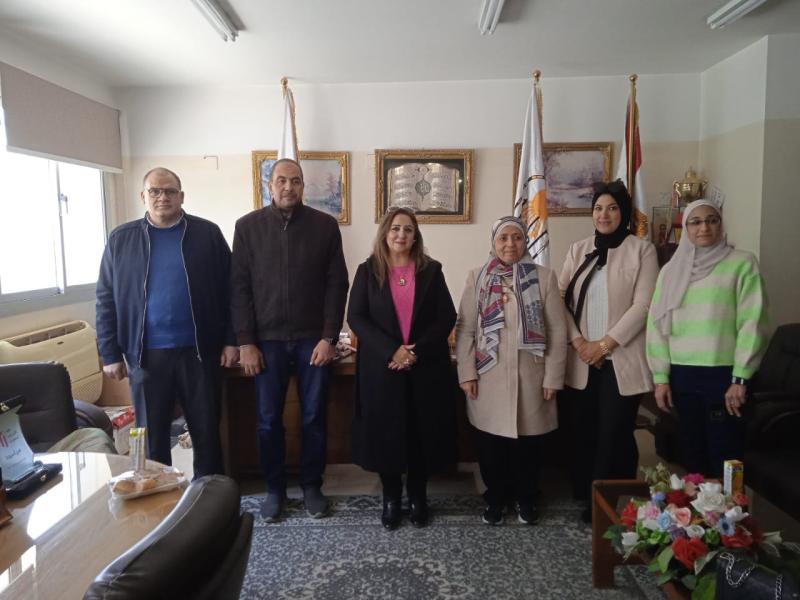



Congratulations from the Dean of the Faculty and the Faculty of Computers and Information to His Excellency Prof. Dr. Ahmed El-Menshawy, President of Assiut University, on the confidence of His Excellency Prof. Dr. Ayman Ashour, Minister of Higher Education, in extending his term for another academic year until July 31, 2026. August 3, 2025 Professor Dr. Tayseer Hassan Abdel Hamid, Dean of the Faculty, the Vice Deans, Department Heads, Faculty Members, Assistant Staff and the Faculty's staff extend their sincere congratulations to His Excellency Prof. Dr. Ahmed El-Menshawy President of Assiut University on the occasion of the issuance of the decision by His Excellency the Minister of Higher Education and Scientific Research to renew his confidence in him and continue his presidency of Assiut University for a new academic year. This well-deserved confidence is the culmination of a journey replete with successes and outstanding achievements that the university has witnessed under your leadership. We have witnessed, over the past period, a comprehensive renaissance across various sectors, and a constant commitment to developing the educational and research process. And to strengthen the university's role in serving the community and developing the environment. We ask God to grant you continued success in continuing this distinguished journey, to bless your efforts aimed at elevating Assiut University's status locally, regionally, and internationally, and to guide your steps toward what is best for science and the nation.

"Children's University" continues its activities with a distinguished training visit to the Faculty of Computers and Information at Assiut University. As part of the "Children's University" educational and awareness initiative, organized by Assiut University under the patronage of Dr. Ahmed El-Menshawy, President of the University, the Faculty of Computers and Information hosted a special visit from the sixth and eighth grades participating in the program. The visit, which is being held from July 9 to 22, was supervised by Dr. Gamal Badr, Vice President for Graduate Studies and Research; Dr. Yara Ibrahim, Program Coordinator and Dean of the Faculty of Early Childhood Education; Dr. Manal Anwar, Vice Dean for Graduate Studies; and Dr. Ayat Farouk, Deputy Program Coordinator. Dr. El-Menshawy emphasized that the program represents a unique educational experience targeting children aged 9 to 14 years old, through practical activities and training workshops designed to stimulate creative thinking and the acquisition of new skills in line with the requirements of the digital age. This contributes to children's development and prepares generations capable of innovation and participation in community development. The special visit to the Faculty of Computers and Information served as an educational platform. The program featured a rich program of activities, with the college welcoming more than 100 children. The event was attended by Dr. Tayseer Abdel Hamid, Dean of the College, and coordinated by Dr. Dalia Mohamed Nashat, Vice Dean for Community Service and Environmental Development and Visit Coordinator. The visit included a variety of practical and applied explanations. On the first day, the children learned about the mechanisms for using Zoom in distance learning and how to leverage Google Docs for collaborative writing activities. The second day was dedicated to training them on designing digital stories using Wixie, as well as learning the steps to create a simplified website using the Google Sites platform. This hands-on experience was held at the college's Computer Consulting Center. Dr. Tayseer Abdel Hamid expressed her appreciation for this fruitful collaboration with the College of Early Childhood Education, praising the children's interaction and outstanding response during the workshops, and the tangible practical benefits they gained that enhanced their technical skills. Dr. Yara Ibrahim, Program Coordinator, also extended her sincere thanks and appreciation to the College of Computers and Information for hosting it. Distinguished, and to all those in charge of training, including faculty members and technicians, for their remarkable efforts that contributed to the success of this distinguished educational visit within the activities of “Children’s University.”

As part of the "Best Environmentally Friendly College" competition Assiut University Vice President inspects the Faculty of Computers and Information The Faculty Evaluation Committee at Assiut University continues its field work as part of the "Best Environmentally Friendly College" competition, organized by the university to monitor colleges' compliance with sustainable environmental standards. The competition is held under the patronage of Dr. Ahmed El-Minshawy, President of Assiut University, under the supervision of Dr. Mahmoud Abdel-Alim, Vice President for Community Service and Environmental Development, and coordinated by Dr. Mohamed Mustafa Hamad, General Coordinator of the competition; Dr. Amr Saeed, Executive Coordinator; and Dr. Rehab El-Dakhili, Media Coordinator for the competition. The fourth round of the committee's work included a visit to the Faculty of Computers and Information, where Dr. Mahmoud Abdel-Alim conducted a field tour of the Faculty of Computers and Information to monitor the college's implementation of the competition's standards. For his part, Dr. Ahmed El-Minshawy, President of Assiut University, explained that the competition comes within the framework of the university's plan to promote the concepts of sustainability, spread environmental awareness among its members, and support the colleges' efforts to improve their educational environment. He emphasized the university's commitment to instilling a culture of sustainable practices that contribute to the protection of natural resources. Reducing waste and supporting engagement with the local community, reflecting the university's role as an environmentally and developmentally responsible institution. The visiting committee to the College of Computers and Information included Dr. Mohamed Mustafa Hamad, Dr. Mohamed Mahmoud El-Wakil, Dr. Sanaa Mohamed Zahran, Dr. Randa Youssef, Dr. Mahmoud El-Qadi, and Professor Osama El-Sayed. The committee was received by Dr. Tayseer Abdel Hamid, Dean of the College, Dr. Dalia Nashaat, Vice Dean for Community Service and Environmental Development, and the College Secretary, along with a team of faculty members and their assistants. Professor Nada Kamal documented the visit. During the visit, the College gave introductory presentations covering the most important environmental activities and practices implemented in the areas of infrastructure, risk management, energy conservation, and strengthening relationships with the community. The committee also reviewed efforts made in managing natural resources and water. The committee also conducted field tours of the College's various facilities, including classrooms, administrative offices, computer labs, cafeterias, green spaces, and parking lots. and bicycles, to assess compliance with sustainable environmental standards.
This paper develops two tempered fractional matrices that are computationally accurate, efficient, and stable to treat myriad tempered fractional differential problems. The suggested approaches are versatile in handling both spatial and temporal dimensions and treating integer- and fractional-order derivatives as well as non-tempered scenarios via utilizing pseudospectral techniques. We depend on Lagrange basis functions, which are derived from the tempered Jacobi-Müntz functions based on the left- and right-definitions of Erdélyi-Kober fractional derivatives. We aim to obtain the pseudospectral-tempered fractional differentiation matrices in two distinct ways. The study involves a numerical measurement of the condition number of tempered fractional differentiation matrices and the time spent to create the collocation matrices and find the numerical solutions. The suggested matrices' accuracy and efficiency are investigated from the point of view of the , -norms errors, the maximum absolute error matrix of the two-dimensional problems, and the fast rate of spectral convergence. Finally, numerical experiments are carried out to show the exponential convergence, applicability, effectiveness, speed, and potential of the suggested matrices.
Medical image copyright protection is becoming increasingly relevant as medical images are used more frequently in medical networks and institutions. The traditional embedded watermarking system is inappropriate for medical images since it degrades the original images’ quality. Furthermore, medical-colored image watermarking options are constrained since most medical watermarking systems are built for gray-scale images. This paper proposes a zero-watermarking scheme for medical color image copyright protection based on a chaotic system and Resnet50, which is a convolutional neural network method. The network Resnet50 is used to extract features from the color medical image, and then a logistic Gaussian map is used to scramble these features and scramble the binary image. Finally, an exclusive OR operation is performed (scrambled binary image, scrambled features for the medical color image) to form a zero watermarking. The experimental result proves that our scheme is effective and robust to geometric and common image processing attacks. The BER values of the extracted watermarks are below 0.0039, and the NCC values are above 0.9942, while the average PSNR values of the attacked images are 29.0056 dB. Also, it is superior to other zero-watermark schemes for medical images in terms of robustness to conventional image processing and geometric attacks. Furthermore, the experimental results show that the Resnet50 model outperforms other models in terms of reducing the mean squared errors of the features between the attacked and original image.
Tables are everywhere, from scientific journals, articles, websites, and newspapers all the way to items we buy at the supermarket. Detecting them is thus of utmost importance to automatically understanding the content of a document. The performance of table detection has substantially increased thanks to the rapid development of deep learning networks. The goals of this survey are to provide a profound comprehension of the major developments in the field of table detection, offer insight into the different methodologies, and provide a systematic taxonomy of the different approaches. Furthermore, we provide an analysis of both classic and new applications in the field. Lastly, the datasets and source code of the existing models are organized to provide the reader with a compass on this vast literature. Finally, we go over the architecture of utilizing various object detection and table structure recognition methods to create an effective and efficient system, as well as a set of development trends to keep up with state-of-the-art algorithms and future research. We have also set up a public GitHub repository where we will be updating the most recent publications, open data, and source code. The GitHub repository is available at https://github.com/abdoelsayed2016/tabledetection-structure-recognition.