
Design and Implementation of a Vibration-Based Real-Time Internet of Things Framework for Road Condition Monitoring

Research Abstract

This paper presents a study on the design and implementation of a real-time Internet of Things (IoT) framework for monitoring road conditions. The proposed system incorporates an accelerometer sensor attached to the rear axle of a vehicle to capture vertical acceleration signals resulting from the interaction between the vehicle suspension system and the road surface. These acceleration signals are utilized to determine vertical displacements, which are then used to calculate the International Roughness Index (IRI) as an indicator of road quality. The system comprises a hardware node for acquiring acceleration signals and a remote monitoring system for calculating and visually representing the IRI on a road map. Our results demonstrate that the proposed system is effective in automatically assessing road conditions, with an error in the calculated IRI of less than 3.5%

Research Authors
Mohamed AbdelRaheem, Muhammad Hassan, Mahmoud A Alyousify, Ali Hussein, Amr A Nassr
Research Date
Research Department
Research Journal
IEEE Open Journal of Vehicular Technology
Research Member
Research Pages
867-876
Research Publisher
IEEE
Research Vol
4
Research Year
2023

Benha University invites all Egyptian university and institute students to participate with their ideas in the Smart Education Hackathon 2025 AD.

https://hackathons.bu.edu.egFor the Fourth Year- Benha University Launches the Smart Education Hackathon 2025

Under the patronage of Professor Ayman Ashour, Minister of Higher Education and Scientific Research, and Professor Nasser El Gizawy, President of Benha University, the university announces the organization of the "Smart Education" Hackathon under the slogan “Artificial Intelligence Applications: The Future of Egypt's Digital Landscape” in February 2025, in collaboration with the Ministry of Higher Education and Scientific Research. This initiative stems from the belief in the role of higher education and scientific research in supporting digital transformation and the ongoing pursuit of achieving the goals of Egypt's Vision 2030 towards a knowledge-based digital economy, as well as encouraging innovation, research, and development by empowering and motivating young programmers and idea creators to present their innovative ideas and software projects.

Prof.Nasser El Gizawy, President of Benha University, stated that the Smart Education Hackathon aims to find innovative solutions in various fields, including: distance learning, interactivity in education, flexible educational tools, language learning platforms, gamifying learning, learner support systems, and data analysis for education.

He added that the winners of the hackathon will receive cash prizes totaling 140,000 Egyptian pounds provided by Benha University; in 7 categories, the first place will receive a prize of 10,000 pounds, the second place 6,000 pounds, and the third place 4,000 pounds.
Prof.Shady El Mashad, Executive Director of Information, indicated that this is the fourth edition of the hackathon. Benha University held the Smart Cities Hackathon in March 2022, the Smart Government Hackathon in February 2023, and the Empowering People with Disabilities Hackathon in February 2024. In 2025, Benha University will launch the Smart Education Hackathon. He added that registration will open starting from 2nd November till December 31, 2024.

Information sessions and other details will be announced through the hackathon website, the Benha University website, and the official university Facebook page at  https://hackathons.bu.edu.eg.

Benha University invites all students from Egyptian universities and institutes to participate with their ideas in the hackathon through the following link: https://hackathon.bu.edu.eg/register.

"The Objectives of the National Anti-Corruption Strategy"

1
The Faculty of Computers and Information at Assiut University hosts a seminar entitled "The Objectives of the National Anti-Corruption Strategy" to raise awareness of the risks of corruption and the need to combat it

Under the supervision of Prof. Ahmed Al-Manshawi, President of Assiut University; The General Directorate of Information Systems and Digital Transformation, in cooperation with the General Directorate of skills Management and Development, organized an awareness seminar; as part of the series of seminars launched by Assiut University; to introduce the national anti-corruption strategy, on Sunday, September 22, at the Faculty of Computers and Information at the university.

Prof. Ahmed El-Minshawy, President of Assiut University, stressed the university's keenness to hold awareness seminars, which contribute to achieving national strategies aimed at combating corruption, and addressing all its forms, and its images, explaining that the symposium discusses the national anti-corruption strategy, in its third phase 2023-2030, and explains its main objectives, where the goal came; an efficient administrative apparatus that provides distinguished services to citizens; to enhance the efficiency and effectiveness of the administrative apparatus of the state; in line with the axis of transparency, and the efficiency of government institutions in Egypt's Vision 2030 for sustainable development on the one hand, and Egypt's plan for administrative reform on the other hand.

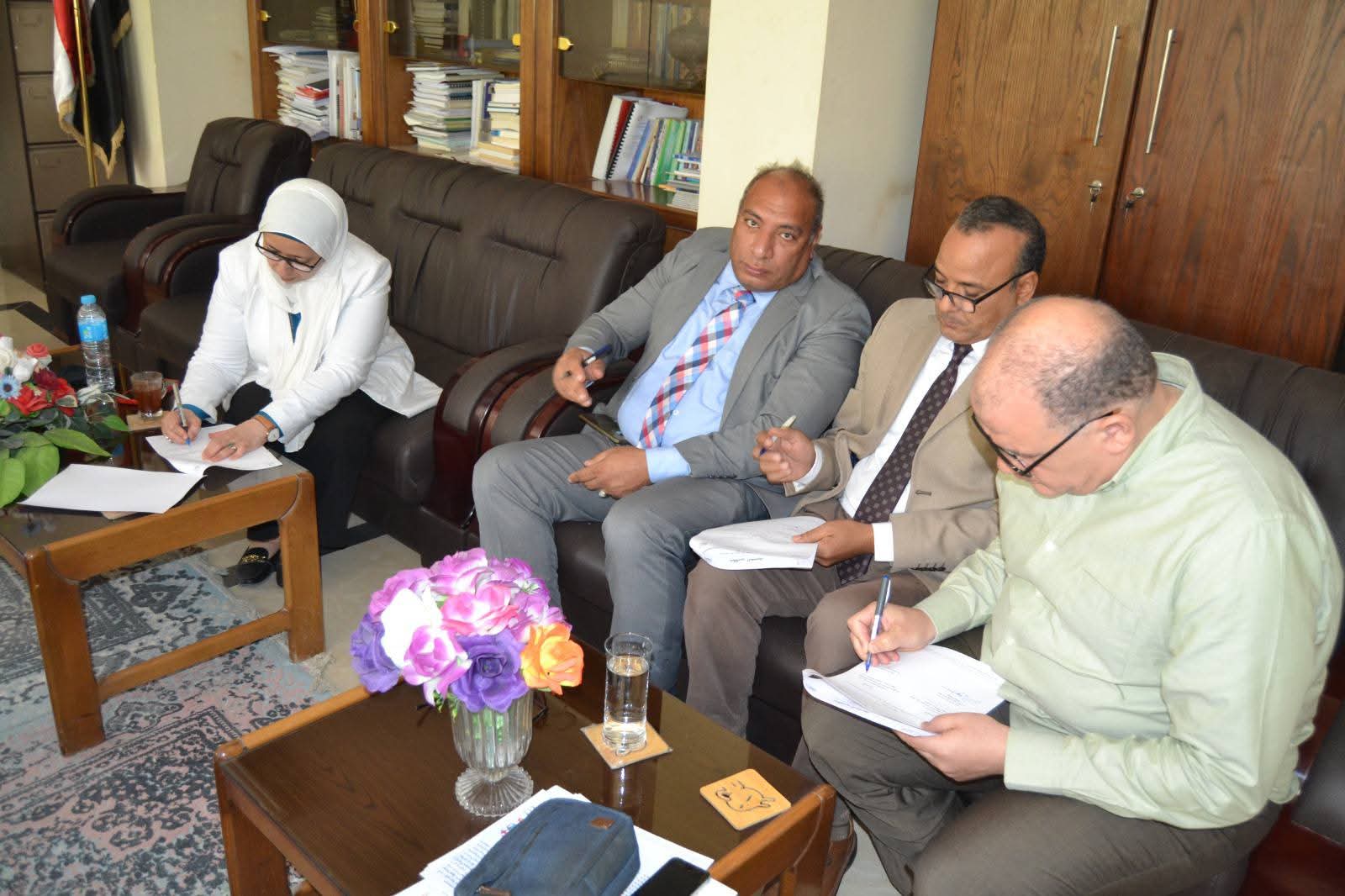
The symposium came under the supervision of: Mr. Shawkat Saber, Secretary General of the University, Dr. Butheina Al-Fatih, Assistant Secretary General of the University, Dr. Tayseer Hassan Abdulhamid, Dean of the Faculty of Computers and Information, Mr. Mohammed Abdul Mohsen, Secretary of the College, Dr. Mustafa Morsi, Director General of the General Directorate of Information Systems and Digital Transformation, and Coordinator of the Implementation of the Anti-Corruption Strategy for Assiut University.

Dr. Tayseer Hassan expressed her pleasure in hosting the symposium activities at the Faculty of Computers and Information, thanking all those responsible for the work of the Information Systems Department; for the efforts exerted in organizing events that are concerned with raising awareness, developing, and developing the academic staff and the administrative staff at the university.

Dr. Buthaina Al-Fatih explained: The university seeks to implement the national anti-corruption strategy, disseminate and establish the values and principles of transparency and integrity, at all levels, as well as developing and developing the skills of employees, in various sectors of the administrative apparatus; in order to create a positive work environment; contributes to achieving the university's goals and vision to develop work and improve administrative performance.

During the symposium, Dr. Mustafa Morsi discussed several axes, including: the definition of corruption, the United Nations Convention against Corruption, the initial anti-corruption strategy 2014/2018, the second anti-corruption strategy 2019/2022, the third anti-corruption strategy 2023/2030, the authorities concerned with anti-corruption, anti-corruption frameworks, including: the legislative, institutional and regulatory framework, and the regulatory framework for the authorities concerned with combating corruption, including: the Administrative Oversight Authority, the Central Accounting Authority, the Supervisory Authority for Technical Works, the Industrial Supervision Department, and the Pharmaceutical Regulatory and Research Authority.

Subscribe to