
ملخص البحث
| Abstract |
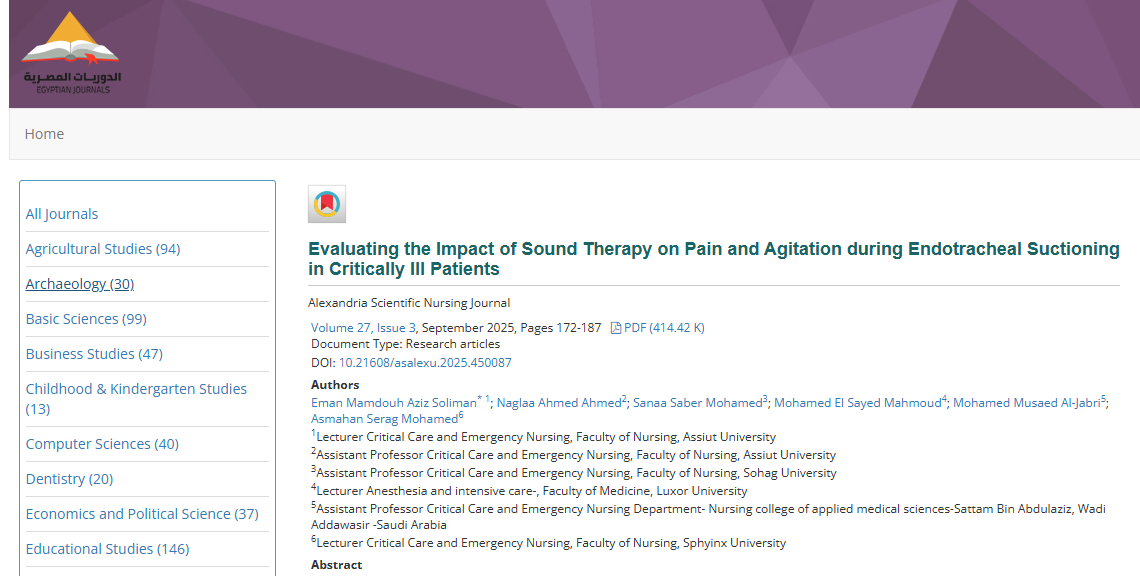
| Background: Sound therapy can successfully relieve a variety of painful symptoms and is one of the most popular non-pharmacological treatments utilized by clinical personnel. Through pitch and rhythm, it activates the limbic system, which in turn triggers the pituitary gland to release endorphins, which results in a feeling of wellbeing Aim of study to evaluate the impact of sound therapy on pain and agitation during endotracheal suctioning in critically ill patients Research design: A Quasi-experimental study design was used. Setting: the study was conducted in General intensive care unit at Sohag main University Hospital. Subjects: Convenient sample of 79 patients were included in the study and they were assigned randomly to a control group and an intervention group. Five tools were utilized in this study: I: sheet for patient assessment, II: Critical-Care Pain Observation Tool (CPOT), III: Richmond Agitation-Sedation Scale (RASS), IV: Glasgow coma scale (GCS), V: Clinical outcomes assessment sheet. Results: revealed that Patient in the intervention group had significant relief of pain 5 min, and 15 min after intervention in comparison with control group patients, as indicated with P=0.04*&0.001**. According to the results, the study group's agitation levels were significantly lower than those of the control group five, three, and five minutes after the intervention (pvalues of 0.005**, 0.005**, and 0.04*, respectively). Conclusion: Sound therapy was effective in the reduction of pain and agitation level among critically ill patients. Recommendations: Provide in-service education about the importance of sound therapy inside the intensive care unit. |
تاريخ البحث
قسم البحث
مستند البحث
ASALEXU-Volume 27-Issue 3- Page 172-187.pdf
(414.42 كيلوبايت)
صورة البحث
مجلة البحث
Alexandria Scientific Nursing Journal
مؤلف البحث
صفحات البحث
172-187
الناشر
EKB
تصنيف البحث
local
عدد البحث
27
موقع البحث
https://journals.ekb.eg/article_450087.html
سنة البحث
2025