
Prevalence and correlates of intimate partner violence among women attending different primary health centers in Aljouf Region, Saudi Arabia

Research Abstract

Background and Objectives

Intimate partner violence (IPV) is a serious and widespread problem worldwide. IPV can seriously influence the physical, mental, sexual, and reproductive health of women as well as the welfare of their children. In the Middle East, IPV is pervasive and widely acceptable. The present study was done to determine the prevalence and correlates of IPV among women attending different primary health centers in the Aljouf region, Saudi Arabia.

Methods

A cross-sectional study was conducted among 403 Saudi women attending different primary health centers in the Aljouf region, Saudi Arabia. A structured anonymous questionnaire was distributed to the targeted population during a face-to-face interview. Data analysis was done using the SPSS program, version 24.

Results

The present study showed that 30.3% of the participants had been exposed to IPV over the last year. Concerning the types of violence, the present study revealed that emotional violence is the highest followed by physical and then sexual violence representing 92.6%, 67.2%, and 44.3%, respectively. The significant predictors of IPV were women with one to three children (OR = 7.322, p-value = 0.006), women with four children or more (OR = 13.463, p-value = 0.006), and women married to husbands with aggressive behavior (OR = 98.703, p-value < 0.001). Not taking the approval on marriage was significantly associated with more exposure to violence (OR = 3.190, p-value = 0.042). In addition, husband smoking status was a significant predictor for IPV (OR = 2.774, p-value = 0.012). However, women married to alcoholic drinkers had a significantly …
Research Authors
Doaa M Abdel-Salam, Bashayer ALruwaili, Doaa Mohamed Osman, Maha Mamluh M Alazmi, Sama Ayman Mater ALghayyadh, Rawan Ghazi Zaki Al-Sharari, Rehab A Mohamed
Research Date
Research Journal
International journal of environmental research and public health
Research Pages
598
Research Publisher
MDPI
Research Vol
vol.19 - issue 1
Research Website
https://scholar.google.com/scholar?oi=bibs&cluster=12453821449152016458&btnI=1&hl=en
Research Year
2022

Prevalence and predictors of depressive symptoms among married Egyptian women: a multicenter primary healthcare study

Research Abstract

Depression affects about 3.8% of the world’s population. Although marriage may contribute to subjective well-being, some marital variables could increase women’s risk for depression. This study aimed to determine the prevalence of depressive symptoms and their correlates among married females attending primary healthcare facilities. A cross-sectional study was conducted on a purposive sample of 371 married women at the primary healthcare centers, Assiut Governorate, Upper Egypt. In this study, an interviewer-administered questionnaire was used for data collection. Depressive symptoms were assessed using the Patient Health Questionnaire-9 (PHQ-9) and marital satisfaction using the ENRICH Marital Satisfaction Scale (EMS). Standardized measurements of weight and height were performed. According to the PHQ-9 diagnostic criteria, the prevalence of depressive symptoms among the studied married females was 30.2%. The significant predictors of depressive symptoms were advanced husbands’ ages, living with an extended family, exposure to spousal verbal violence, high body weight, and low marital satisfaction levels. Approximately one-third of married Egyptian women experienced depressive symptoms. In addition to high body weight, some social and marital factors contributed to the increase in women’s vulnerability to depressive symptoms. Egyptian primary healthcare physicians should be trained to identify females with depressive symptoms and refer them to specialists if need be. To combat depression in women, it may be helpful to construct qualified marital counseling centers. This may improve marital satisfaction …

Research Authors
Doaa Mohamed Osman, Gellan K Ahmed, Manal Mukhtar Farghal, Ahmed K Ibrahim
Research Date
Research Journal
BMC psychiatry
Research Pages
1-12
Research Publisher
BioMed Central
Research Vol
vol.22 - issue 1
Research Website
https://scholar.google.com/scholar?oi=bibs&cluster=6654963237505281115&btnI=1&hl=en
Research Year
2022

Healthcare Professionals’ Knowledge, Attitudes and Counselling Practice Regarding Prevention of Secondhand Smoke Exposure Among Pregnant Women/Children in Assiut, Egypt

Research Abstract

Objectives

To explore Knowledge, attitudes and counselling practices of HCPs regarding SHS exposure among pregnant women and children in Egypt.

Methods

Survey of HCPs working in public maternal and child health clinics in Assiut city, Egypt. Descriptive and regression analyses were performed.

Results

367 HCPs participated in the study, 12% of whom were smokers. The majority were nurses (45%). A considerable proportion of HCPs reported being exposed to SHS in the workplace (70%) and home (52%). About half HCP reported high SHS risk awareness (56%), supportive attitude towards preventing SHS exposure (53%), and having good counselling practice regarding SHS exposure (52%). Being a GP and serving urban communities were significantly associated with high risk awareness. Being female, serving rural communities and not being exposed to SHS at home were significantly associated with self-reported supportive attitudes and good counselling practice.

Conclusion

HCPs’ awareness, attitudes and practice regarding the risks of SHS to pregnant women and children in Egypt should be improved. Training for HCPs and enforcement of smoke free polices are needed to improve awareness and facilitate changes in social norms.

Research Authors
Zeinab M Hassanein, Rachael L Murray, Ilze Bogdanovica, Tessa Langley
Research Date
Research Journal
International Journal of Public Health
Research Pages
1605073
Research Publisher
Frontiers
Research Vol
vol.67
Research Website
https://scholar.google.com.eg/scholar?oi=bibs&cluster=11285063993132341040&btnI=1&hl=ar
Research Year
2022

Experiences and views of parents on the prevention of second-hand smoke exposure in Middle Eastern countries: a qualitative systematic review

Research Abstract

Objective:

The objective of this review was to identify, appraise, and synthesize the evidence related to experiences and views of parents, children, and professionals on the prevention of second-hand smoke exposure to women and children in Middle Eastern countries.

Introduction:

Second-hand smoke exposure is a major health concern. It is problematic during pregnancy because of potential adverse reproductive effects and poor fetal outcomes. Childhood second-hand smoke exposure is linked to increased morbidity and mortality. Smoking prevalence is high among men in Middle Eastern countries and, as a result, large numbers of non-smoking men, women, and children are exposed to second-hand smoke daily.

Inclusion criteria:

Studies were considered for inclusion if they explored experiences and views on the prevention of second-hand smoke exposure among women and children in homes, workplaces …

Research Authors
Zeinab M Hassanein, Gamze Nalbant, Tessa Langley, Rachael L Murray, Ilze Bogdanovica, Jo Leonardi-Bee
Research Date
Research Journal
JBI Evidence Synthesis
Research Pages
1969-2000
Research Publisher
LWW
Research Vol
vol.20 - issue 8
Research Website
https://journals.lww.com/jbisrir/Fulltext/2022/08000/Experiences_and_views_of_parents_on_the_prevention.4.aspx?context=FeaturedArticles&collectionId=2
Research Year
2022

Prevention of second-hand smoke exposure among pregnant women and children in Egypt and the rest of the Middle East: a mixed-methods investigation

Research Abstract

Second-hand smoke (SHS) exposure is a major public health concern. Pregnant women and children are a priority population for tobacco control efforts because second-hand smoke (SHS) exposure during pregnancy/childhood poses serious risks to foetal/child health. Due to strong cultural constraints against women smoking in many Middle Eastern countries, the prevalence of tobacco smoking is higher among men than women, which puts non-smoking women and children on risk of exposure to SHS. The Middle Eastern countries are Bahrain, Cyprus, Egypt, Iran, Iraq, Israel, Jordan, Kuwait, Lebanon, Oman, Palestine, Qatar, Saudi Arabia, Syria, Turkey, United Arab Emirates, and Yemen. In Egypt, daily SHS exposure among pregnant non-smoking women and children is estimated to be more than 50% at home and more than 70% in public places. The aim of the current thesis is to investigate the experience of SHS exposure among pregnant women and children in Middle Eastern countries with focus on Egypt, barriers and facilitators to reduce it, and to come up with recommendations on how to reduce this exposure. Three studies were conducted to achieve this aim. The first study aimed to identify, appraise, and synthesize the evidence related to experiences and views of parents, children, and professionals on the prevention of second-hand smoke exposure to women and children in Middle Eastern countries by conducting a qualitative systematic review. Six databases and grey literature were searched from inception to January 2021 to identify published and unpublished studies. No language restrictions were applied. The JBI guidelines …

Research Authors
Zeinab M Hassanein
Research Date
Research Journal
University of Nottingham
Research Publisher
University of Nottingham
Research Year
2023

Posttherapy technetium-99m pentavalent dimercaptosuccinic acid brain single-photon emission computed tomography/computed tomography: diagnostic and prognostic values in patients with glioma

Research Abstract

Abstract

Purpose 

To assess the value of posttherapy 99mTc-pentavalent dimercaptosuccinic acid (DMSA-V) brain SPECT/CT in patients with brain glioma.

Methods 

Patients with pathologically or radiologically proven glioma were prospectively enrolled in this study. 99mTc-DMSA-V brain SPECT/CT images were acquired at 120–180 min after i.v. injection of 555–740 MBq of 99mTc-DMSA-V. Three nuclear medicine physicians blindly interpreted the scans visually as positive or negative for residual/recurrent disease. Agreement between two or more readers was considered a consensus. The composite reference standard was considered based on subsequent clinical/neuroimaging follow-up or histopathology whenever available. Overall survival (OS) was calculated from the date of initial diagnosis till the death or the date of last follow-up.

Results 

Thirty-four patients (18 males and 16 females; mean age 37.7 ± 16 years) were enrolled in this study. Interreader agreement between the readers ranged from 0.71 to 0.82. Based on the composite reference standard, residual/recurrent disease was confirmed in 16 patients, whereas 18 patients were negative for disease. Consensus reading of 99mTc-DMSA-V SPECT/CT accurately diagnosed 13 true positive (sensitivity 81%) and 17 true negative scans (specificity 94%). After a median follow-up of 22.9 months, 7/14 patients with positive 99mTc-DMSA-V SPECT/CT brain readings died compared to 4/20 with negative readings. The median survival was 24.1 months for the positive group and was not reached for the negative group.

Conclusion 

Posttherapy brain SPECT/CT scanning with 99mTc-DMSA-V is a noninvasive, reliable, and specific tool for evaluation of patients with brain glioma after definitive therapy. Scan positivity was associated with poor OS.

Research Authors
Mohamadien, Nsreen R.A.a; Diab, Waleed A.a; Abd El-Ghani, Wael M.A.b; Abdelhafez, Yasser G.c,d
Research Date
Research Journal
Nuclear Medicine Communications
Research Pages
11
Research Publisher
Wolters Kluwer Health
Research Rank
Q2
Research Vol
4
Research Website
https://journals.lww.com/nuclearmedicinecomm/abstract/2022/12000/posttherapy_technetium_99m_pentavalent.5.aspx
Research Year
2022

Intrapatient variability of 18F-FDG uptake in normal tissues

Research Abstract

Objectives: To investigate the effect of serum glucose level and other confounding factors on the variability of maximum standardized uptake value (SUVmax) in normal tissues within the same patient on two separate occasions and to suggest an ideal reference tissue.

Materials and methods: We retrospectively reviewed 334 18F-FDG PET/CT scans of 167 cancer patients including 38 diabetics. All patients had two studies, on average 152 ± 68 days apart. Ten matched volumes of interest were drawn on the brain, right tonsil, blood pool, heart, lung, liver, spleen, bone marrow, fat, and iliopsoas muscle opposite third lumber vertebra away from any pathological 18F-FDG uptake to calculate SUVmax.

Results: SUVmax of the lungs and heart were significantly different in the two studies (P = 0.003 and P = 0.024 respectively). Only the brain uptake showed a significant moderate negative correlation with the level of blood glucose in diabetic patients (r = -0.537, P = 0.001) in the first study, while the SUVmax of other tissues showed negligible or weak correlation with the level of blood glucose in both studies.The liver showed significant moderate positive correlation with body mass index (BMI) in both studies (r = .416, P = <0.001 versus r = 0.453, P = <0.001, respectively), and blood pool activity showed significant moderate positive correlation with BMI in the first study only (r = 0.414, P = <0.001). The liver and blood pool activities showed significant moderate negative correlation with 18F-FDG uptake time in first study only (r = -0.405, P-value = <0.001; and r = -0.409, P-value = <0.001, respectively).In the multivariate analysis, the liver showed a consistent effect of the injected 18F-FDG dose and uptake duration on its SUVmax on the two occasions. In comparison, spleen and muscle showed consistent effect only of the injected dose on the two occasions.

Conclusion: The liver, muscle, and splenic activities showed satisfactory test/retest stability and can be used as reference activities. The spleen and muscle appear to be more optimal reference than the liver, as it is only associated with the injected dose of 18F-FDG.

Keywords: 18F-FDG PET/CT; Blood glucose; Intrapatients; Normal tissues.

Research Date
Research File
JCIS-12-37.pdf (573.87 KB)
Research Journal
Journal of Clinical Imaging Science
Research Year
2022

The prognostic value of post thyroidectomy Tc-99m pertechnetate thyroid scan in patients with differentiated thyroid cancer

Research Abstract

Aim To evaluate the prognostic value of postoperative Tc-99m pertechnetate scanning in patients with differentiated thyroid cancer (DTC).
Method Patients with pathologically proven low or intermediate-risk DTC were enrolled in this study. Postoperative Tc-99m pertechnetate scintigraphy was performed 20 min after IV of 185 MBq of Tc-99m pertechnetate Positive thyroid residual uptake was characterized as higher Tc-99m pertechnetate uptake at the thyroid bed than the surrounding background’s activity. A negative residual was considered if there was no definite abnormal radioactivity at the thyroid bed. Follow-up by thyroglobulin, thyroglobulin antibodies (Tg Abs), neck ultrasound (US) and diagnostic I-131 WBS (Dx WBS) were considered the reference standard. Successful ablation outcome was considered if there was free Dx WBS, stimulated serum thyroglobulin < 1 ng/ml with negative Tg Abs, and free US
Result Two hundred and two patients, mean age; of 38.8 years were retrospectively recruited in this study. Positive residual uptake at the thyroid scan was detected in 131 patients whereas the remaining 71 patients had no detectable uptake. According to the reference standard we encountered 114 and 88 cases with successful ablation and unsuccessful ablation respectively, Tc-99m pertechnetate scanning successfully detected 63 true positive and 46 true negative cases giving 72% sensitivity, 40% specificity, 48% positive predictive value, and 56% negative predictive value.
Conclusion In low- and intermediate-risk DTC patients; despite the relatively high sensitivity of postoperative Tc-99m pertechnetate thyroid scan, it has low specificity and low negative predictive value so it cannot be used to predict the ablation outcome. 
Keywords: ablation outcome, basal thyroglobulin, DTC, Tc-99m pertechnetate, thyroid scanning

Research Authors
LM Eloteify, Samy M Algizawy, Aya KM Abdelnaim, Nesreen Mekkawy.
Research Date
Research Journal
nuclear medicine communication
Research Year
2023

Evaluation of serum protein 14-3-3η (eta) as a novel biomarker for rheumatoid arthritis

Research Abstract
Rheumatoid arthritis (RA) is one of the most common systemic autoimmune diseases. New markers are needed for early diagnosis of RA as seronegativity in both early and established RA remains a major limitation of both anticitrullinated protein antibodies (ACPA) and rheumatoid factor (RF). The 14-3-3η protein may represent a novel biomarker for the detection of RA. We evaluated the diagnostic performance of serum 14-3-3η protein in early and established cases of rheumatoid arthritis and we compared the diagnostic accuracy of it with those of the well-known RA markers (eg RF and ACPA). Sera from 50 patients with RA (20 early and 30 established) based on the 2010 ACR/EULAR Rheumatoid Arthritis Classification Criteria, 15 patients with non-RA arthritis as diseases control group (8 patients with OA and 7 patients with SLE) and 14 healthy controls were enrolled in the study. Serum RF was determined by latex, ACPA and 14-3-3η protein were determined by ELISA. Serum 14-3-3η protein levels in patients with RA were significantly higher (P= 0.001*) as compared to healthy individuals. For serum 14-3-3η diagnostic accuracy in RA; Receiver operating characteristic curves (ROC) analysis comparing patient with RA with healthy control showed AUC (0.916) at optimum cutoff of> 2.5 ng/mL, and a sensitivity of 100%, a specificity of 78.57%, a PPV of 94.3, and an NPV of 100. No significant difference in 14-3-3η protein serum levels was found between early and established RA groups. It was positive in 100% of early and established RA patients who were seronegative for RF and ACPA. It is concluded that, 14-3-3η protein could improve the …
Research Authors
Alaa M Kassem
Research Date
Research Member

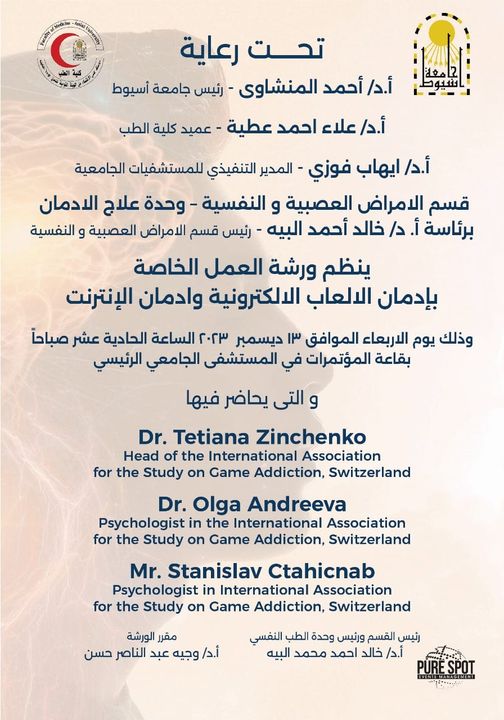
Invitation from the Department of Neuropsychiatry at Assiut University to attend a workshopل

Invitation from the Department of Neuropsychiatry at Assiut University to attend a workshop

يتشرف قسم الأمراض العصبية والنفسيه بجامعة أسيوط بدعوتكم لحضور ورشه عمل لمجموعه من المتخصصين على رأسهم د.تيتيانا رئيسة رابطة( الجمعية العالمية لدراسة أدمان الألعاب) عن الأدمان السلوكى بعنوان

 “Clinical research on games and other informational behavioural addictions. Effective methods of prevention, therapy and rehabilitation”

في تمام الساعة الحادية عشر صباحا يوم ١٣ ديسمبر ٢٠٢٣فى قاعه بجوار مكتب مدير المستشفى الرئيسى-مستشفى أسيوط الجامعي 

Subscribe to

