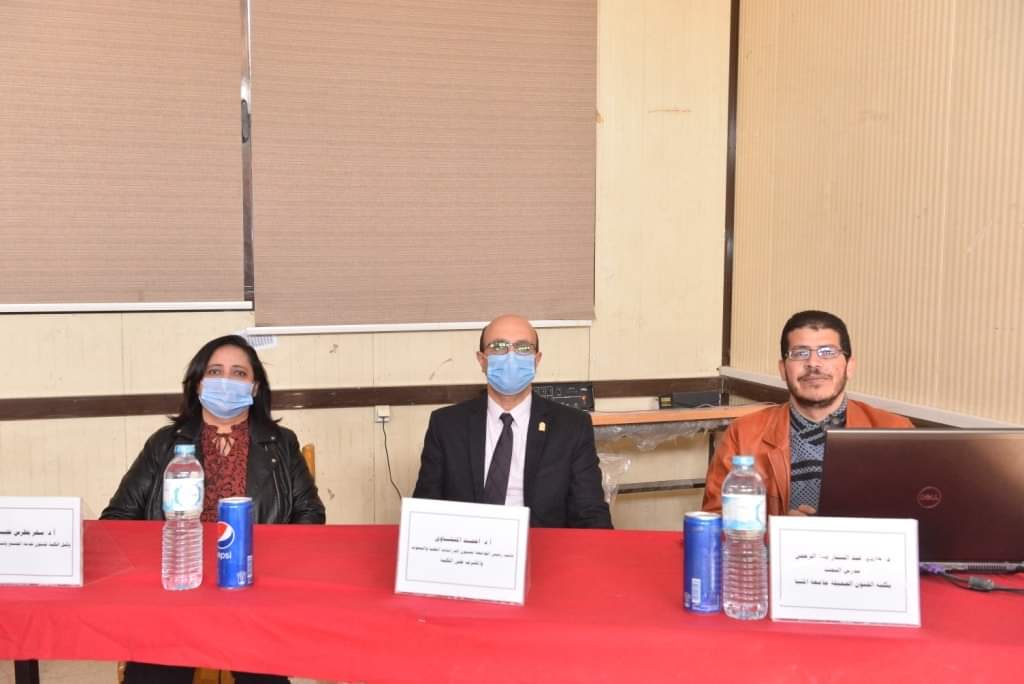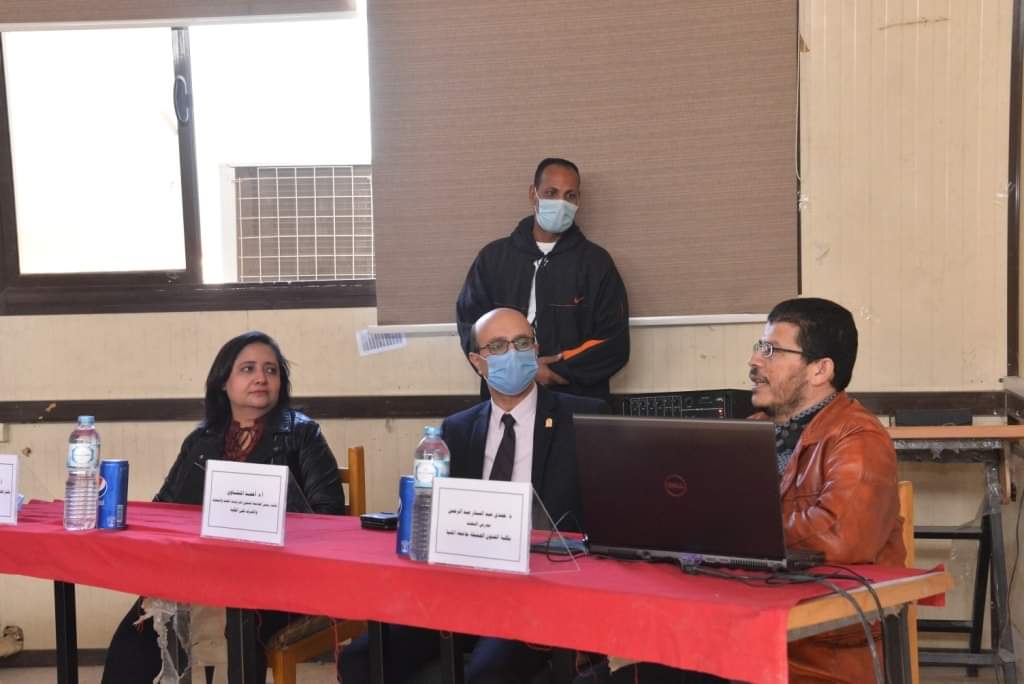

Sculpture and digital formation and developments in the labor market in an introductory symposium for students of the Faculty of Fine Arts at Assiut University
https://youtu.be/0Omk1EZ5dsY
Hybrid micro-grid systems (HMGS) are small scale power system where the energy sources are installed to supply local customers. These systems may be considered as promising energy solution to meet the increased in energy demand and traditional sources depletion. Cost of electricity, system reliability, and environmental impacts of the system are three design criteria that must be considered in obtaining the accurate parameters of hybrid renewable energy system components. In this paper, hybrid micro-grid renewable energy system includes photovoltaic system, (PV) wind energy system, (WES) battery bank,(BB) and conventional diesel generator (DG) are proposed to meet the energy requirements in remote area, located in Red Sea called city of Bernice, Egypt, at 23 540 3100 N, 35 280 2100 E. Optimization of Cost of Electricity (COE), Renewable Factor (RF), and Loss of Power Supply Probability (LPSP) are main objective of the designing process of the hybrid system considered as the objective functions. Then, Multi-objective multi-verse optimization (MOMVO) algorithm is used with considering two scenarios, the first one is renewable sources and the second is renewable/diesel energy source. All the possible HMGS configurations namely: PV/battery, wind/battery, PV/wind/battery and PV/battery/diesel, wind/-battery/diesel, PV/wind/battery/diesel are studied and analyzed. Moreover, one year hourly meteorolog-ical weather data for case study are recorded. Reverse osmosis desalination (ROD) is considered in conjunction with the residential load. The proposed power management strategy is used to manage the system operation when supplying the load. A linear fuzzy membership function is used for purpose of decision making. The simulation results show that MOMVO produces appropriate components size and the PV/wind/battery/diesel is the optimum configuration with values of COE = 0.2720$/KWh, LPSP = 0.1397, and RF = 92.37% at w1 = 0.5, w2 = 0.3, and w3 = 0.2. Sensitivity analysis is performed to show the effect of changing system parameters on the objective functions. It is also shown that the techno-economic feasibility of using HMGS for rural electrification systems and enhance energy access. 2021 THE AUTHORS. Published by Elsevier BV on behalf of Faculty of Engineering, Ain Shams Uni-versity. This is an open access article under the CC BY-NC-ND license (http://creativecommons.org/licenses/by-nc-nd/4.0/).
Agricultural drainage water (ADW) reuse is the most promising option to increase the availability of water for irrigation. The pollution of drainage networks and the Nile River water supply shortage threaten the largest ADW reuse project in Egypt (El-Salam Canal), especially following the construction of the Grand Ethiopian Renaissance Dam (GERD). Accordingly, a one-dimensional hydrodynamic and water quality (WQ) simulation model was built as a tool to manage the quantity and quality of the canal water using MIKE 11 modules. Three proposed scenarios aimed to assess the current situation (Scenario 1), the best WQ parameter reduction ratio of the highly pollutant drains (Scenario 2), and the effect of the construction of the GERD on the canal WQ (Scenario 3). The results provided a quantitative canal WQ management tool to comply with the standards for irrigation purposes and illustrated that after the …
: In this paper, we studied the vibration performance, energy transfer and stability of the offshore wind turbine tower system under mixed excitations. The method of multiple scales is utilized to calculate the approximate solutions of wind turbine system. The proportional-derivative controller was applied for reducing the oscillations of the controlled system. Adding the controller to single degree of freedom system equation is responsible for energy transfers in offshore wind turbine tower system. The steady state solution of stability at worst resonance cases is studied and examined. The offshore wind turbine system behavior was studied numerically at its different parameters values. Furthermore, the response and numerical results were obtained and discussed. The stability is also analyzed using technique of phase plane and equations of frequency response. In addition, the numerical results and comparison between analytical and numerical solutions were obtained with MAPLE and MATLAB algorithms. Keywords: Vibration control, stability, offshore wind turbine system, energy transfer.
This paper presents a Genetic Algorithm (GA)- based method to determine the location and size of DG sources in distribution systems using single DG placement algorithm for determining the locations at first. Then, the GA is utilized to determine the global sizes of DG sources which minimize single- or multi-objective function related to these systems. The influence of active- and reactive-power injection on the sizing and placement of DG sources is investigated. The predictions of the proposed method as regards the sizing and placement of DG sources are compared with those obtained before using particle swarm optimization at steady weather conditions.